
‘THE SHATTERED WORLDS: MICRO NARRATIVES FROM THE HO CHI MINH TRAIL TO THE GREAT STEPPE,’ AN EXHIBITION EXPLORING THE IMPACT OF THE COLD WAR THROUGH THE WORK OF CONTEMPORARY ARTISTS FROM SOUTHEAST ASIA AND EURASIA, AT FOUR VENUES ACROSS BANGKOK
TEXT: TUNYAPORN HONGTONG
PHOTO: JUKKRIT HANPIPATPANICH EXCEPT AS NOTED
(For Thai, press here)
This year marks the 50th anniversary of the James H.W. Thompson Foundation, named after Jim Thompson, the American architect who once served in the U.S. military during World War II and later played a pivotal role in bringing the Thai silk industry to international prominence. To commemorate this milestone, The Jim Thompson Art Center is hosting a major exhibition across four venues: in addition to its own gallery, the exhibition extends to the Bangkok Art and Culture Centre (BACC), the William Warren Library, and the Jim Thompson House Museum. Bringing together a diverse body of work by 13 artists from Thailand, Southeast Asia, and the greater Eurasian region, the exhibition reflects on the enduring impact of the Cold War. Although often regarded as a chapter closed, the Cold War continues to cast a long shadow over global politics.
Bangkok Art and Cultural Centre (BACC)
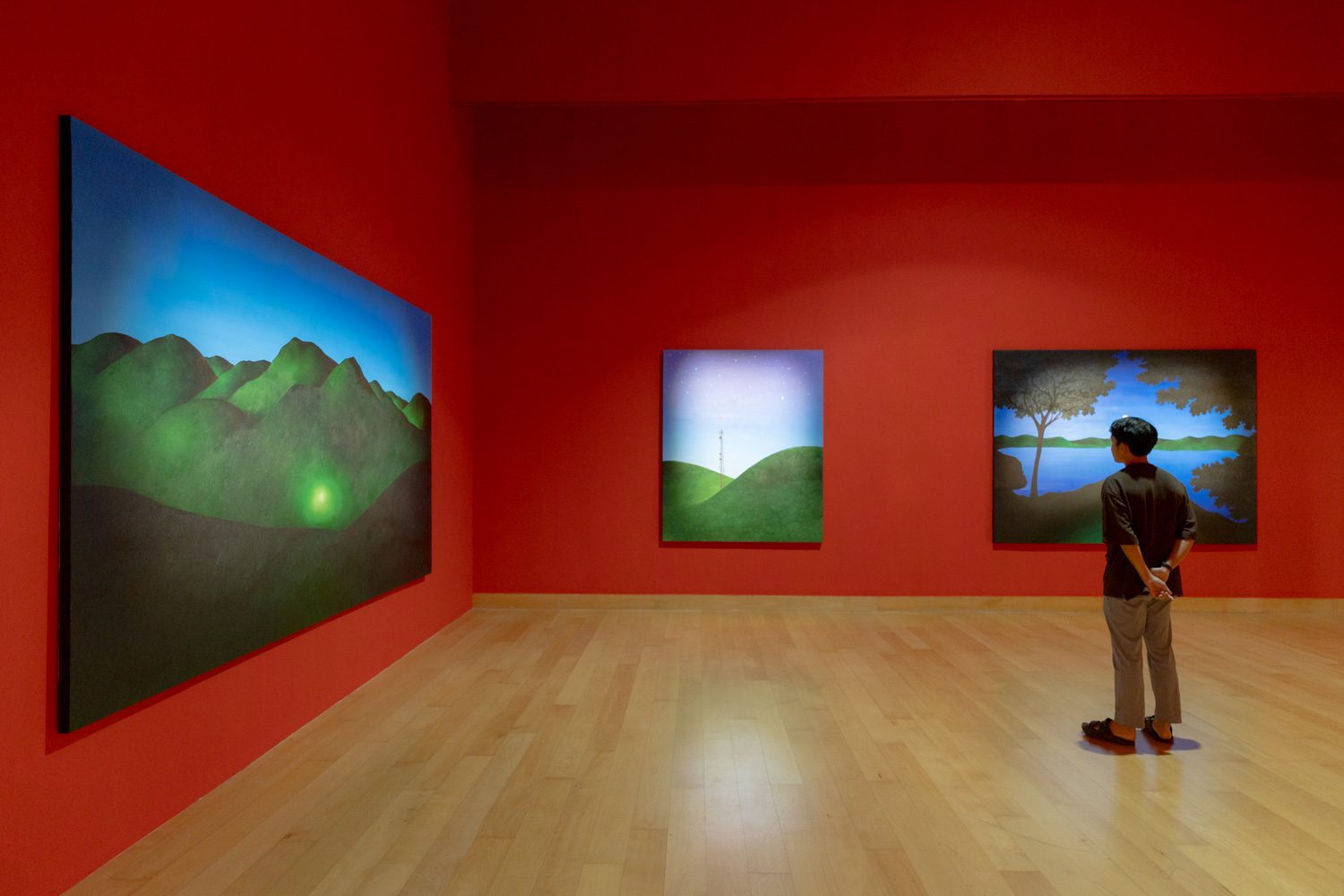
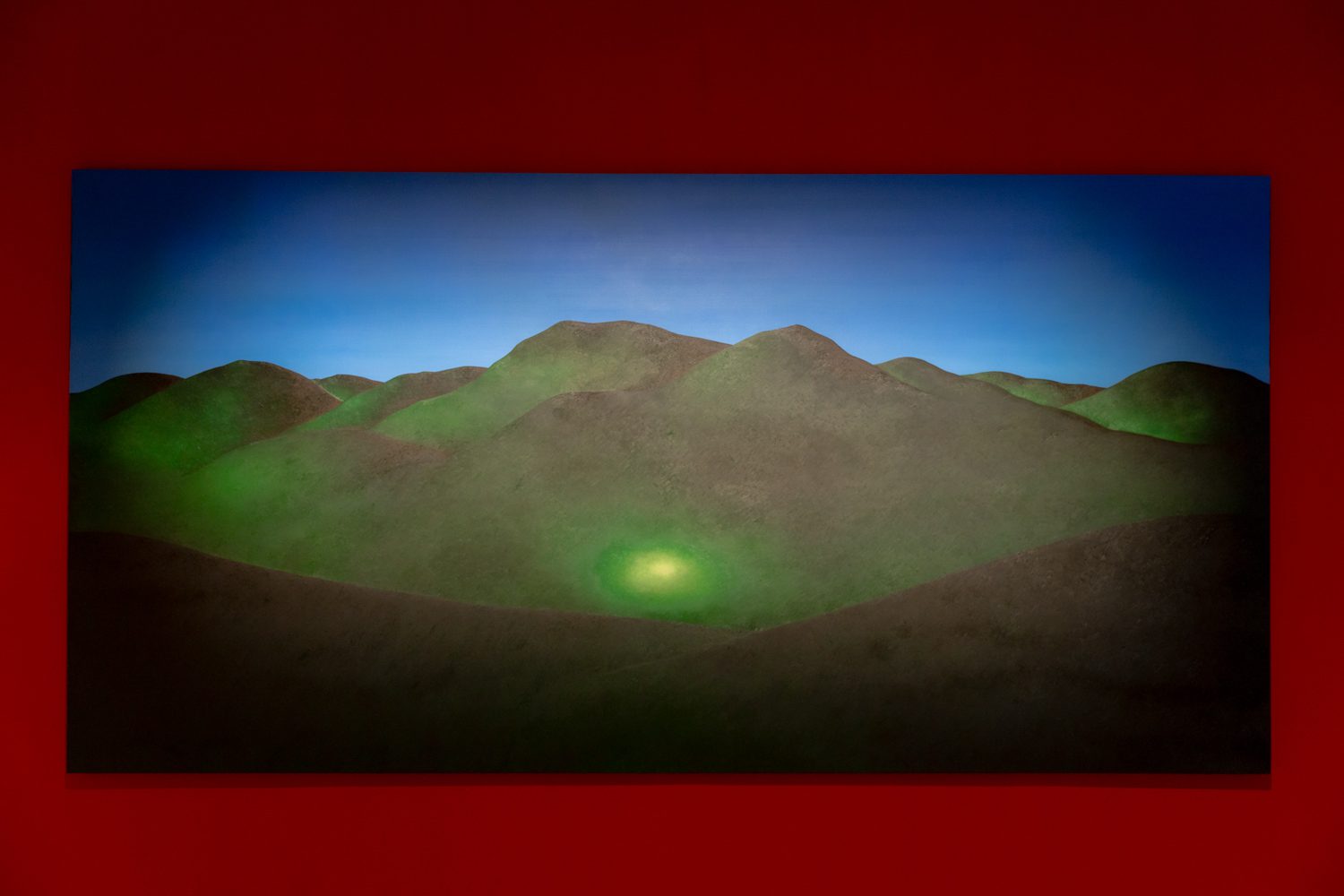
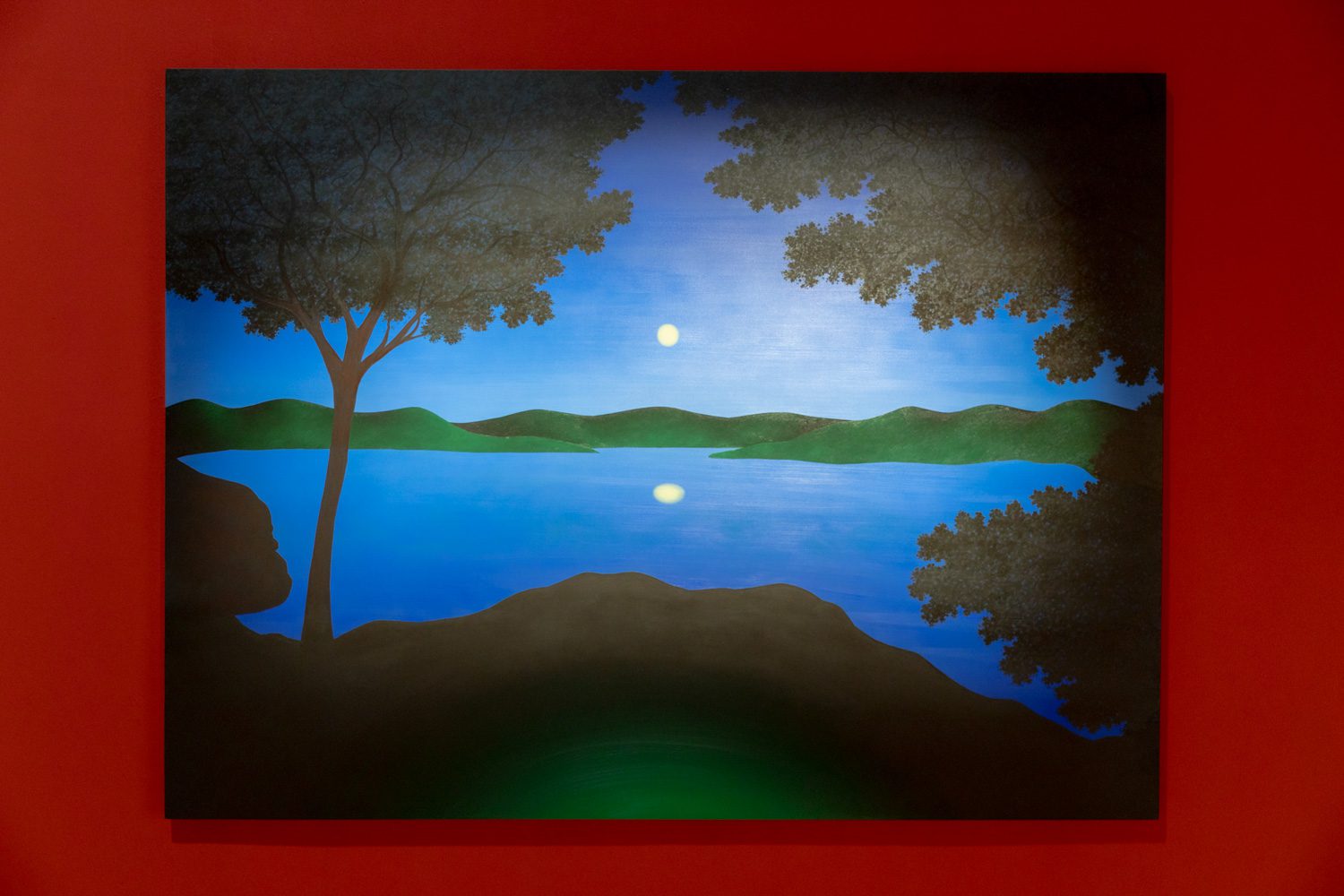
At the Bangkok Art and Culture Centre (BACC), the exhibition opens with A Song from the Forest (2025) by Vacharanont Sinvaravatn. Installed within a gallery room painted an evocative, vibrant red, the work consists of three oil paintings depicting landscapes associated with Thailand’s northeastern “red zones.” Beyond the quiet, melancholic beauty captured in each canvas, the choice of locations and titles selected by Vacharanont highlight a chapter of Thai history involving the armed conflict between the Thai state and communist insurgents — a conflict whose impact continues to shape contemporary society yet remains largely overlooked. One painting, Night After Night, portrays the dense wilderness of Dong Phaya Yen, a forest area once a strategic route used to deploy troops in efforts to encircle communist forces, and now a national park frequented by visitors. Another painting, titled The Ballad of Spectre, draws the viewer’s gaze toward a luminous moon. The image recalls the poignant melody of Kid Tueng Baan (Missing Home), composed by Asanee Polajan, better known by his nom de guerre “Comrade Fire” or “Nai Phee,” during the period he spent far from his hometown, amid his commitment to the Communist Party of Thailand. While the song is widely recognized today as Duean Phen (Full Moon), which was first brought from the forest and recorded by Phongthep Kradonchamnan, subsequently becoming popular through numerous reinterpretations, its true origins and historical significance remain obscure to most listeners.
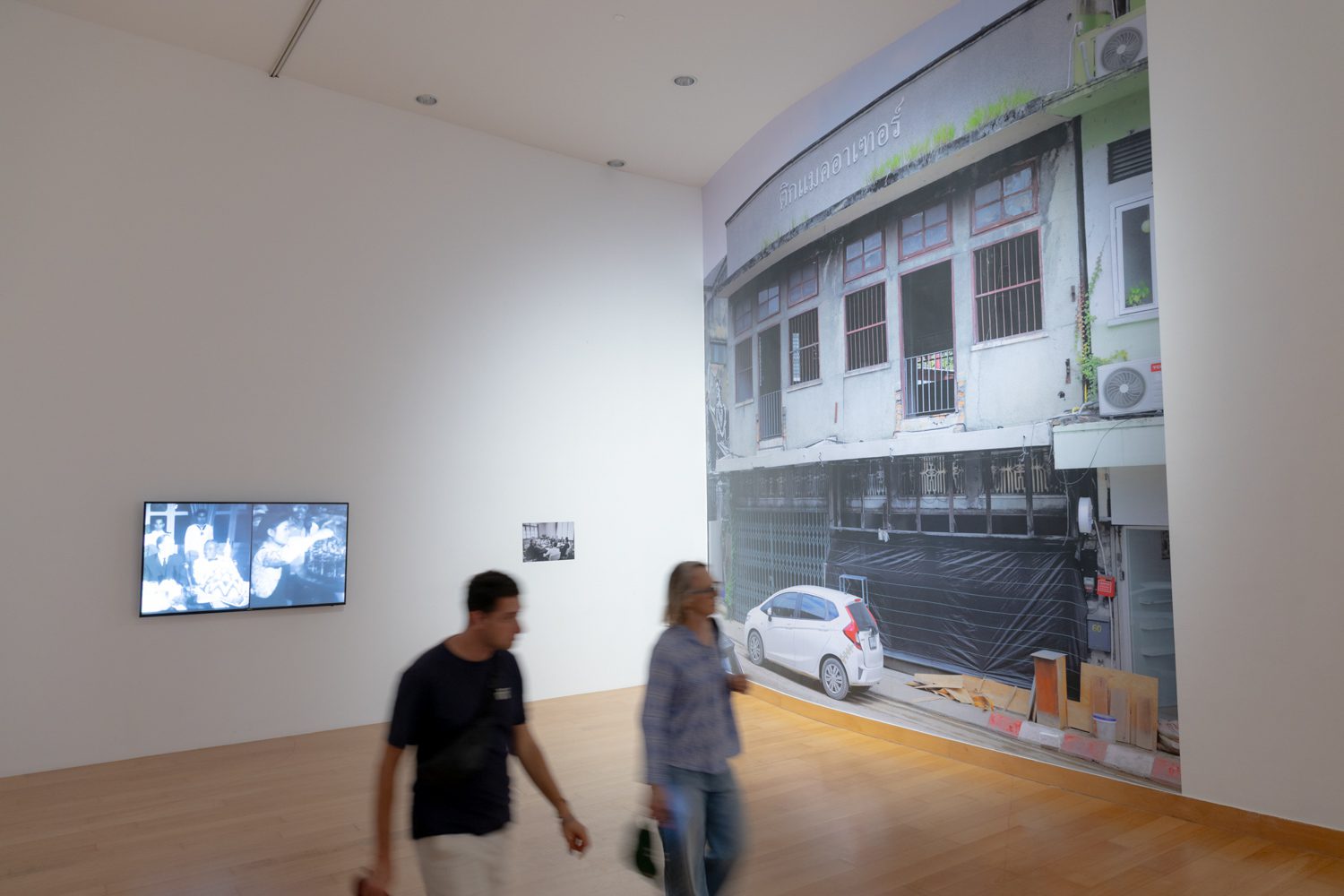
Next is a work by Som Supaparinya, which shifts the Cold War narrative away from Thailand’s northeastern region to examine the ambiguous and often estranged relationship between Thailand and Laos, two neighboring countries that remain curiously distant despite their shared border. Two Corners of a Wall (2025) comprises two large-scale photographs mounted on a single curved wall. Because of the wall’s curvature, both images cannot be seen in their entirety. One photograph captures an old building in Chiang Mai bearing a faded sign that reads “MacArthur,” while the other shows a similarly aged structure in Vientiane marked with the word “Atomic.” Though geographically and architecturally distant, the names anchor both sites in the ideological landscape of the Cold War: General Douglas MacArthur, a prominent figure in World War II, the Korean War, and the Cold War; and “Atomic,” which evokes associations with the atomic bomb and atomic energy.
Though the Cold War formally ended with the dissolution of the Soviet Union in 1991, its specter continues to shape contemporary geopolitics. A striking example is Russia’s stance toward Ukraine and the West. Ukraine, long regarded by Russia as part of its historical sphere of influence, signaled its intent to join NATO, an act perceived by Russia as an existential threat, ultimately leading to the full-scale invasion of Ukraine in 2022.
Polish artist Rafal Milach, together with The Sputnik Photos Collective, hailing from one of Ukraine’s most steadfast allies, presents a series of works that grapple directly with the ongoing conflict. In Message from the Future (2022–2024), sweetly colored floral wallpaper is torn open, revealing images of war lurking beneath the surface. UATLAS. War Migration Record (2022–2023) features video testimonies of Ukrainian refugees who fled to Poland, while Solidarity with Ukraine and Anti-War Protests in Warsaw, Poland (2022–2023) compiles footage of public demonstrations and civic action in support of Ukraine.
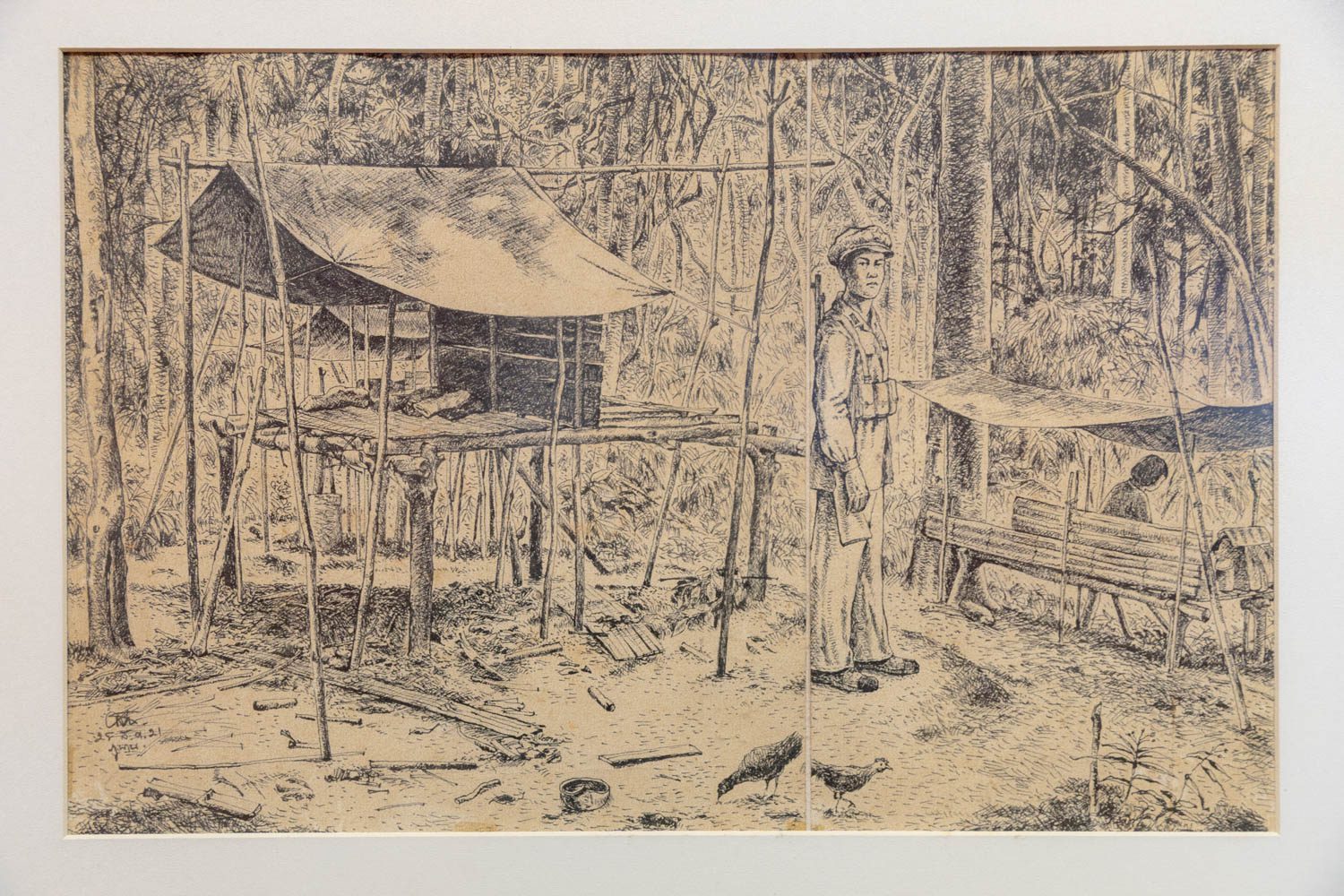
The BACC exhibition includes works by six additional artists, but one in particular speaks to the emotional toll of war with the cadence of poetry. Vision in the Darkness (2015) by the late Dinh Q. Lê (1968–2024), a central figure in Vietnam’s contemporary art scene, tells the story of Tran Trung Tin (1933–2008), another influential Vietnamese artist.
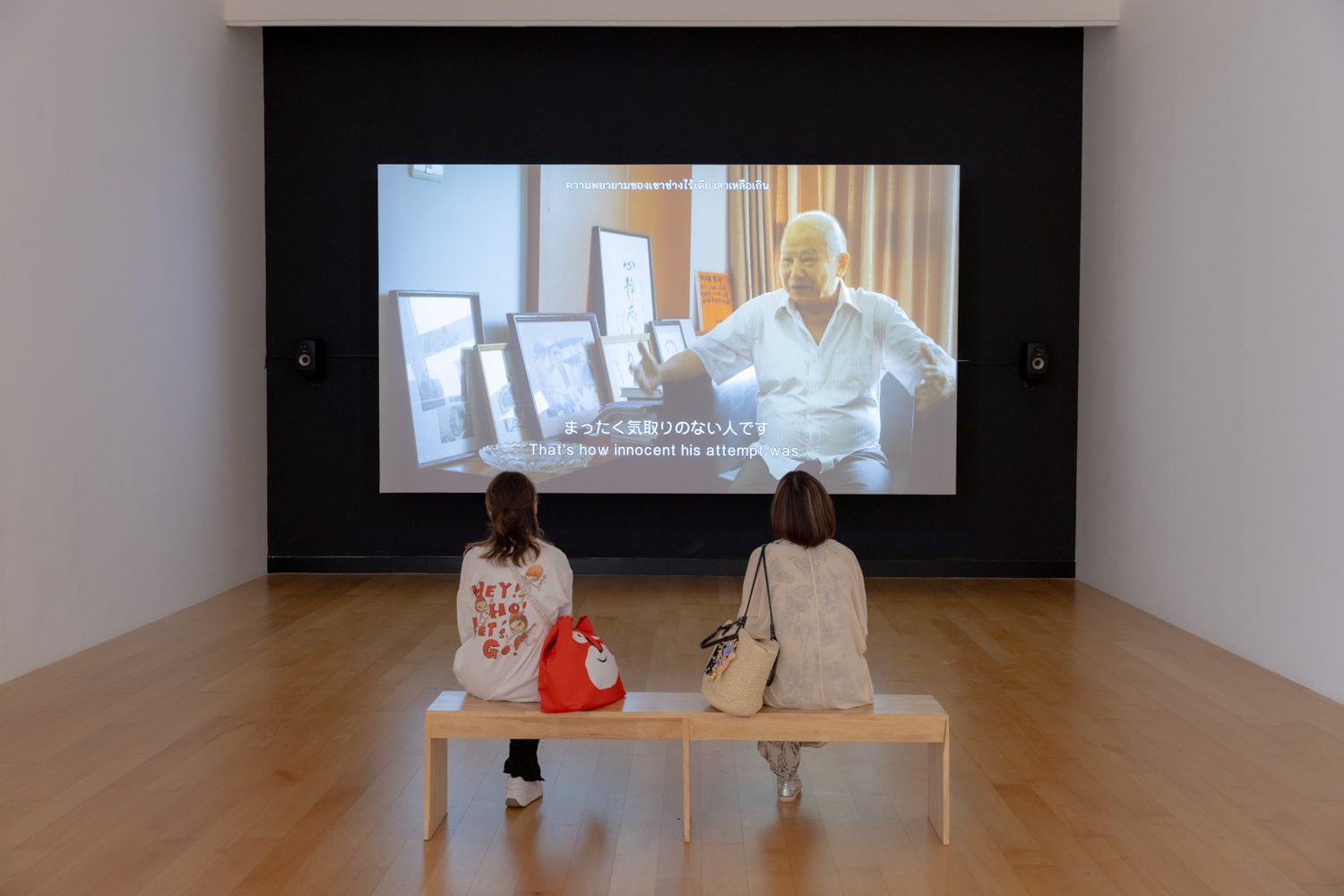
Vision in the Darkness comprises a series of video interviews with Tran Trung Tin’s family and close friends, including fellow artists who, like Tin, once worked for the Viet Cong’s propaganda unit. The conversations recount Tin’s transformation, from producing patriotic illustrations and scripts for the military to embracing abstract painting, a practice he pursued from 1969 until his death. Through these recollections, the work reveals the deep psychological scars left by war and the artist’s growing disillusionment with Vietnam’s socialist regime.
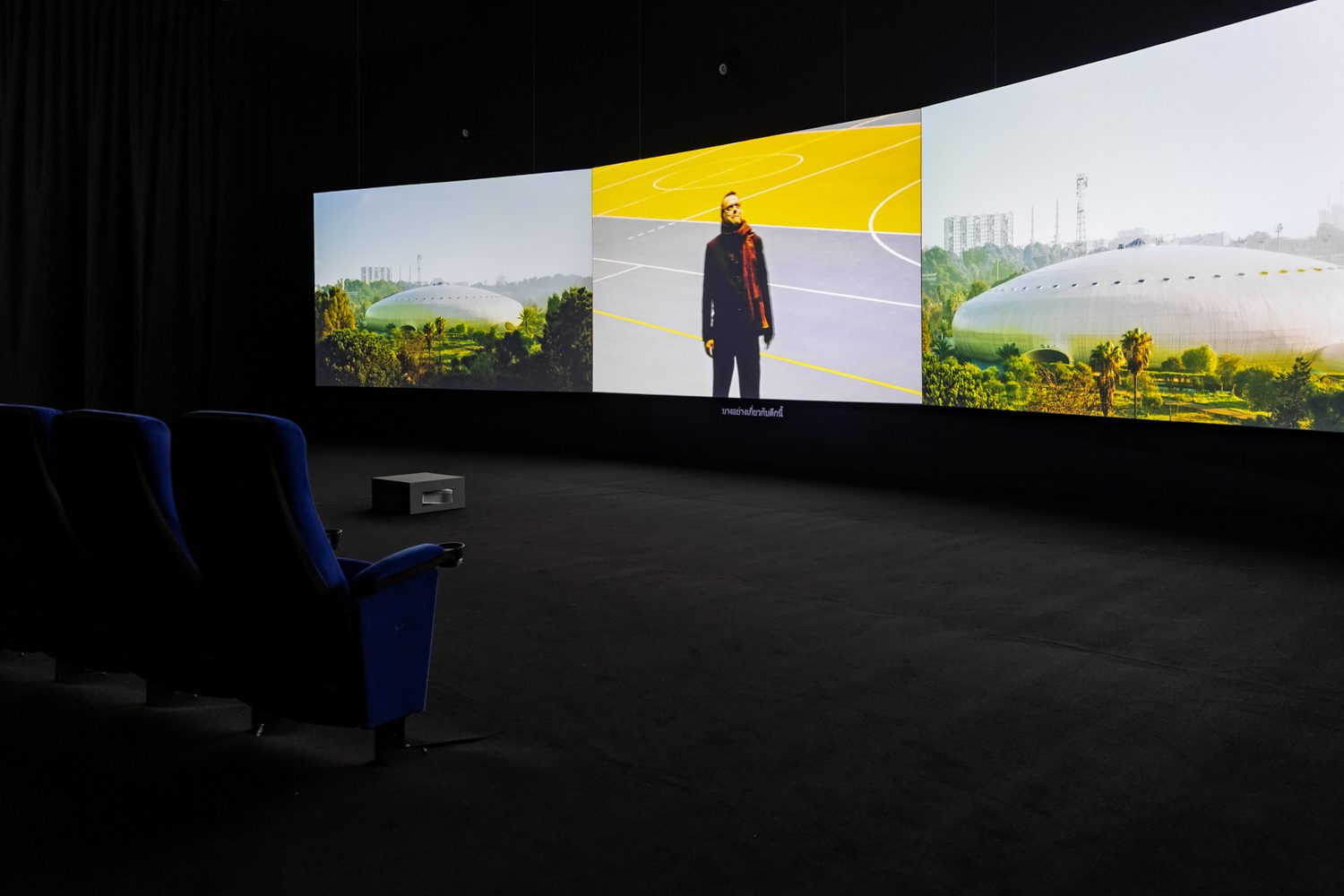
The Jim Thompson Art Center
As the exhibition transitions into The Jim Thompson Art Center, its tone and content grow more pointed and intense. The works presented across both gallery spaces grapple with the unfulfilled ambitions of the Non-Aligned Movement (NAM), a coalition of Third World countries that sought to chart a political and economic course independent of the world’s dominant superpowers.
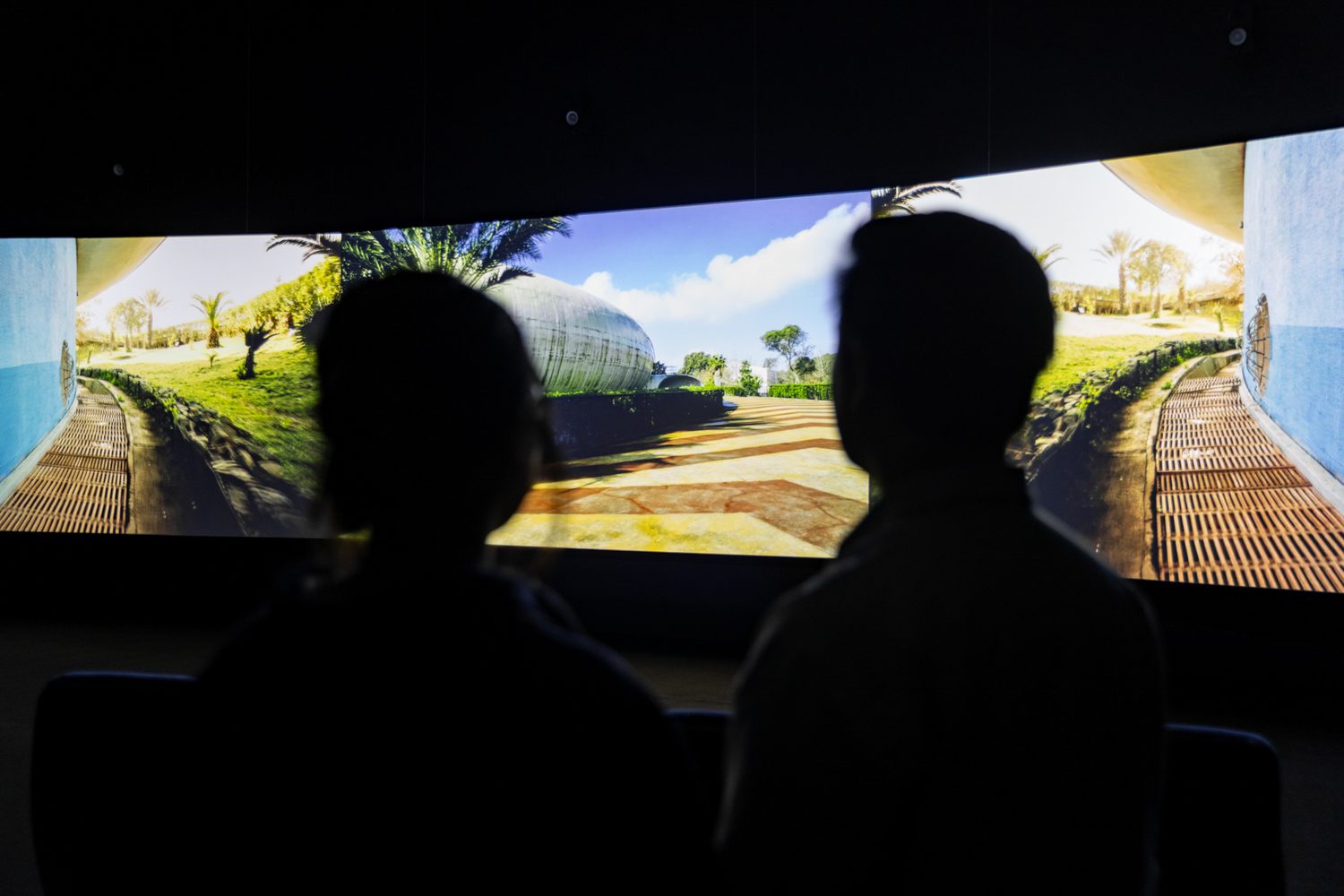
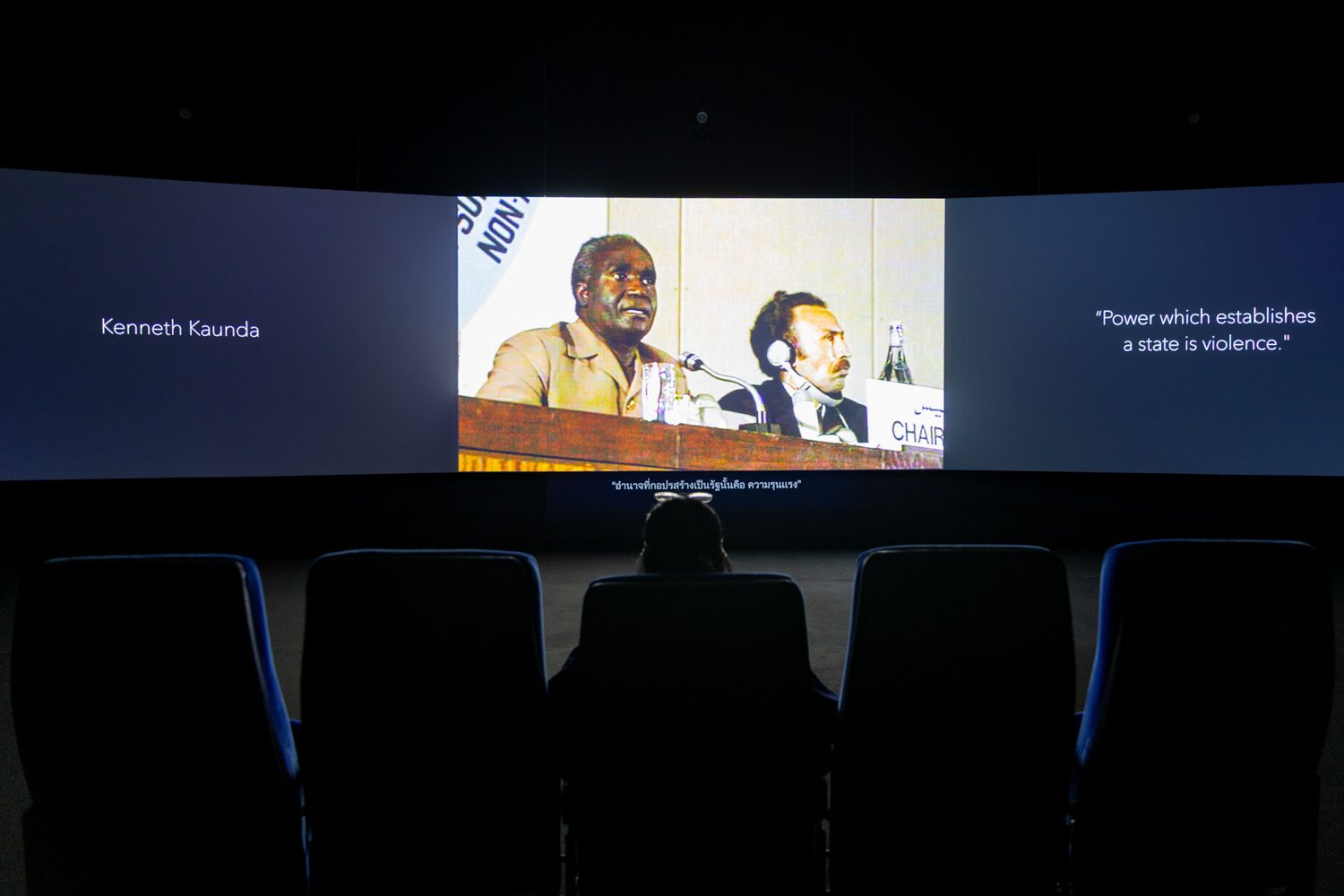
Two Meetings and a Funeral (2017) is a 90-minute, three-channel video installation by New York–based Bangladeshi artist Naeem Mohaiemen. The work revisits two historic gatherings: the 1973 NAM summit in Algeria and the 1974 Organisation of Islamic Cooperation (OIC) meeting in Pakistan. Mohaiemen frames these events as the “two meetings” of the developing world; an effort to forge a united front that might resist alignment with either the American or Soviet blocs. Yet what unfolds is a sobering narrative of ideological rifts, political rivalries, and national self-interests that ultimately fractured the movement. Pressured by the competing forces of global power, NAM member states were gradually drawn toward one side or the other, unable to sustain a truly non-aligned position. In this context, the “funeral” in the title becomes a poetic metaphor for the death of a shared ideal.
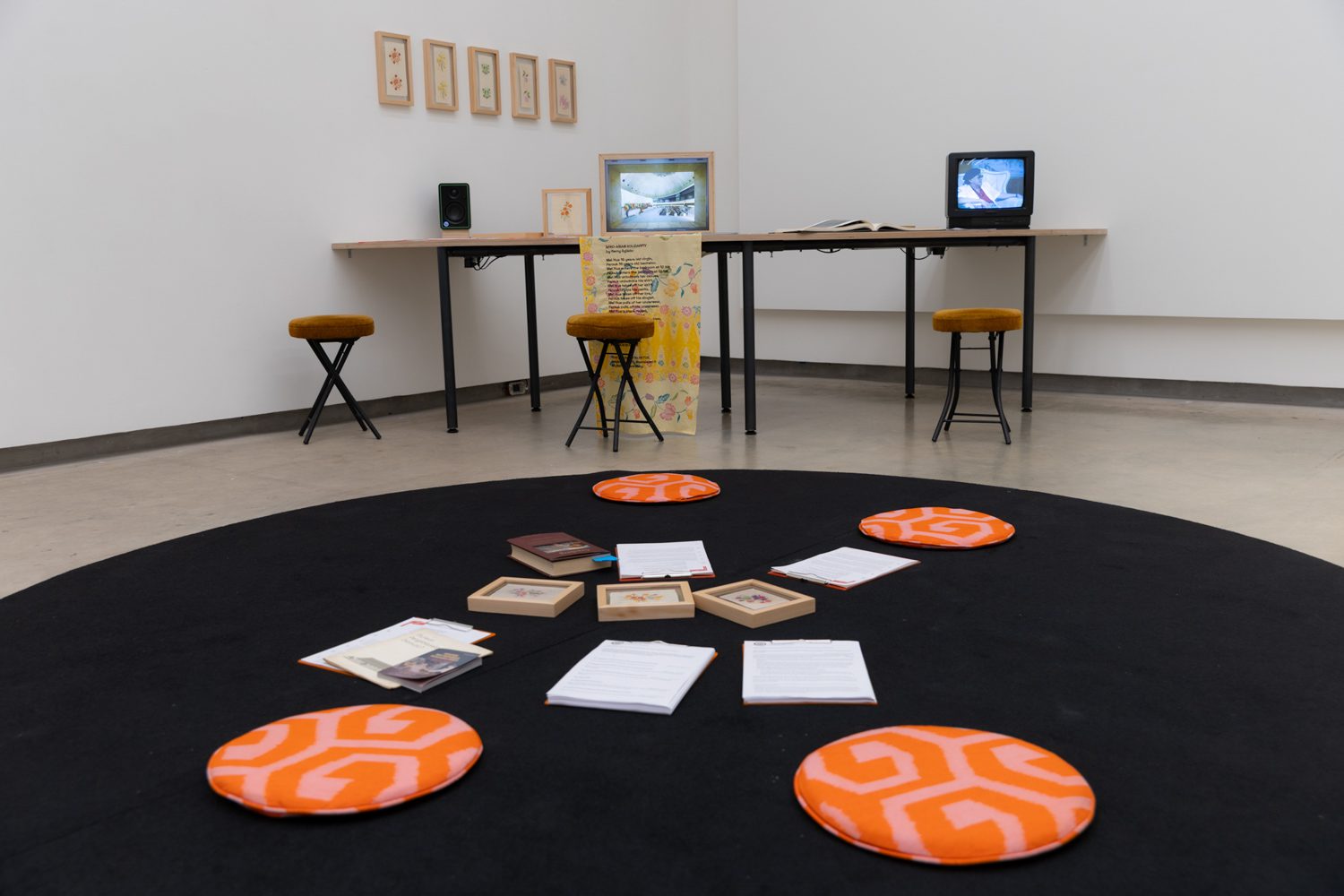
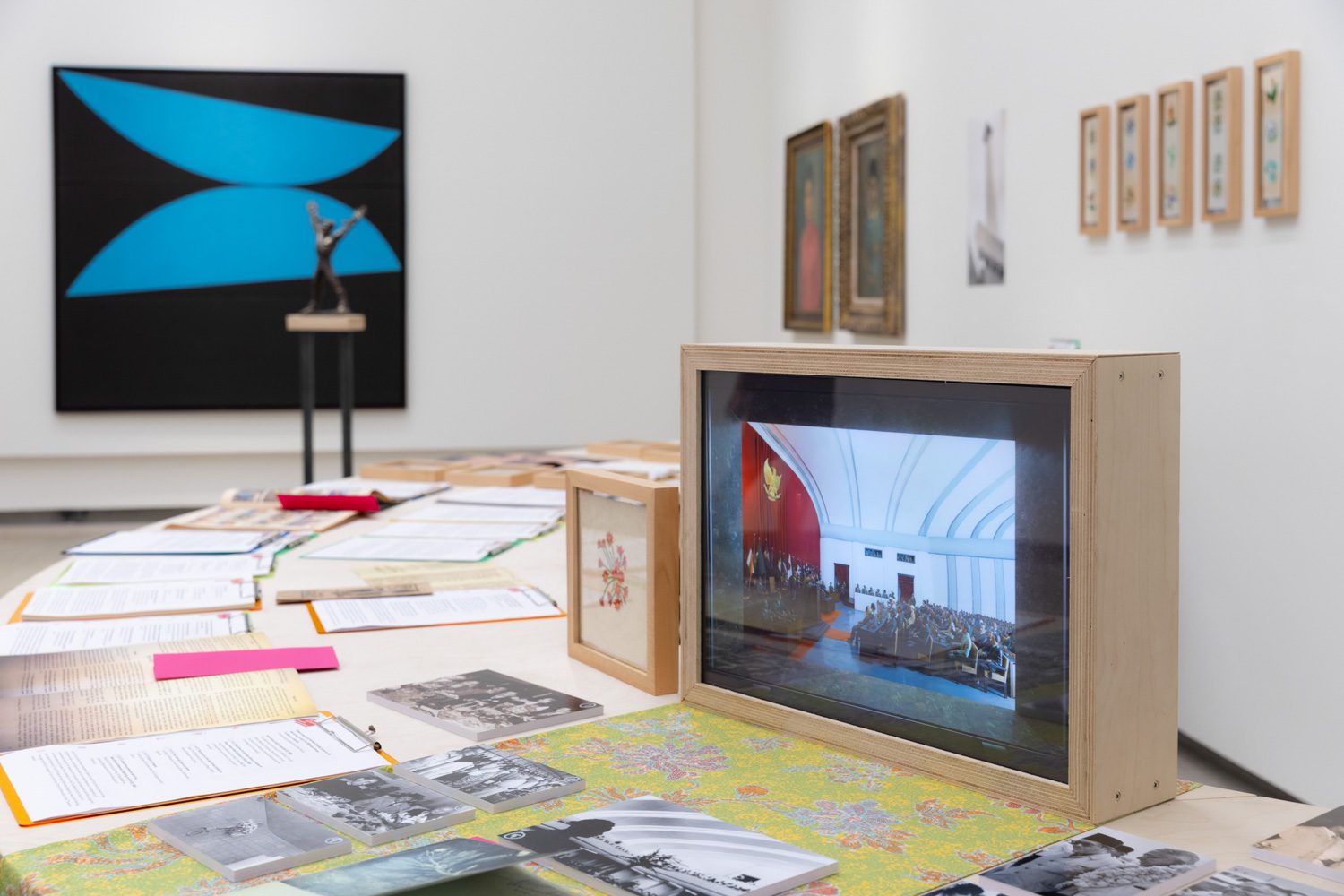
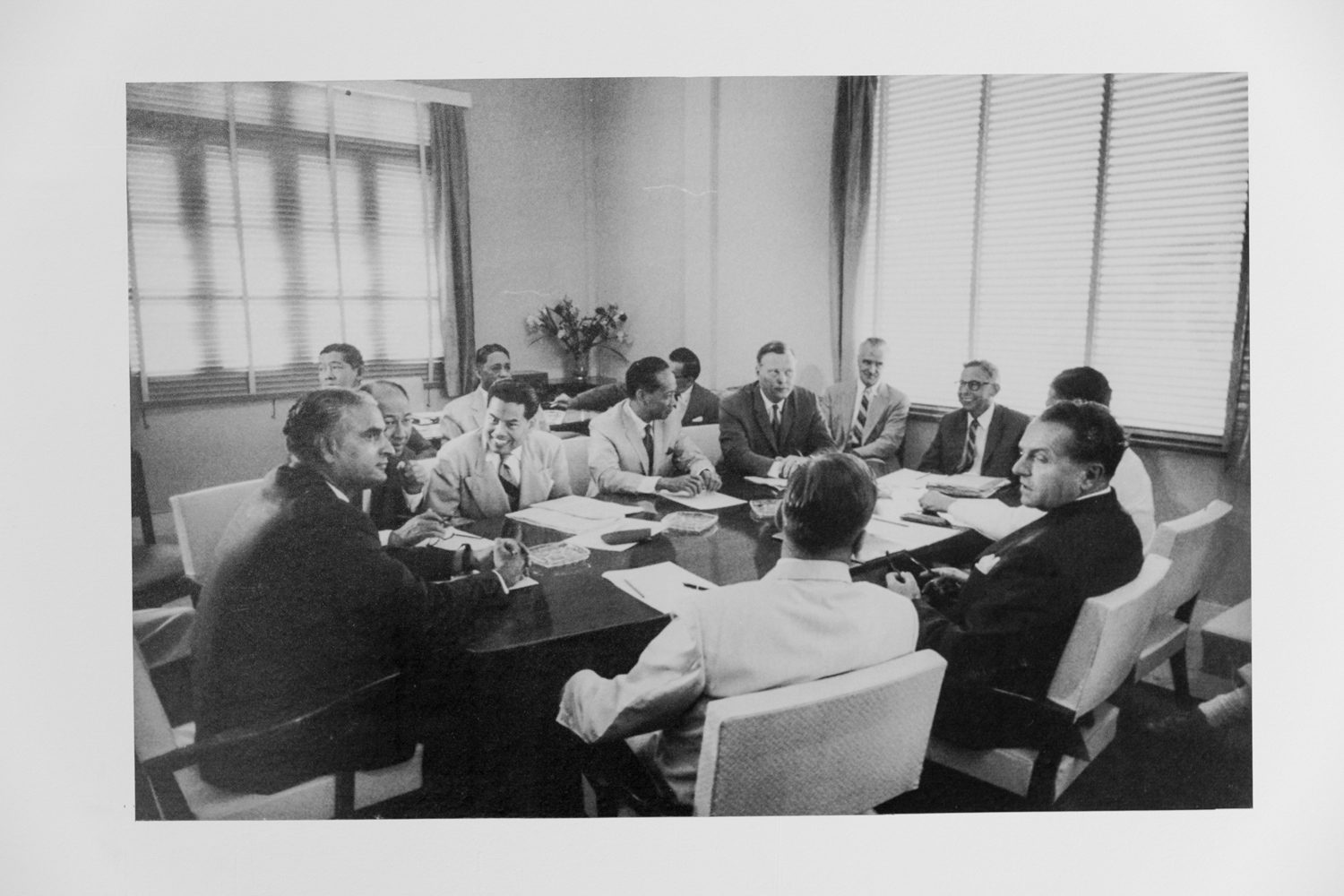
In the second gallery room, a dense arrangement of photographs, documents, and printed media lines the walls. These materials are drawn from an in-depth research project by Hyphen, a collective of Indonesian researchers. Their focus is the 1995 Bandung Conference, organized by President Suharto’s administration to commemorate the 40th anniversary of the original 1955 Bandung Conference. That earlier summit, held under President Sukarno’s leadership, marked a pivotal moment in the rise of the Non-Aligned Movement (NAM). While the 1995 conference was intended to reaffirm Indonesia’s leadership in Third World diplomacy, its outcome revealed a starkly different reality. By then, Suharto’s pro-Western stance was well known, and his authoritarian government was notorious for restricting civil liberties and silencing the press.
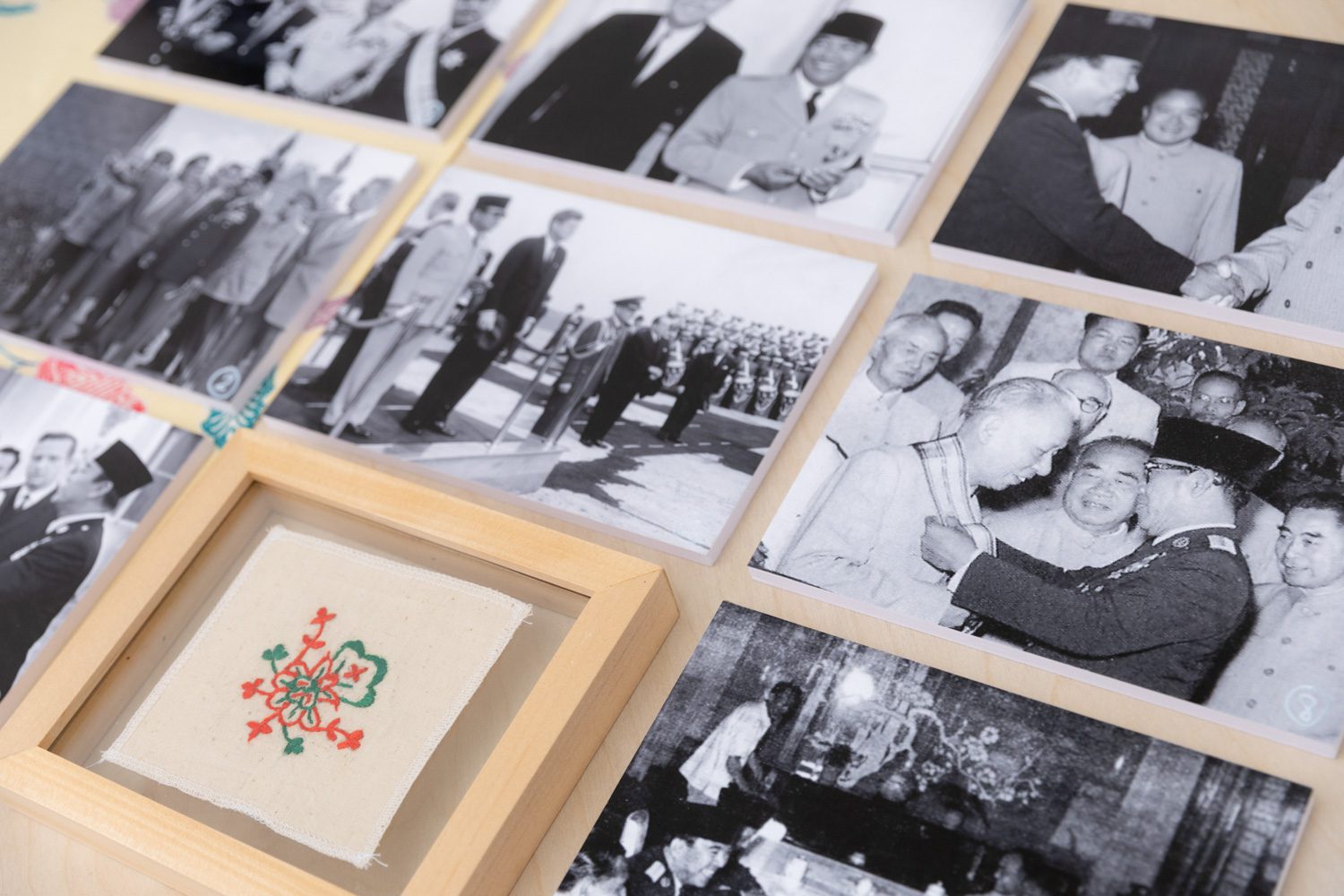
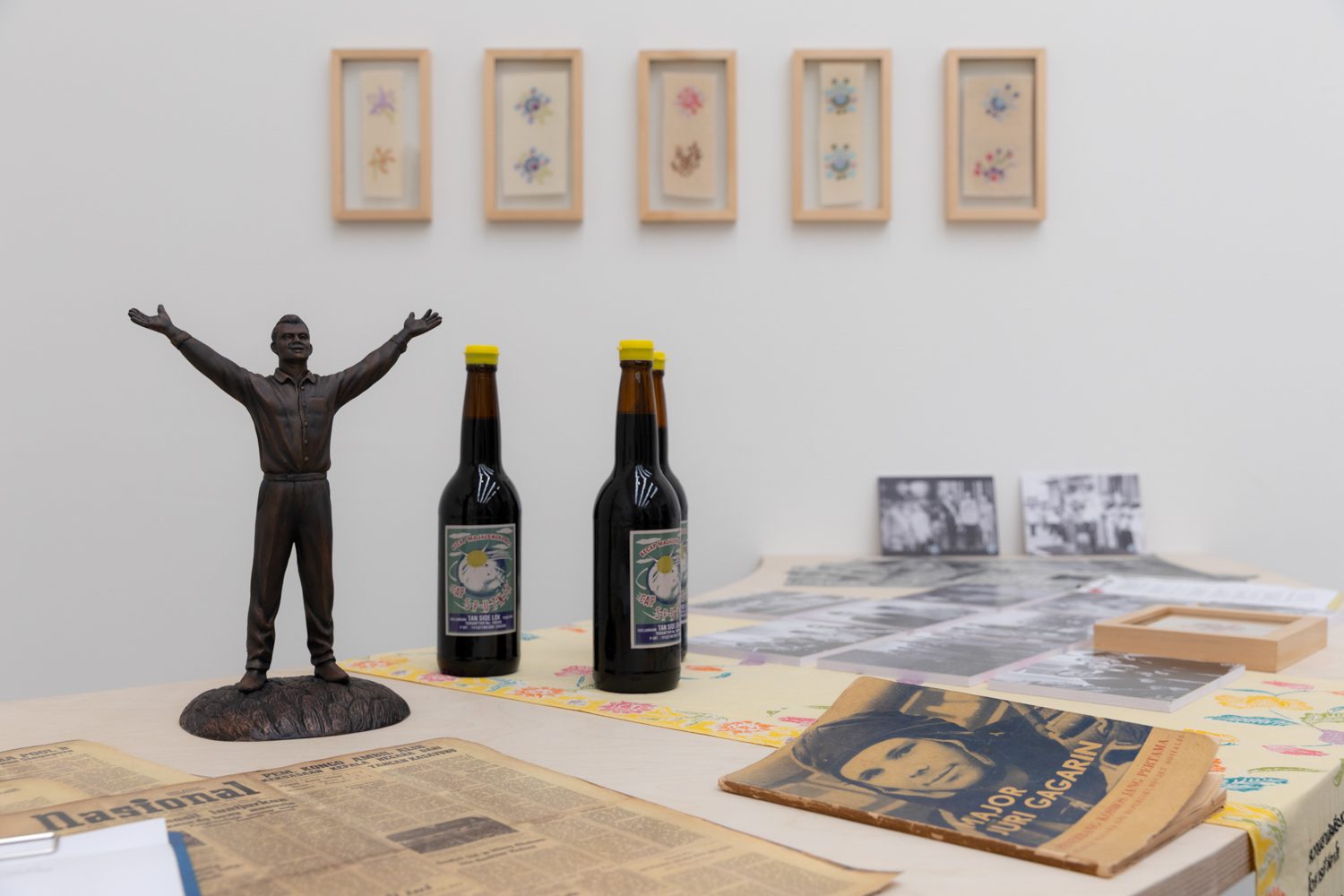
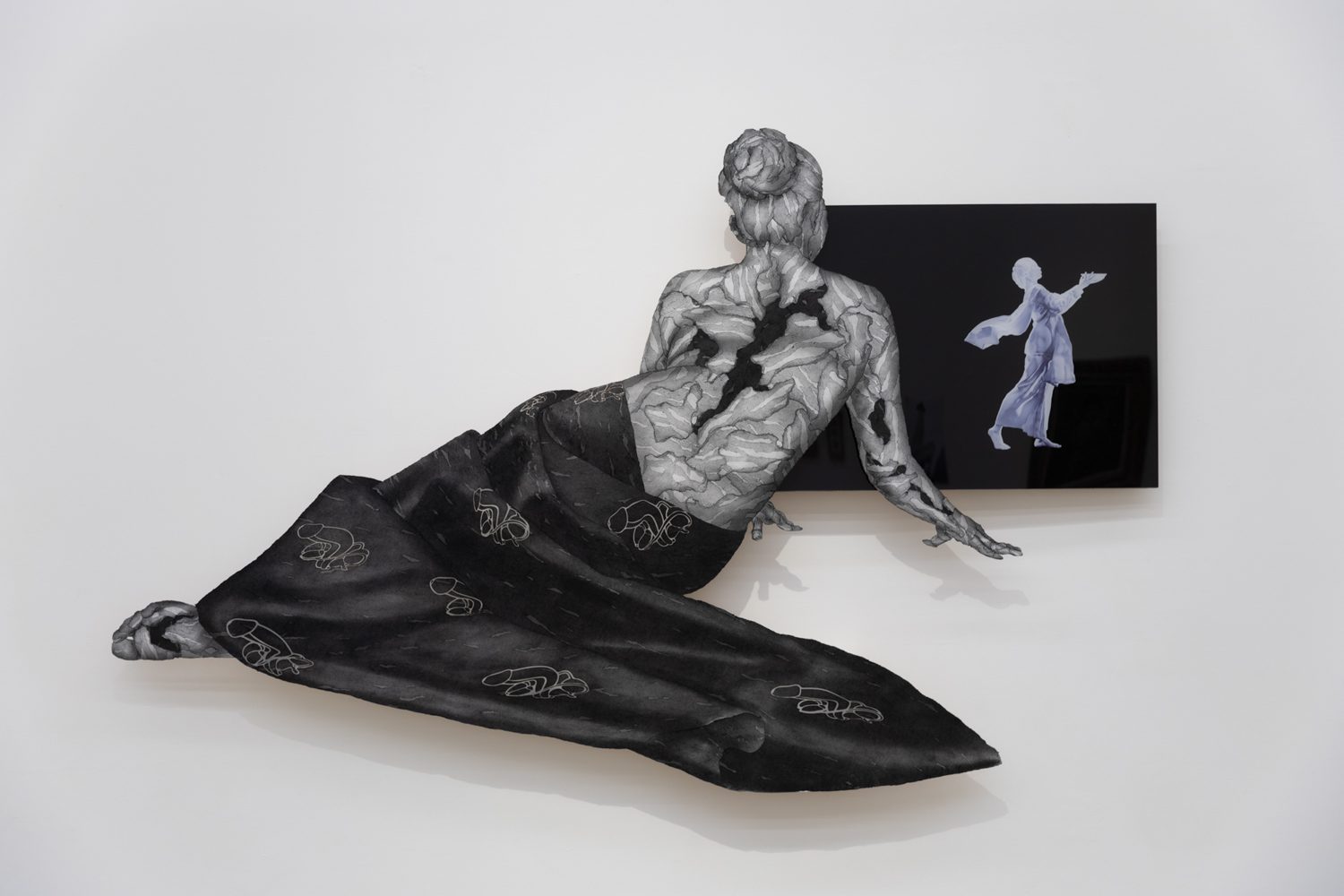
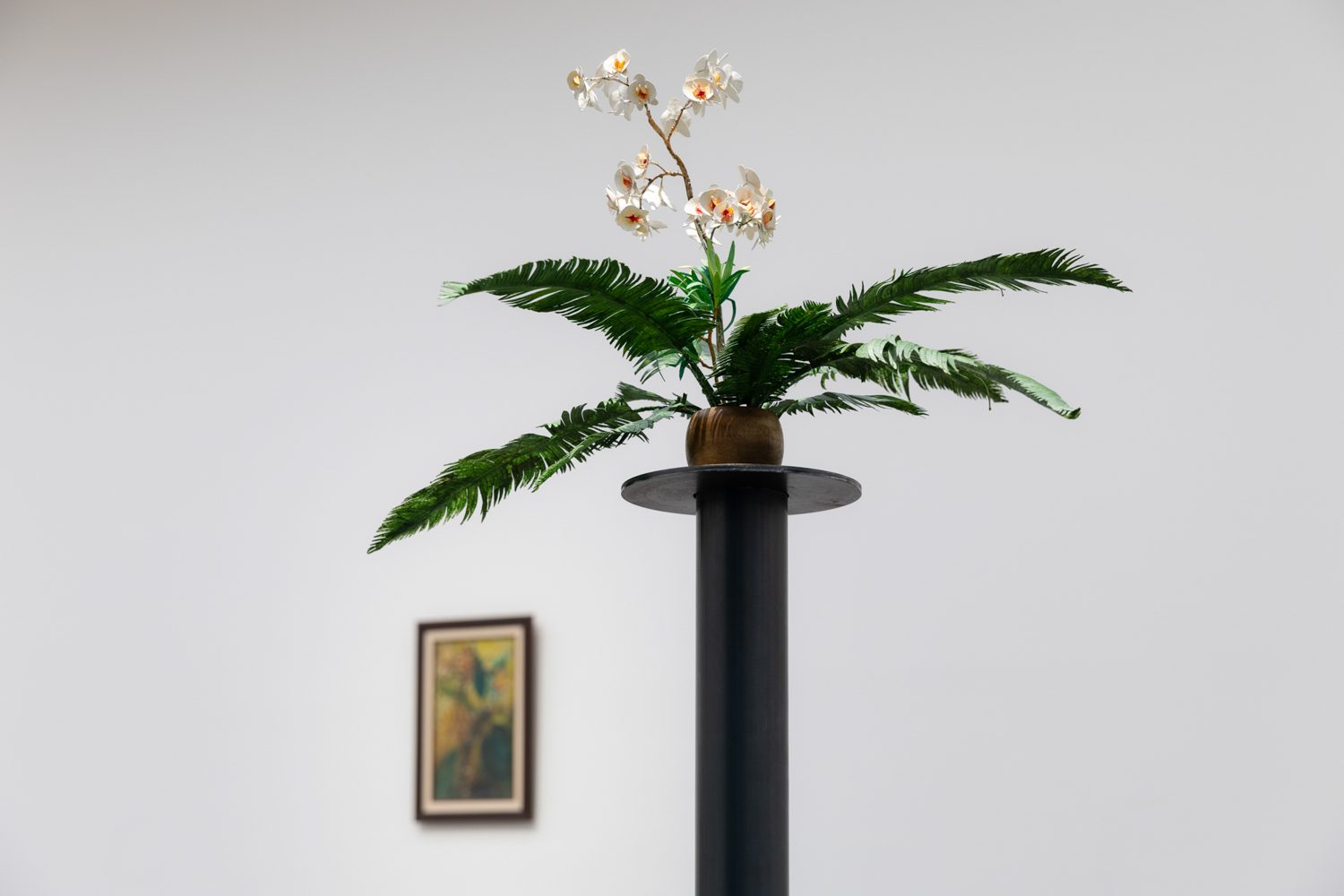
Hyphen critiques the dissonance between the projected image and political reality of the 1995 Bandung Conference through the motif of flowers. Drawing from archival photographs of floral arrangements used at the event, the collective invited artists to reinterpret these displays through embroidery and painting. The flowers serve as a metaphor, evoking an orchid garden in Jakarta sponsored by Ibu Tien Soeharto, the president’s wife. Suharto himself presided over its official opening. Yet, despite the ceremony’s grandeur, the garden paid surprisingly little attention to the orchids themselves—an act that, for Hyphen, reflects the overly curated image of beauty and unity.
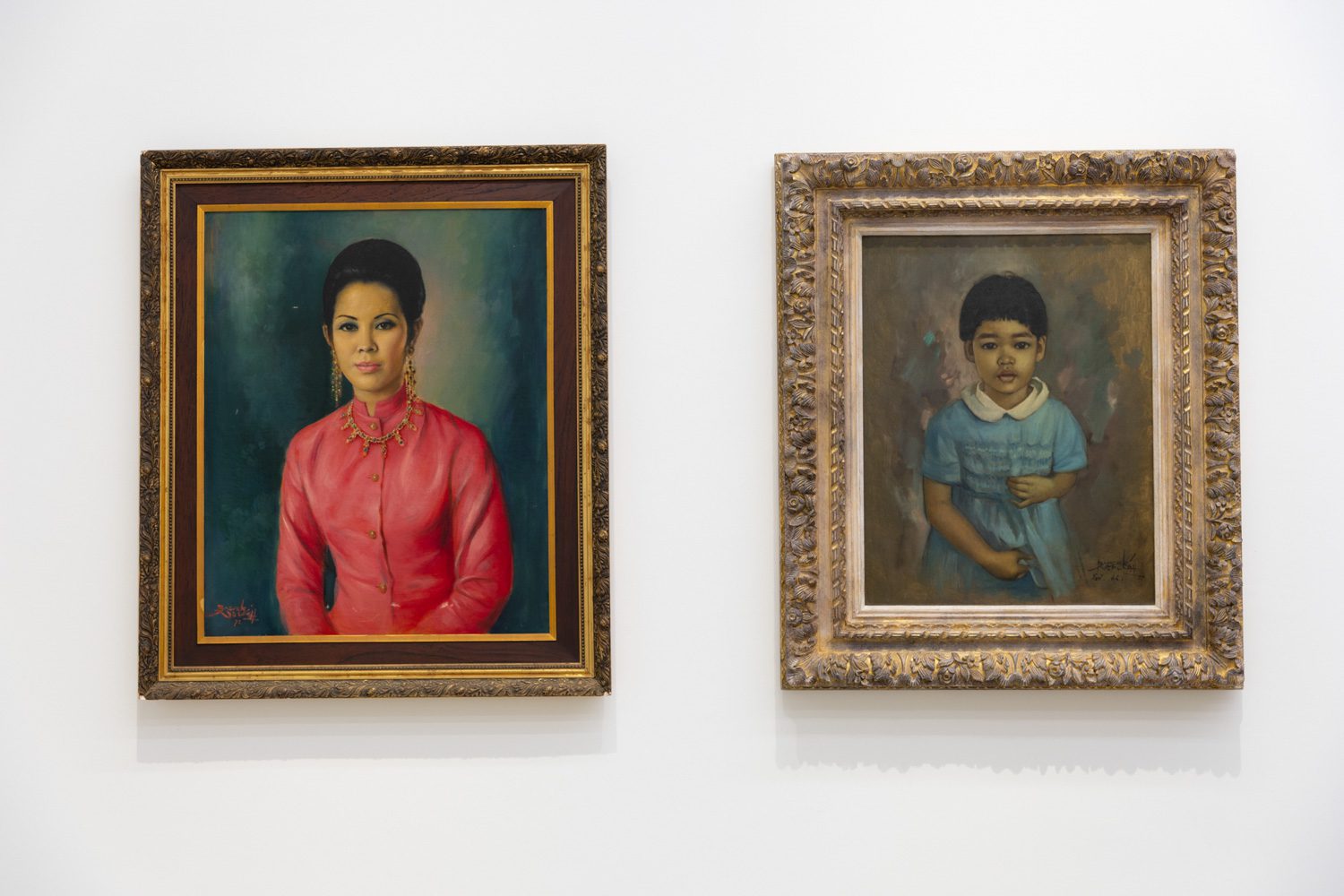
Elsewhere in the gallery, works by other artists offer additional perspectives on the era. Among them is Basoeki Abdullah, a celebrated 20th-century portraitist known for his close ties to Suharto and his prolific portraits of the Indonesian elite. Also featured is Nadia Bamadhaj, whom viewers may recall from her participation in the Bangkok Art Biennale. Bamadhaj is a socially engaged artist whose practice explores themes of political power, civil rights, and gender, particularly the rights of women.
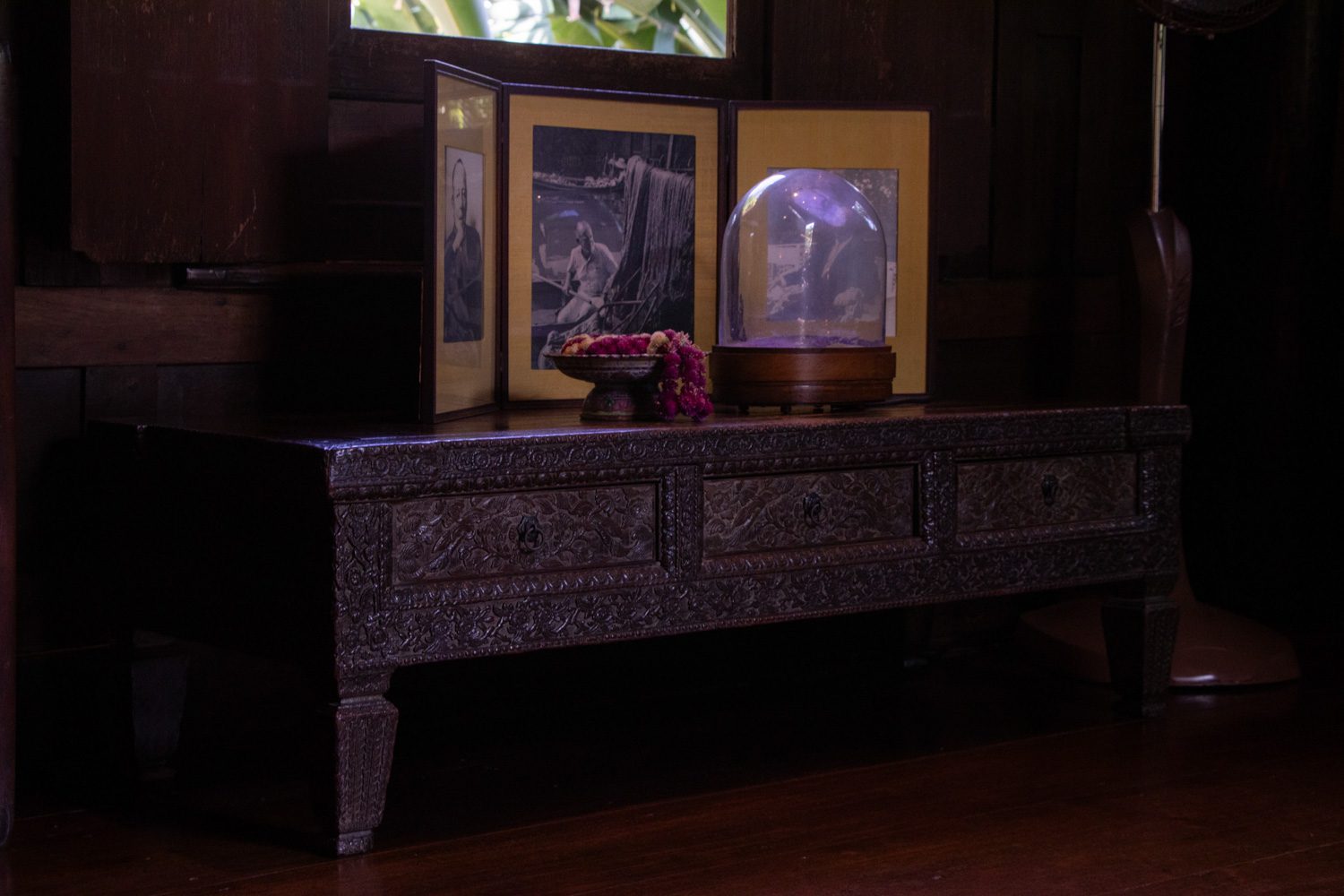
Photo: Chitpon Paengwiengjan
Jim Thompson House Museum
Prateep Suthathongthai’s work presents two interwoven facets of Jim Thompson’s life, both of which relate directly to the legacy of this house. The first concerns Thompson’s role as a former officer of the Office of Strategic Services (OSS), the wartime U.S. intelligence agency active during World War II. He was tasked with supporting resistance movements against the Japanese Empire in Southeast Asia, including Thailand’s own Free Thai Movement. The OSS would later form the basis for the Central Intelligence Agency (CIA), which played a covert role in shaping political and social events across the region and beyond. The second facet considers Thompson as a passionate collector of Southeast Asian art and antiquities. In Prateep’s work, these two sides, intelligence officer and connoisseur, are not treated separately but are shown to inform and intertwine with one another.
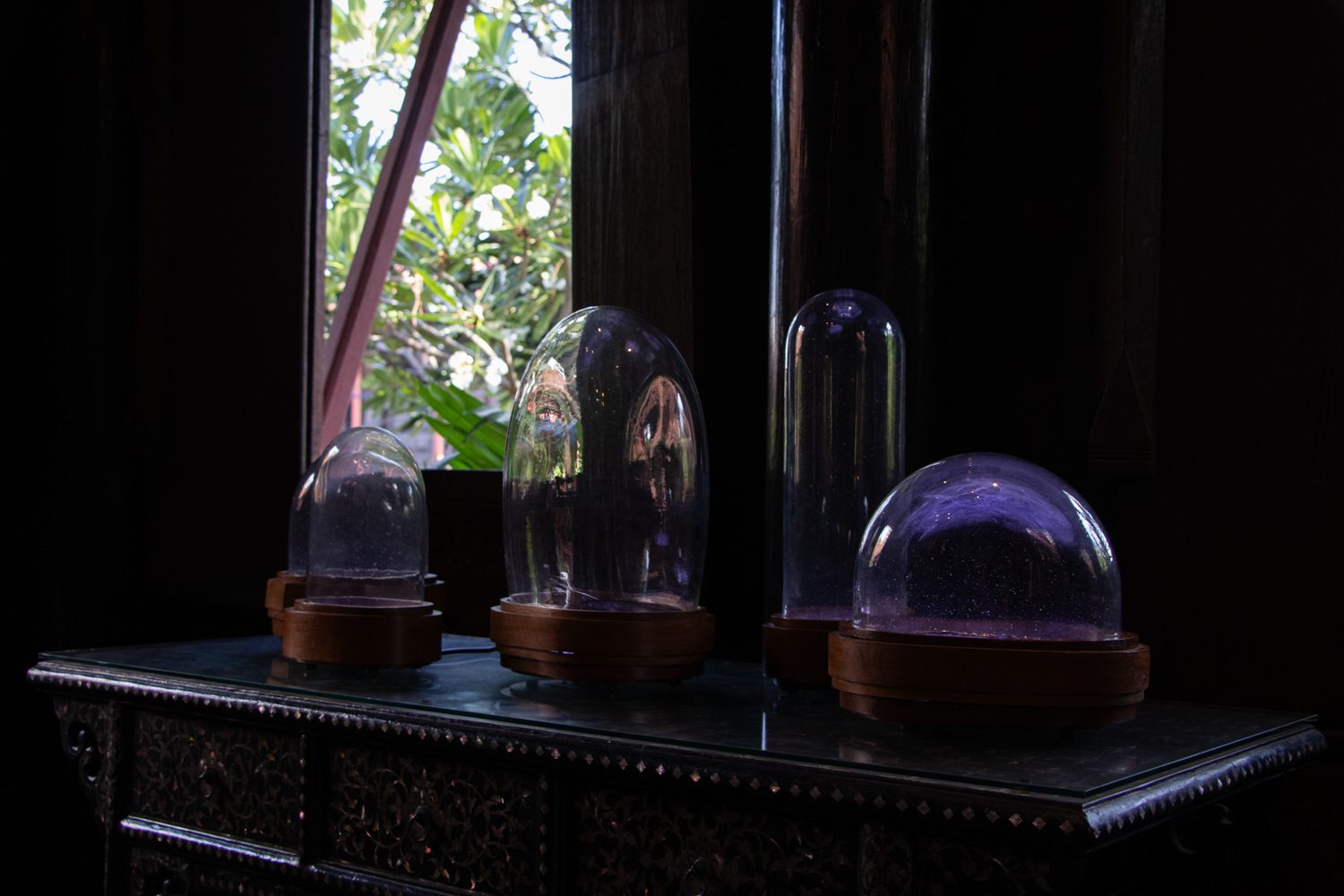
Photo: Chitpon Paengwiengjan
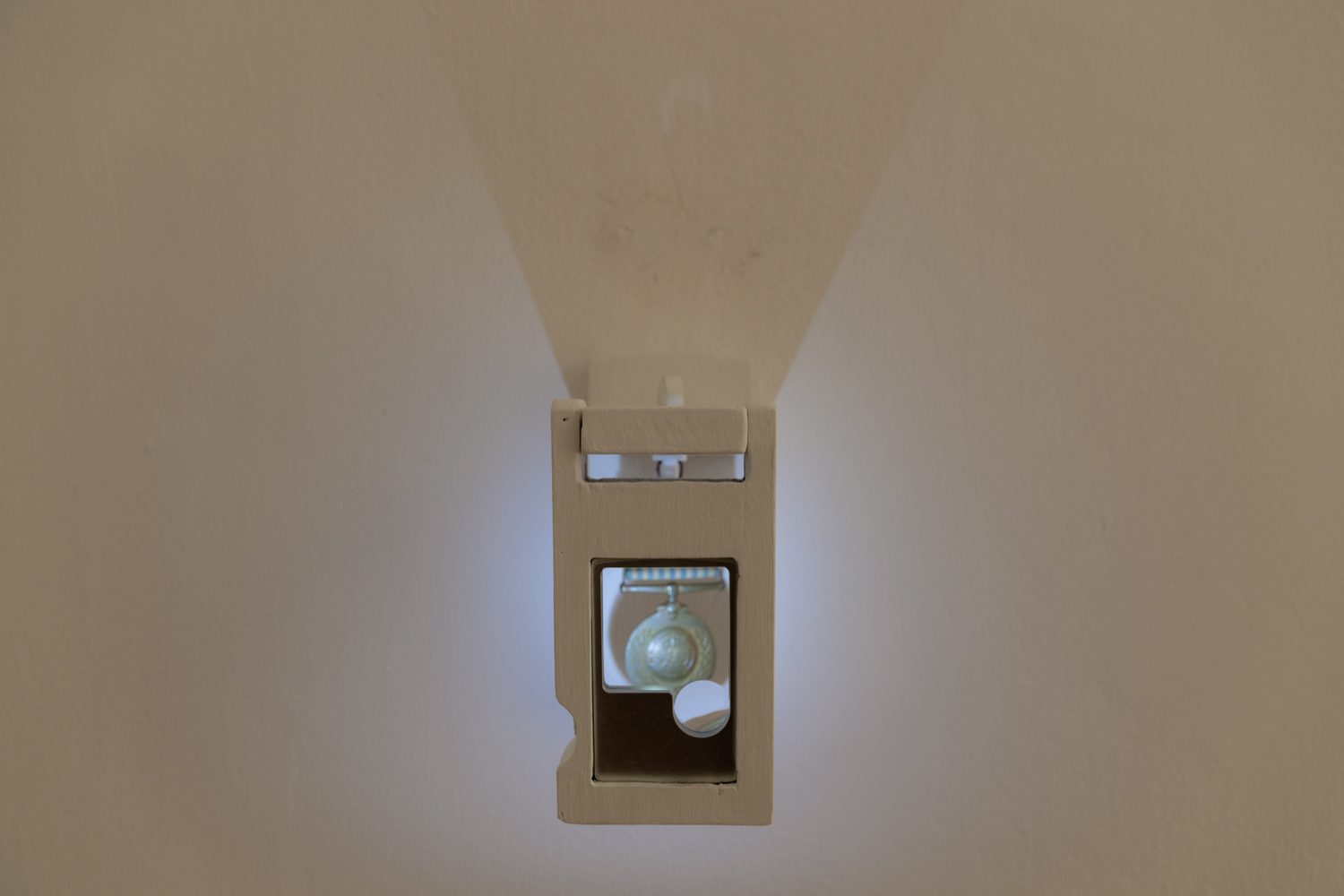
This duality is introduced through Aerial Photograph (1953–1954, 2025), a series in which the artist prints historical aerial maps onto lightboxes and encases them in hand-blown glass domes—crafted in the traditional style of those used to enshrine Buddhist sculptures. The aerial maps, originally produced by Thailand’s Ministry of Defense in 1951 with support from the United States, marked the country’s first complete series of 1:50,000 scale topographic maps. In exchange, the Thai government allowed the U.S. to establish air force bases on Thai soil during the Vietnam War.
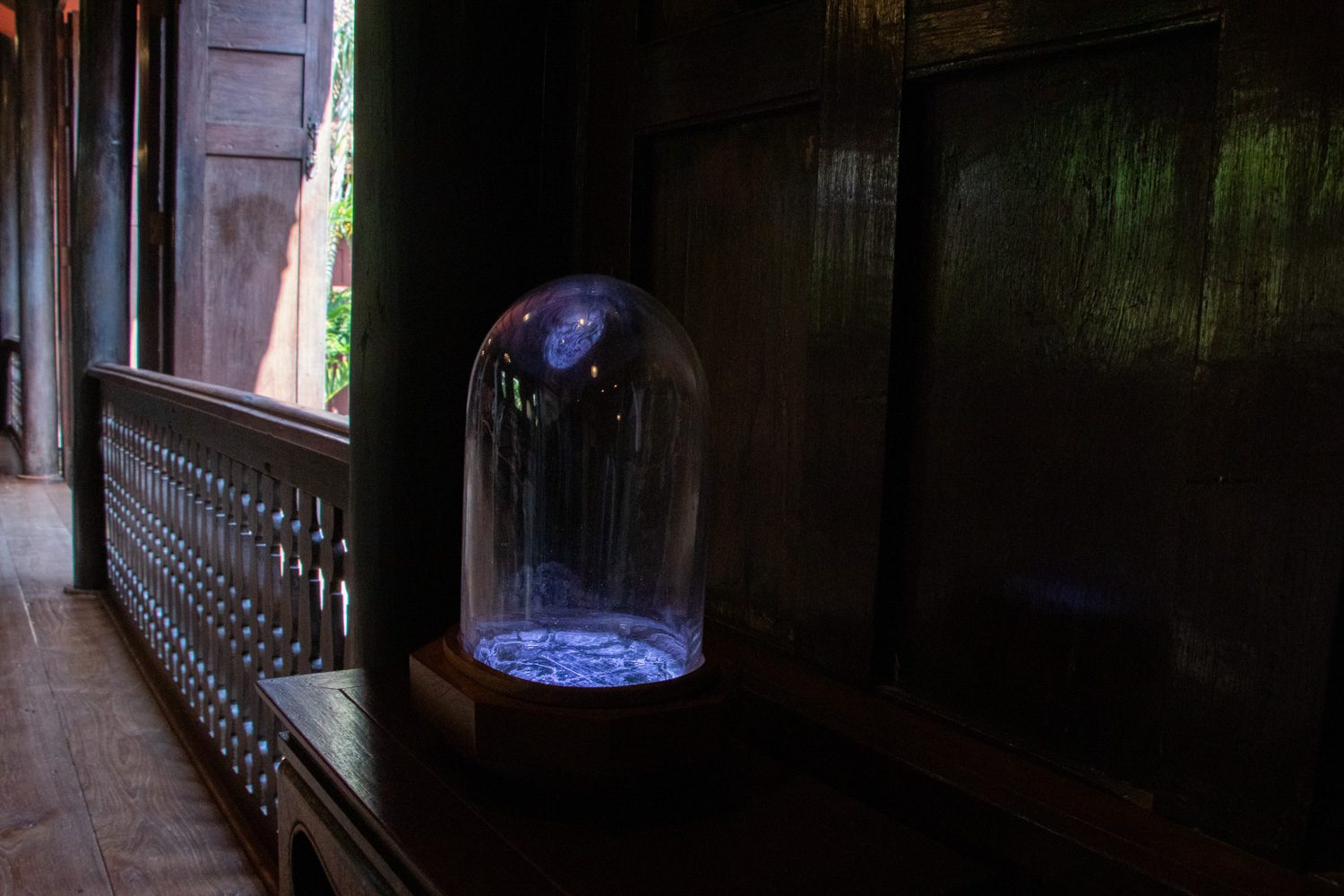
Photo: Chitpon Paengwiengjan
The maps selected by Prateep for this series span multiple geographies. Among them is an aerial photograph of an airstrip in northeastern Thailand, once used by the Free Thai Movement during World War II. Another depicts Khao Thamorat in Phetchabun province, a site where Jim Thompson acquired several antiquities. These objects were later exported abroad during a period when the Thai public had yet to fully recognize the cultural value of such collections. A third map presents an aerial view of Ayutthaya, the province from which Thompson sourced a traditional Thai house that would eventually become part of his iconic Bangkok residence. What connects these seemingly disparate sites is the way Prateep weaves together the narratives of cartography and material heritage. The creation of Thailand’s first comprehensive national maps during this period helped spark domestic interest in archaeological research. This growing awareness of the country’s ancient past became part of a broader nation-building process—one that aligned closely with the strategic objectives of the United States.
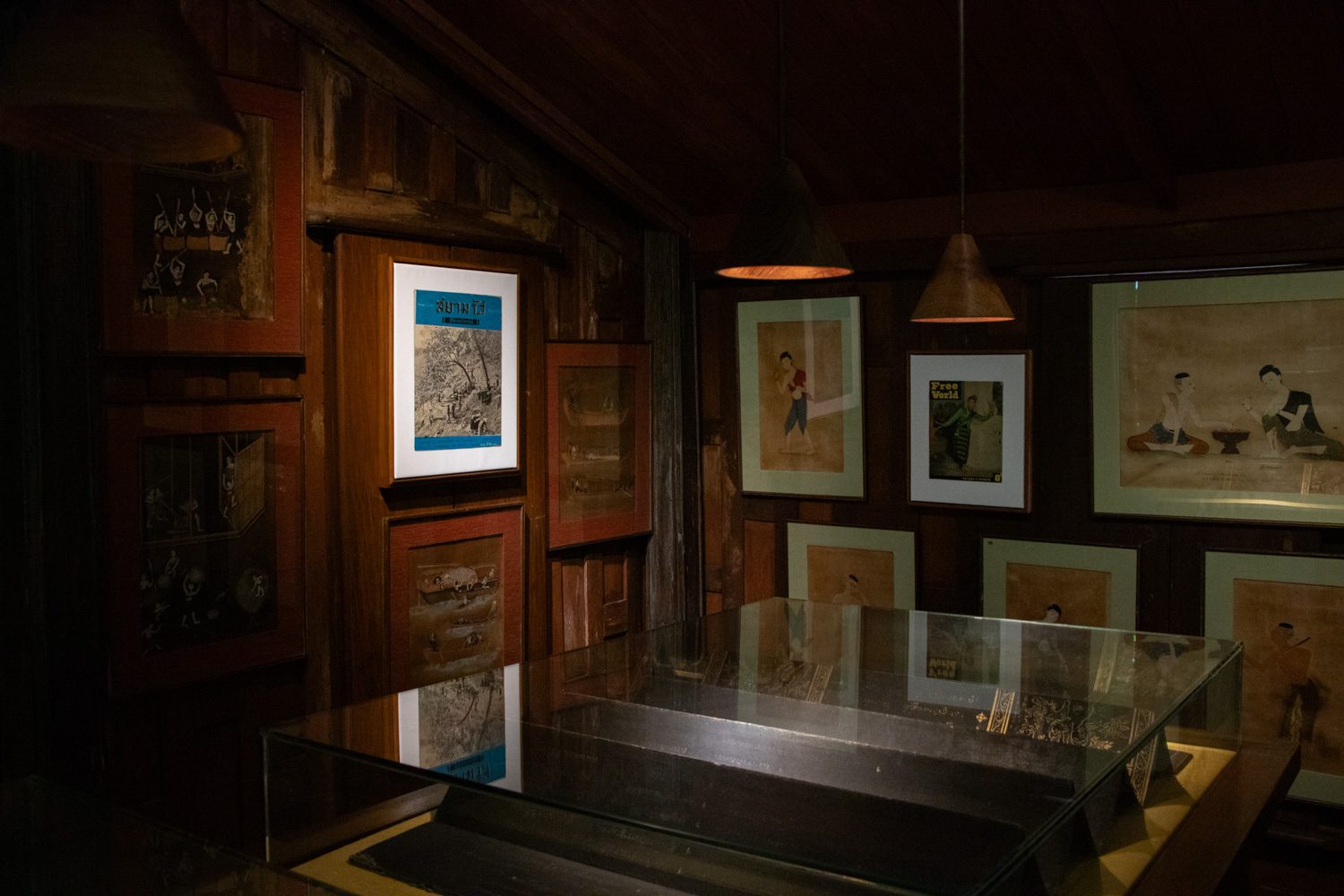 Photo: Chitpon Paengwiengjan
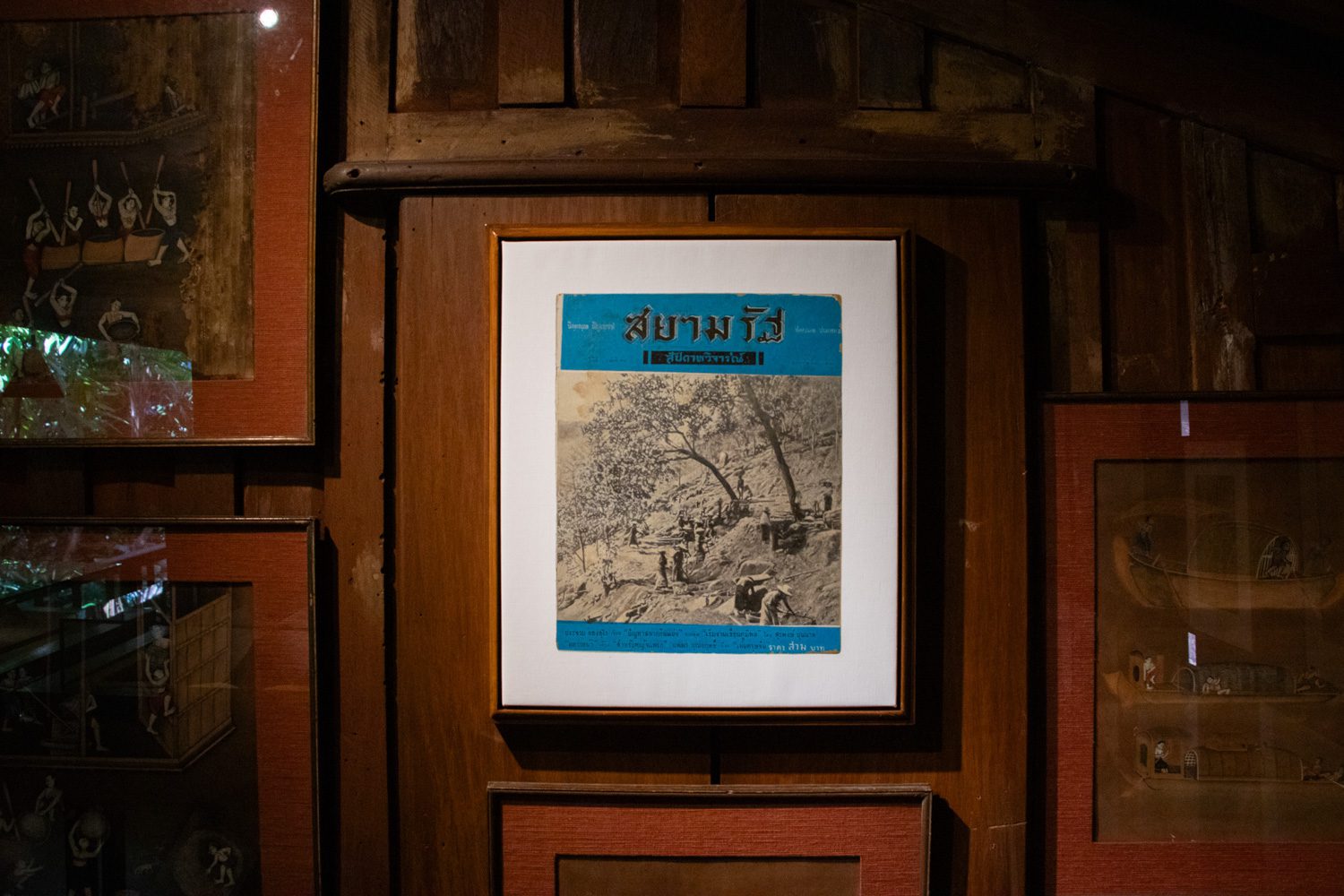
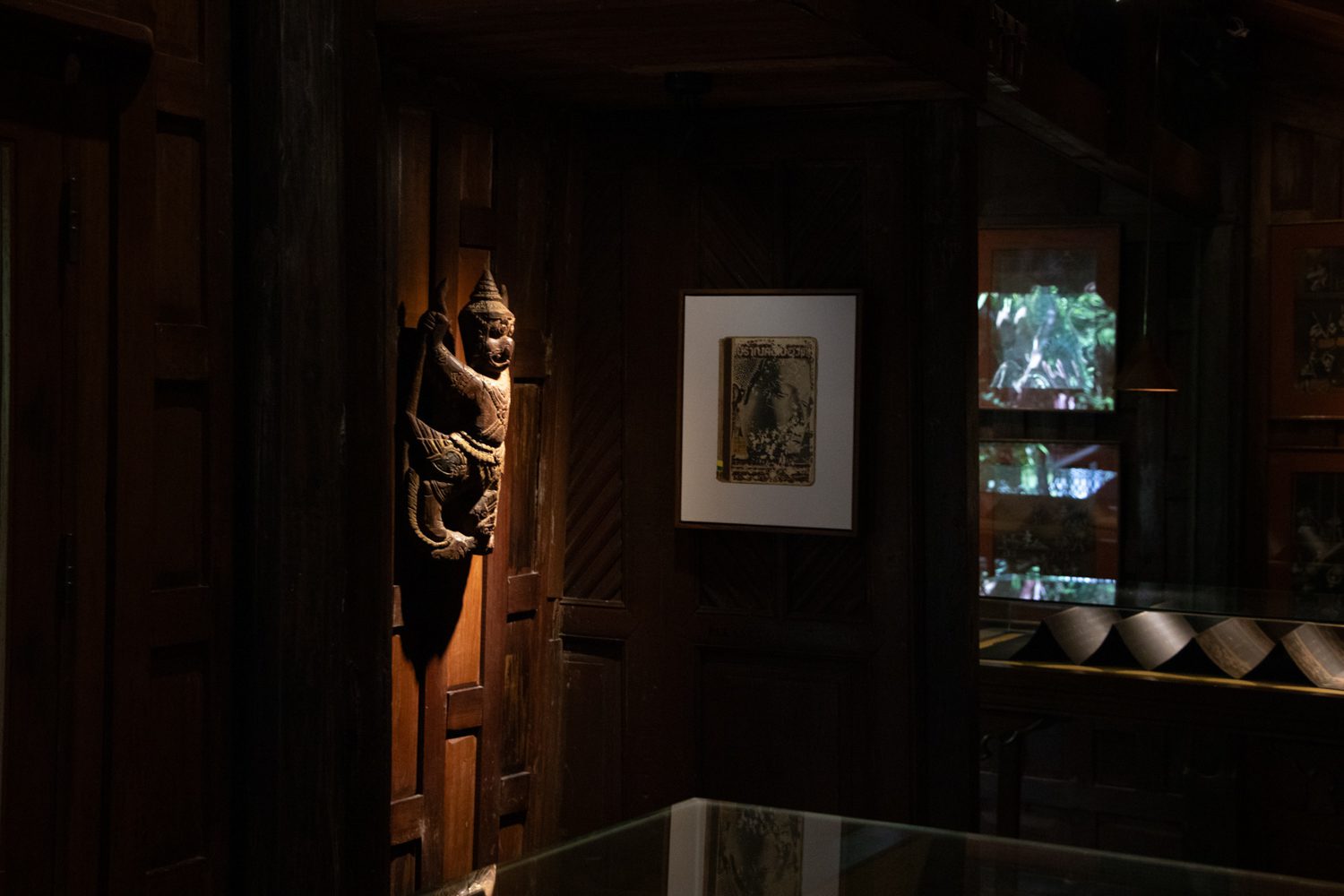
The theme of Thai nationhood continues in Paintings from Publication Covers (2010–2025), another series by Prateep Suthathongthai, displayed in one of the smaller traditional Thai houses on site. In this body of work, Prateep meticulously recreates the covers of vintage publications that serve as historical traces of the Cold War era. These include a Tourism Authority of Thailand magazine featuring a Thai pavilion at an international expo in Paris; a book by No. Na Paknam, which is one of the earliest publications to explore archaeology in Ayutthaya; an introductory archaeology textbook; and a volume titled Lam Lao Verses, which offers evidence of how Cold War ideologies were disseminated in Thailand’s northeastern region. At the time, these poetic verses were used in anti-communist campaigns to rally public sentiment in areas facing armed conflict with communist insurgents. Each cover is rendered in acrylic paint with such precision that the works blend seamlessly into the museum’s permanent display of historical documents and artifacts, mirroring the quiet integration seen in Prateep’s earlier Aerial Photograph series, where hand-blown glass domes encase old aerial maps. In both bodies of work, Prateep reconstructs existing historical evidence while deliberately refraining from imposing interpretive bias or commentary.
William Warren Library
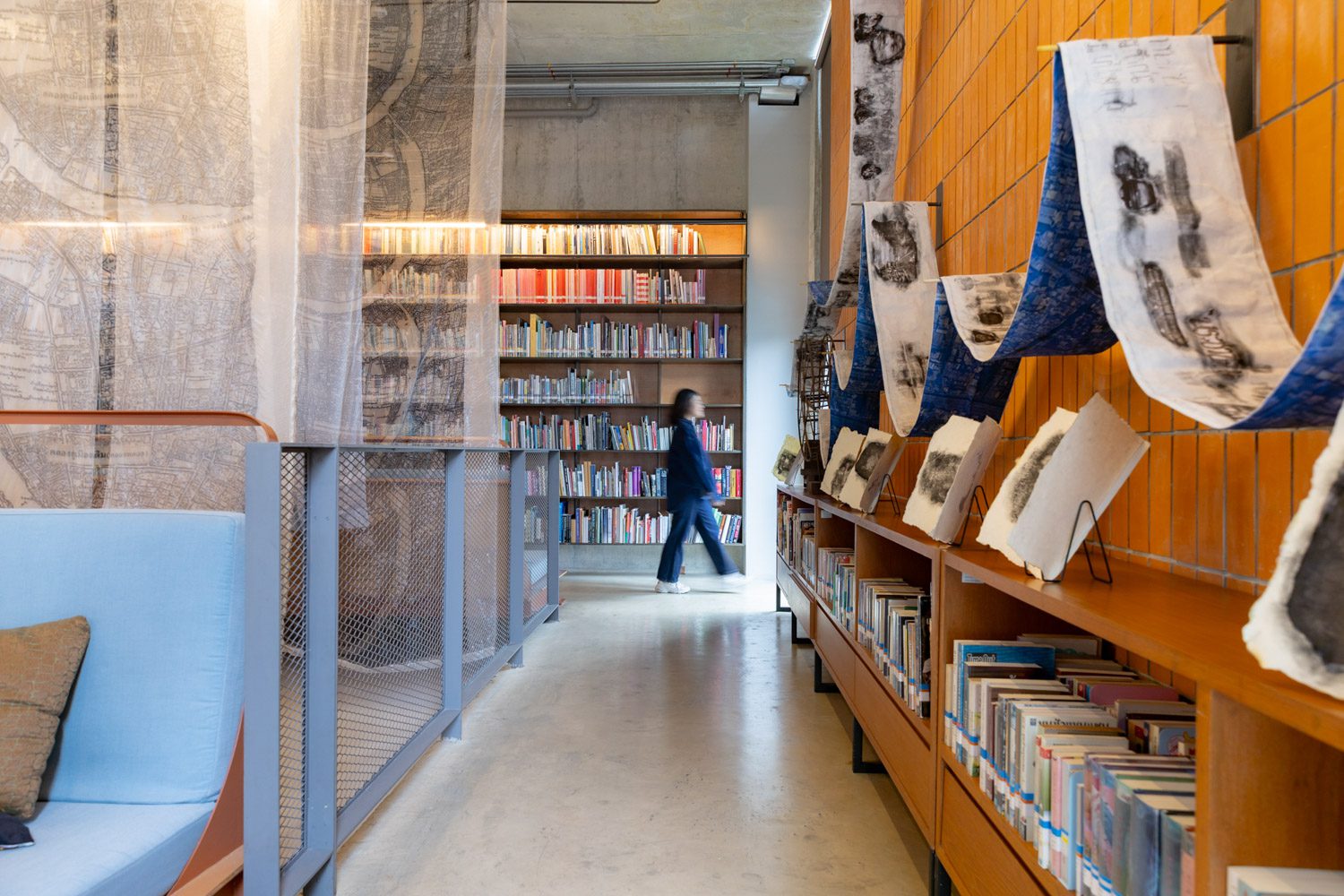
Ban Krua Ban Khaek (2025) by Keeta Isran is perhaps the most intimate and personally resonant work in the exhibition. Although Keeta is currently based in Pattani and Narathiwat, she was born in Bangkok and once lived in the Ban Krua community located along the Saen Saep Canal, directly across from Jim Thompson’s house.
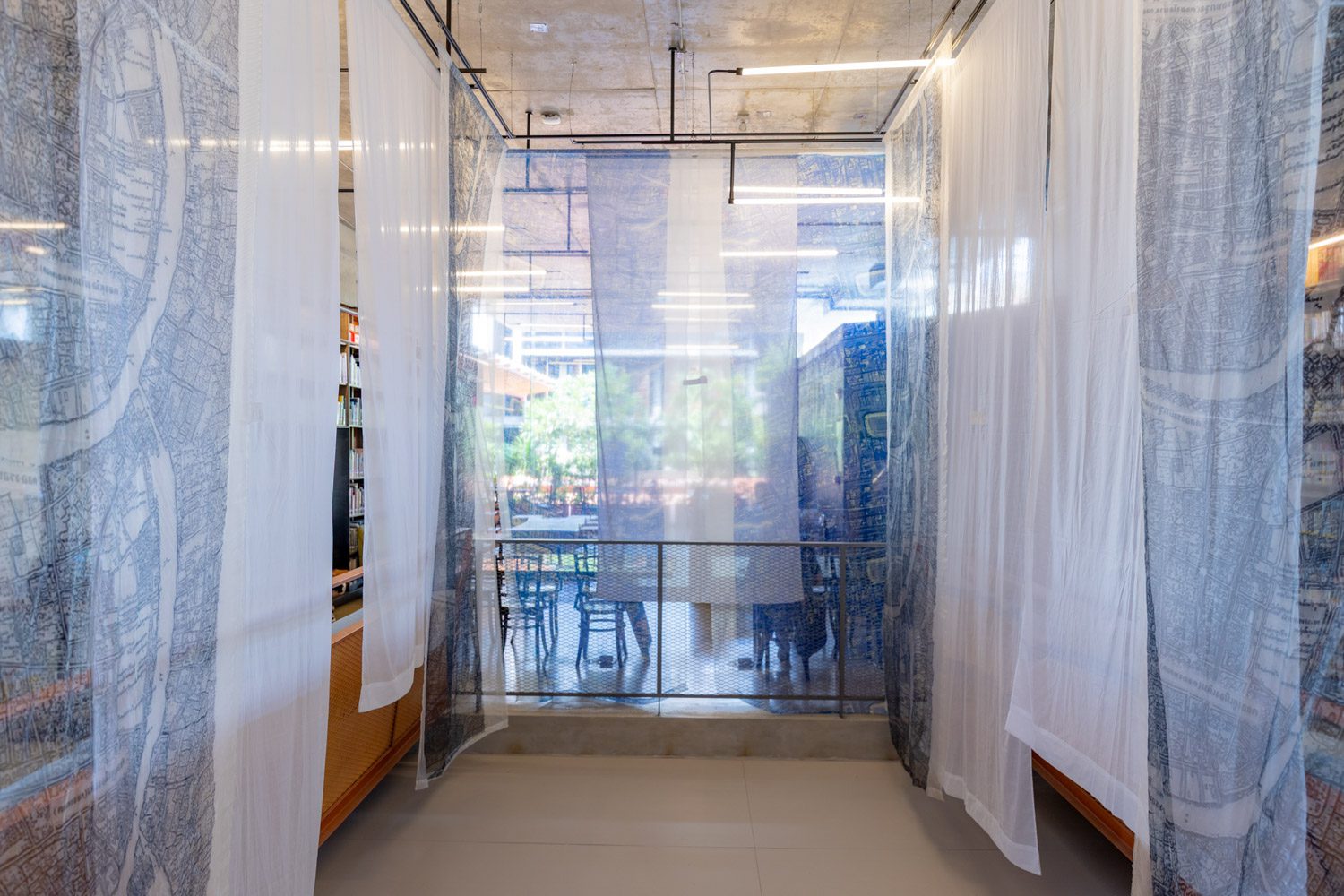
Ban Krua is a Cham Muslim community whose origins in Thailand date back to 1785, when Cham fighters joined the Siamese army in its war against Burma. After the victory, King Rama I granted the group land along the Mahanak and Saen Saep canals as a reward for their service. The Cham people brought with them a rich tradition of textile weaving, and upon settling in the area during the early Rattanakosin period, they became known for producing fine silk for the royal court. Their reputation would later extend globally, as Ban Krua became the community responsible for weaving Thai silk fabrics for Jim Thompson1
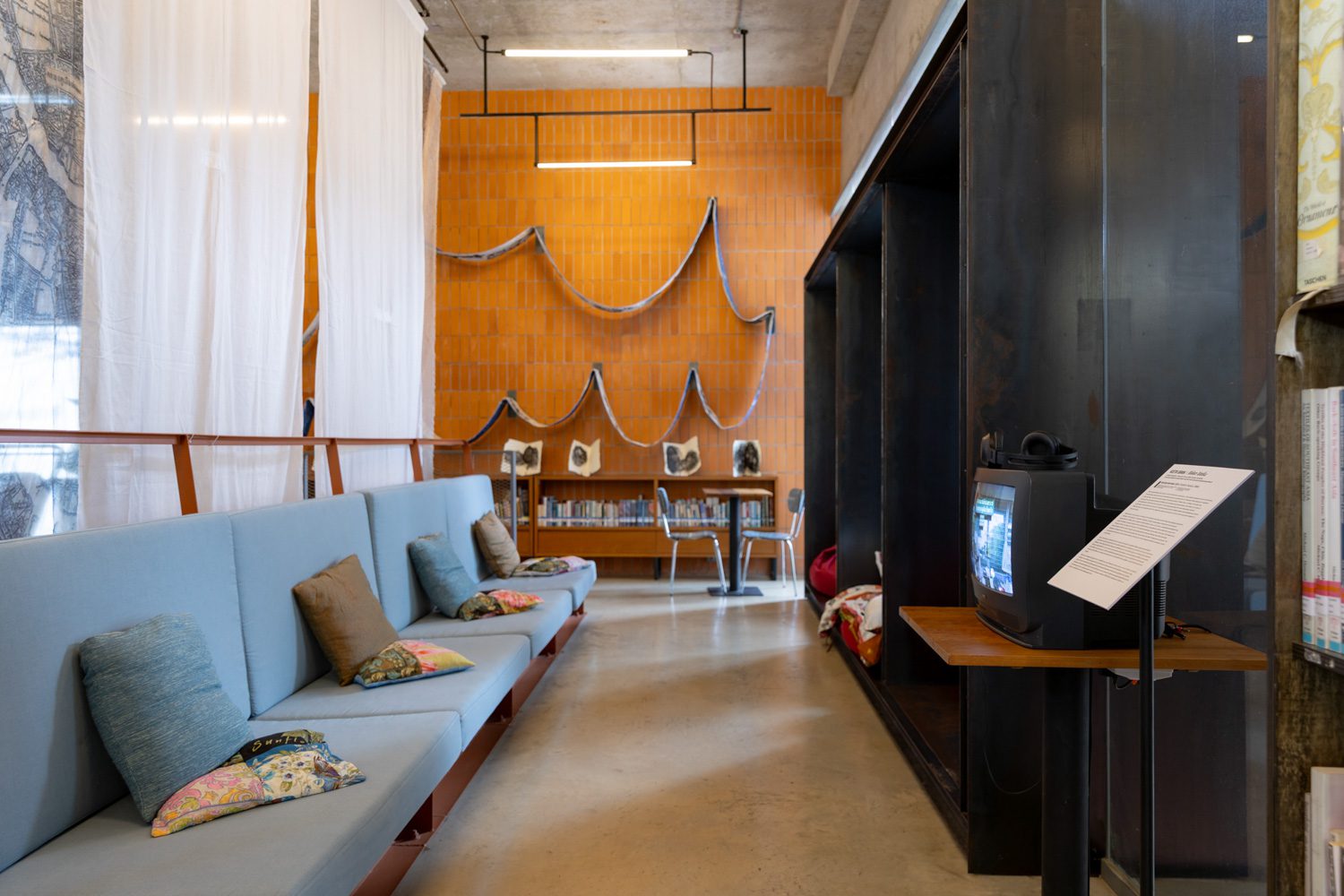
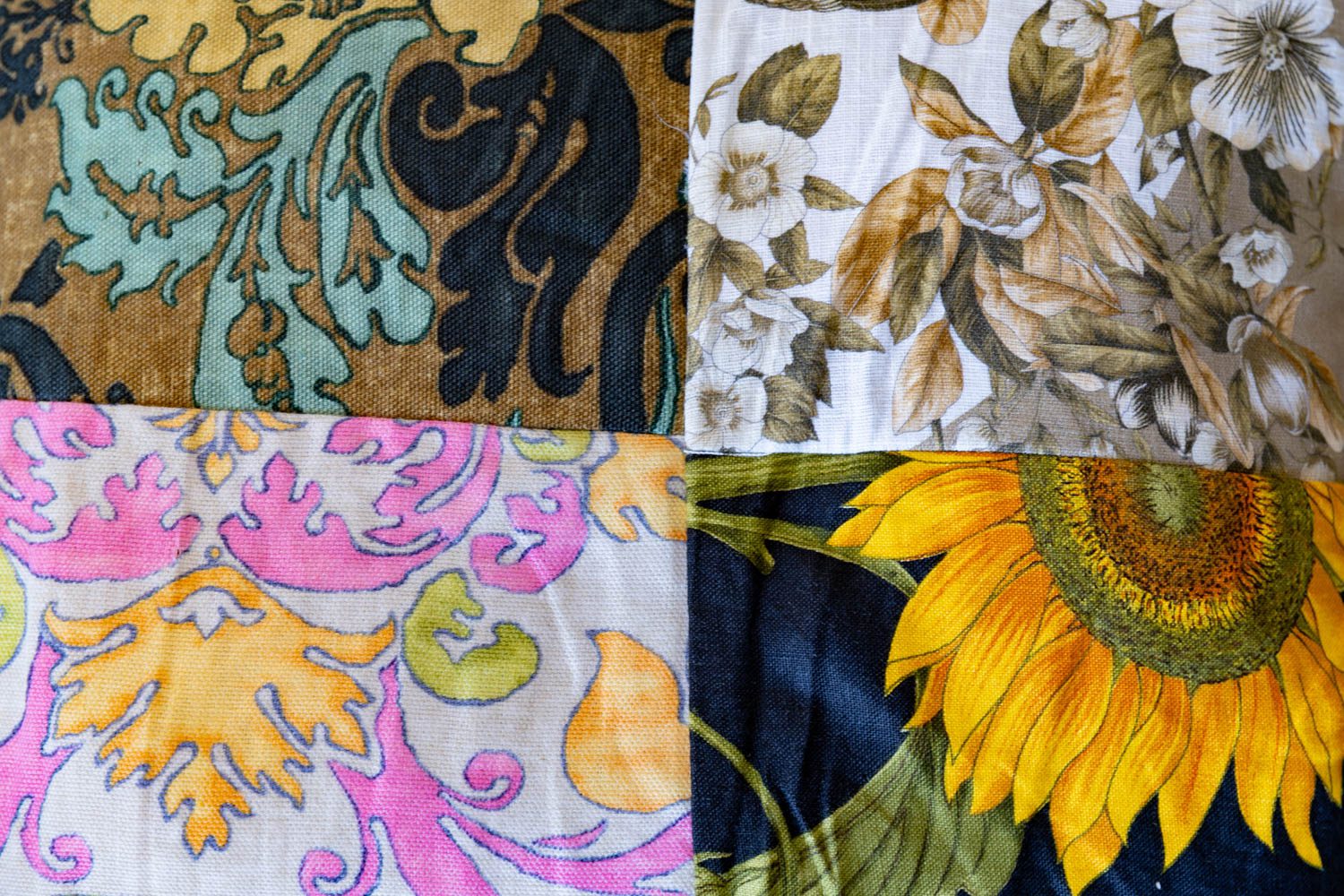
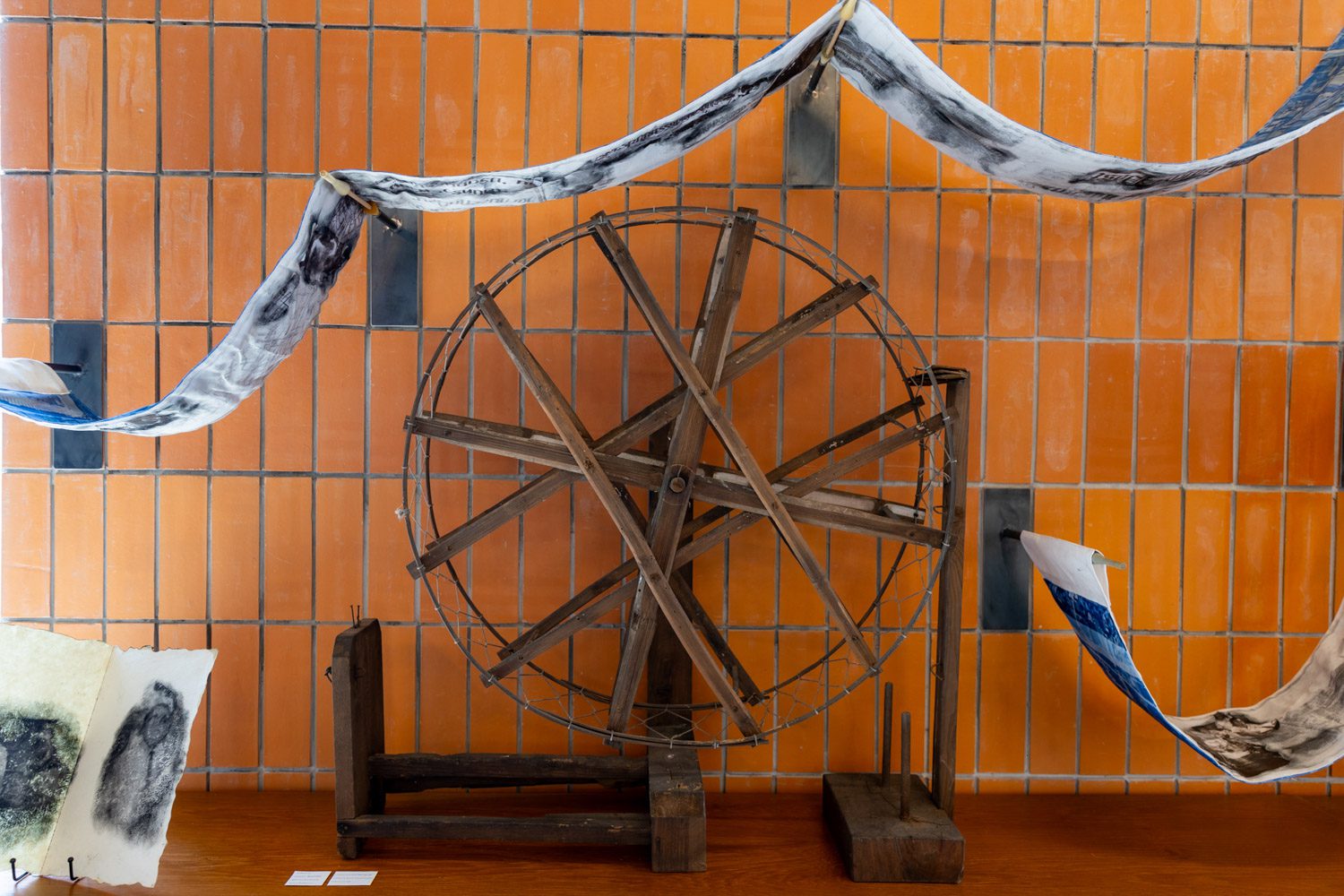
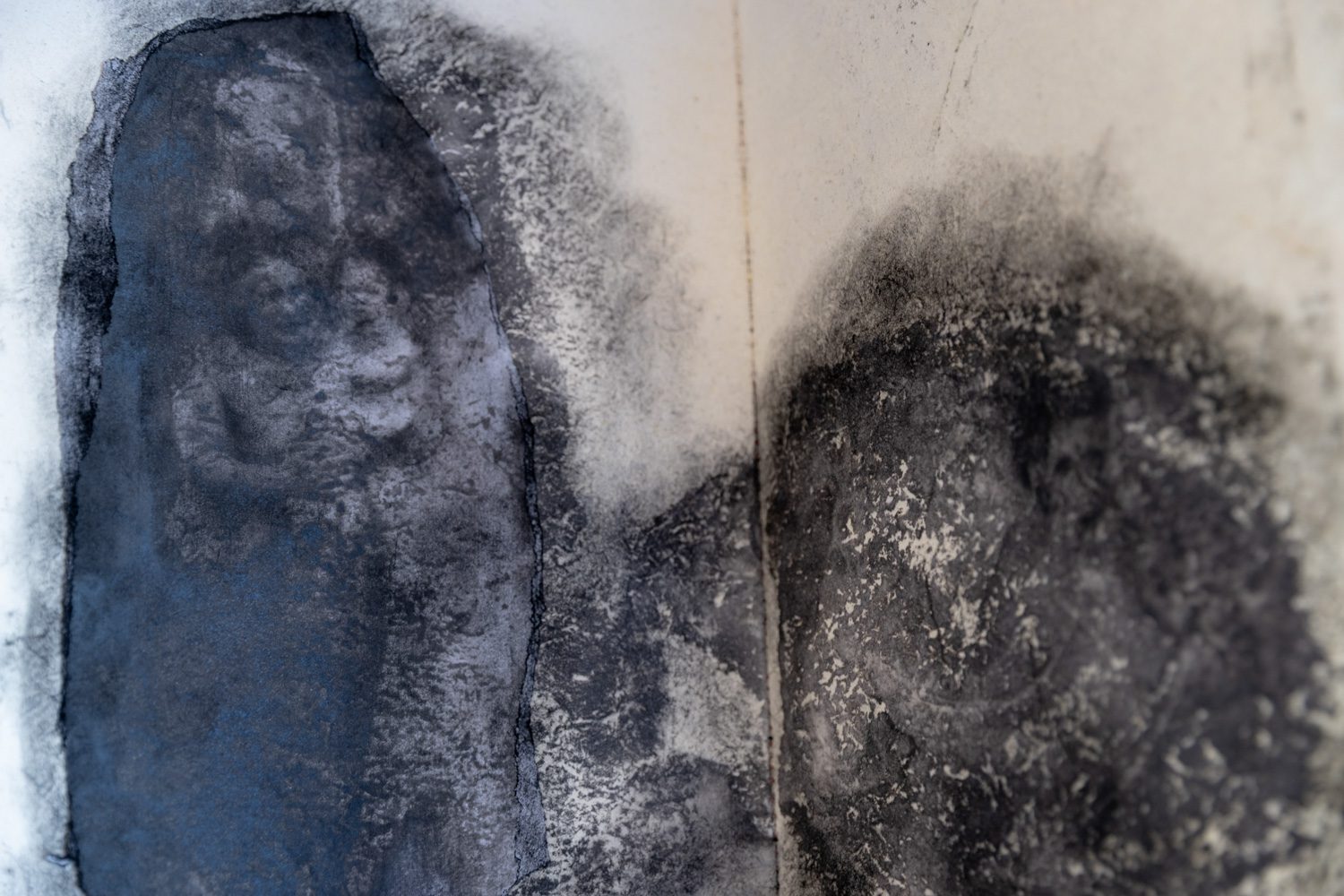
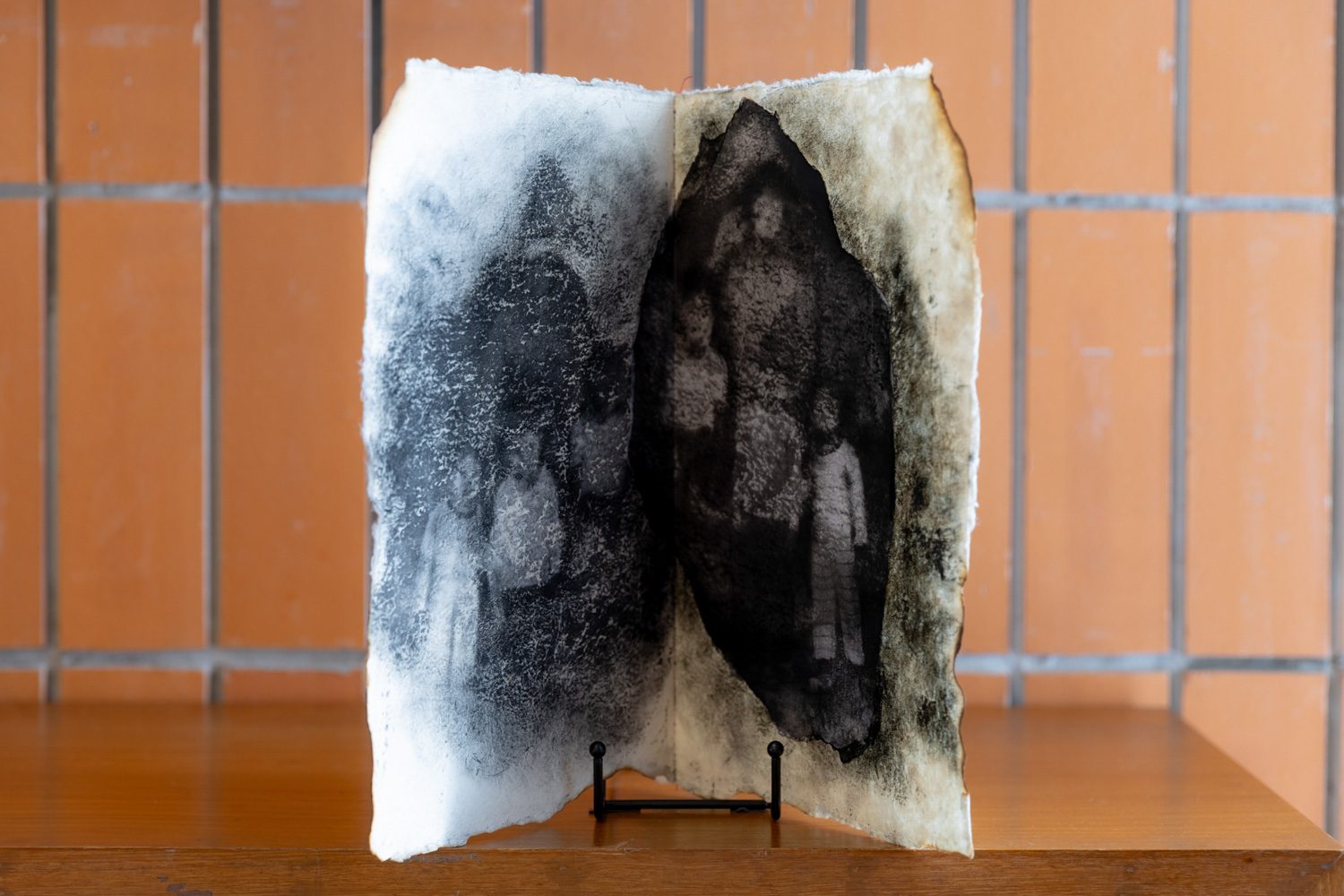
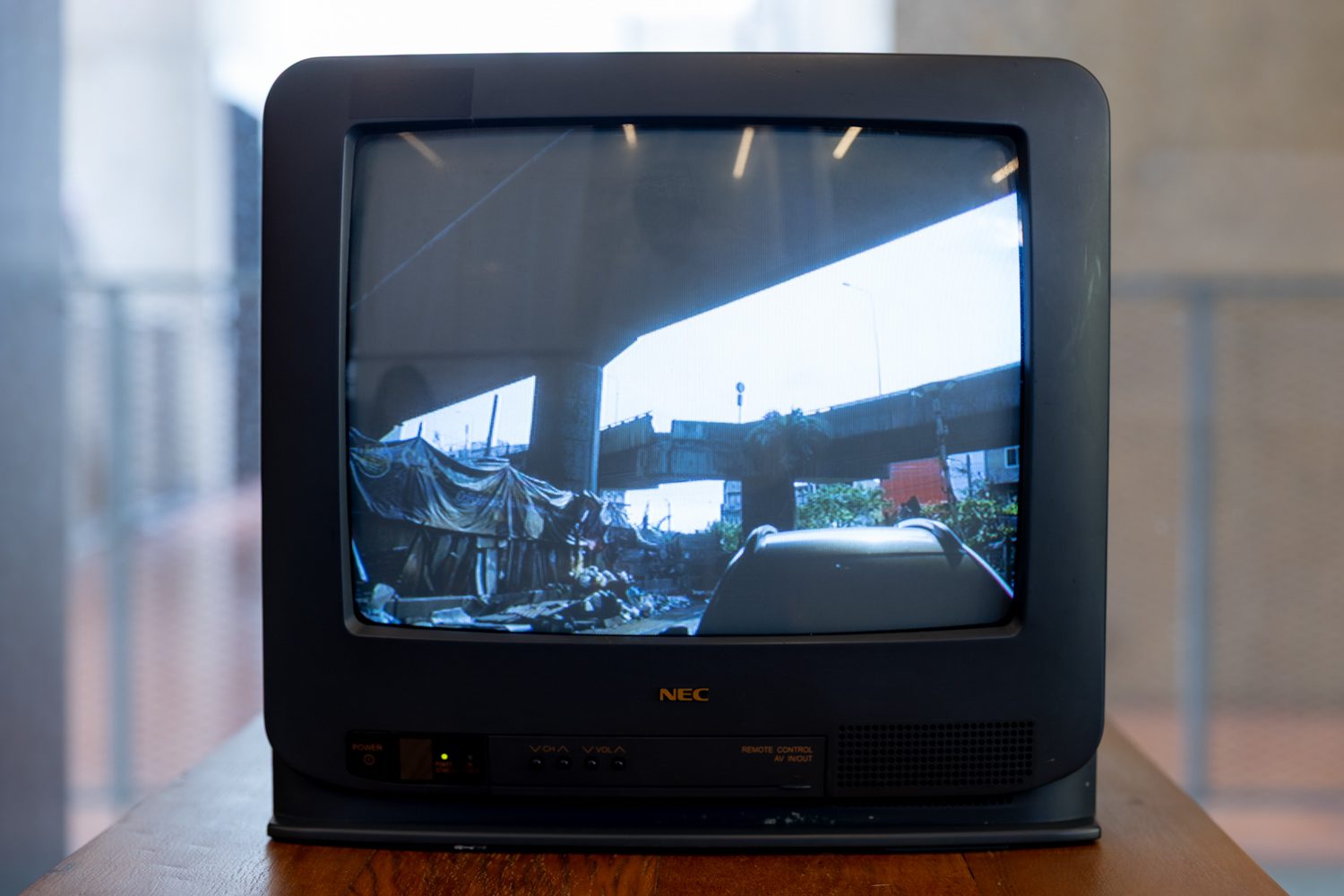
Part of Keeta’s work tells the story of the Ban Krua community and its long-standing tradition of silk weaving. She prints a map of the neighborhood onto white fabric, suspending it from the ceiling like a mosquito net, a household object once commonly used in community homes. Nearby, fragments of Jim Thompson’s silk have been sewn into pillowcases and placed on a sofa in the library, while an old spinning wheel, borrowed from the community, stands as a material witness to its textile legacy. Yet Ban Krua’s story extends beyond its silk legacy. Around the late 1980s, the community faced a new threat: a government-led urban development plan for the Chaeng Watthana–Bang Khlo expressway, which would have required the expropriation of land in the neighborhood. The community mobilized in resistance, sparking a period of intense conflict that escalated to the point of arson. In response to this history, Keeta uses soot as an echo of the fires that once threatened the community to create faint, ghostlike human figures on paper and across an 18-meter length of fabric. The piece marks the 18 years of her own memories tied to the neighborhood.
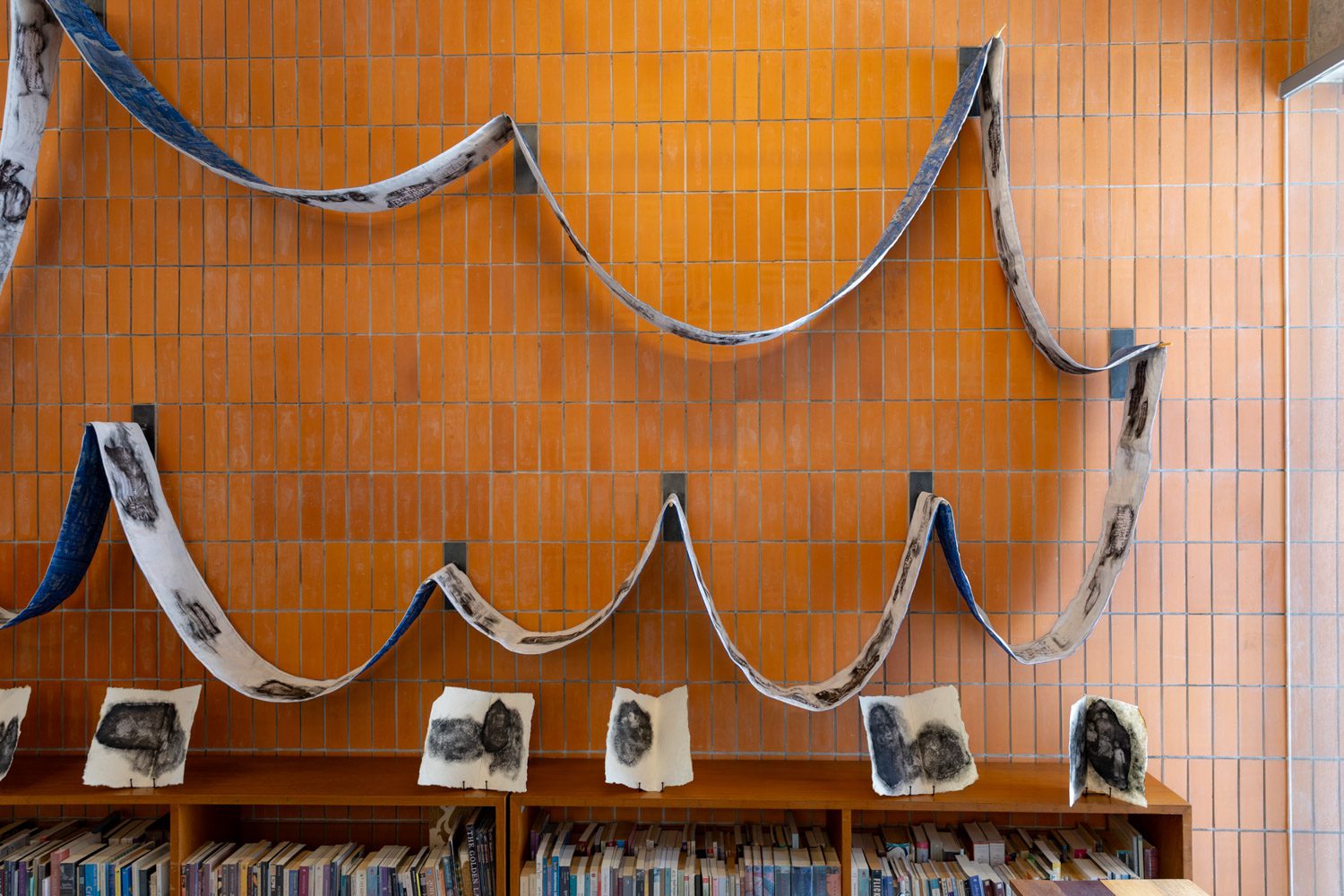
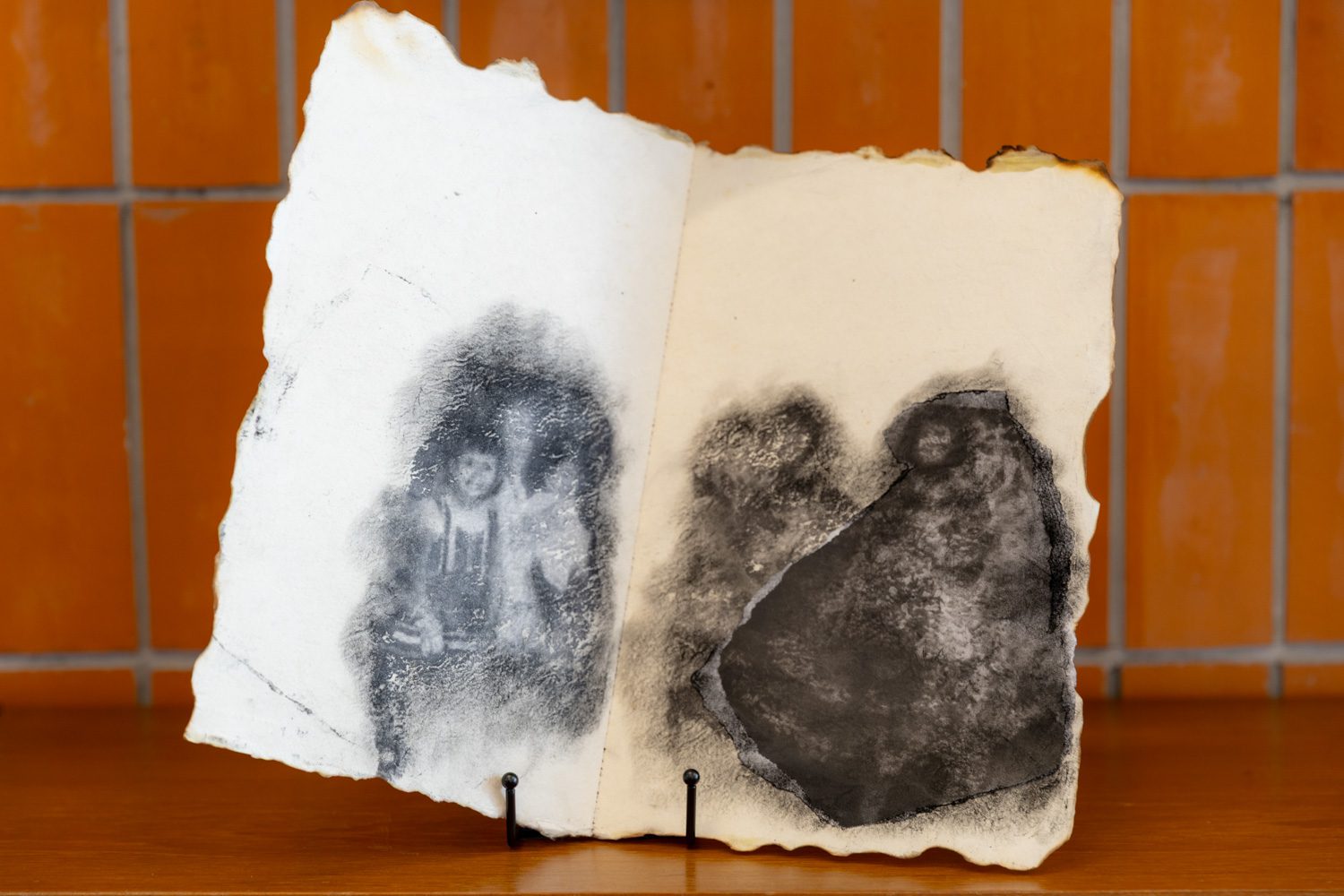
Although Ban Krua ultimately survived the threat of expropriation and still stands today along the banks of the Saen Saep Canal, the community is no longer what it once was. Many of the original families, including Keeta’s, have since moved away, while newcomers from other areas have gradually settled in. The neighborhood has split into what are now known as Ban Krua Nuea (North Ban Krua) and Ban Krua Tai (South Ban Krua), and divisions have emerged within the community itself. These differences in opinion are believed to have stemmed from the expropriation crisis, during which some residents supported the plan while others opposed it, depending on their individual gains or losses. Though rooted in a single local neighborhood, this internal fracture can be seen as a microcosm of broader societal divisions that persist in Thailand today. In part, these divisions trace back to the Cold War, which laid the ideological groundwork for political polarization between conservative forces aligned with traditional state power and liberal movements calling for greater equity and democratic reform.
The exhibition The Shattered Worlds: Micro Narratives from the Ho Chi Minh Trail to the Great Steppe, curated by Gridthiya Gaweewong in collaboration with Rinrada Na Chiangmai and Chanapol Janhom, is on view from April 3 to July 6, 2025.
_
1 Source: silpa-mag.com