SLOWLY READ THE THOUSANDS OF STORIES OF ARAYA RASDJARMREARNSOOK IN ‘ARAYA RASDJARMREARNSOOK: TEXTUALLY’
TEXT: SARUNKORN ARTHAN
PHOTO: KRITTAWAT ATTHASIS EXCEPT AS NOTED
(For Thai, press here)
I Am a Writer (Who Would Like to Imitate Araya)
“I am a teary person, especially when I have to say goodbye to ‘a being’ to which I feel attached, whether it be a dog or a person. My first farewell was when I was three, when all of a sudden my mother and brother vanished from my mornings and nights. My grandma said my mother and my brother had died. In a frantic bustle of funerals, no one cared to explain to a small child what death was…”
Araya Rasdjarmrearnsook and Kong Rithdee. I Am an Artist (He Said).
Edited by Roger Nelson and Chanon Kenji Praepipatmongkol.
National Gallery Singapore, 2022. p.399
Youth
Indeed, ‘death.’ Death had never once entered my mind until one day in 2009, when my grandfather’s younger brother went away and never came back. My mother and I had to hurry back from Chiang Mai, where we had been on holiday, so that I could have my head shaved, put on a monk’s robe, and become a nen na fai, the novice ordained for the funeral rites. He had no grandsons, and I was the grandson of his elder brother. So that was how it had to be.
I don’t know. Perhaps death was something like lying perfectly still while the heart, or whatever it is that keeps one alive, simply vanished. Like my own grandmother, like my own grandfather, who fell asleep on a bed, whether in a hospital or at home. My mother and aunts wept heavily at the loss of their parents. I sobbed too, because I had also lost the people who had raised me since childhood.
Another encounter with death, one I experienced without yet knowing or being certain of what it was, took place at the Bangkok Art and Culture Centre. On a white wall appeared a video of a woman walking in circles, or perhaps sitting and reading something aloud to bodies without souls. I stood there watching, scratching my head and muttering, “What the hell is this?” Then I moved on to look at other works. I went home, slept, woke up, and continued playing games.
Maturity
Unlike me, someone who has lived for just over nine thousand days, enough days and nights to have learned from and accumulated a modest share of experience, though certainly not as much as someone nearing twenty-five thousand days, like Araya Rasdjarmrearnsook. Since her youth, Araya has lived in close proximity to both life and death, an intimacy she has previously allowed and laid bare for us to ‘scan’ in Araya Rasdjarmrearnsook: The Same Old Karma, her exhibition at 100 Tonson Foundation, which concluded this past February, the so-called month of love.
To speak plainly, and I may as well simply say it here, what we saw in Araya’s same old karma was only a fragment, bound to its own specific deeds and occasions. For within Araya’s karma, karma in the sense of action, writing, and even the condition of being a writer, forms one of the larger acts, one of the more consequential burdens through which she is remembered. Alongside, of course, her identity as an artist, a woman, someone reconciled to mortality, a teacher, and the guardian of the stray dogs she has taken into her care at Ban Wang Hma or Dog’s Palatial House.
Now, 100 Tonson Foundation is presenting an exhibition devoted to her writings, titled Araya Rasdjarmrearnsook: Textually.
Youth (Awestruck)
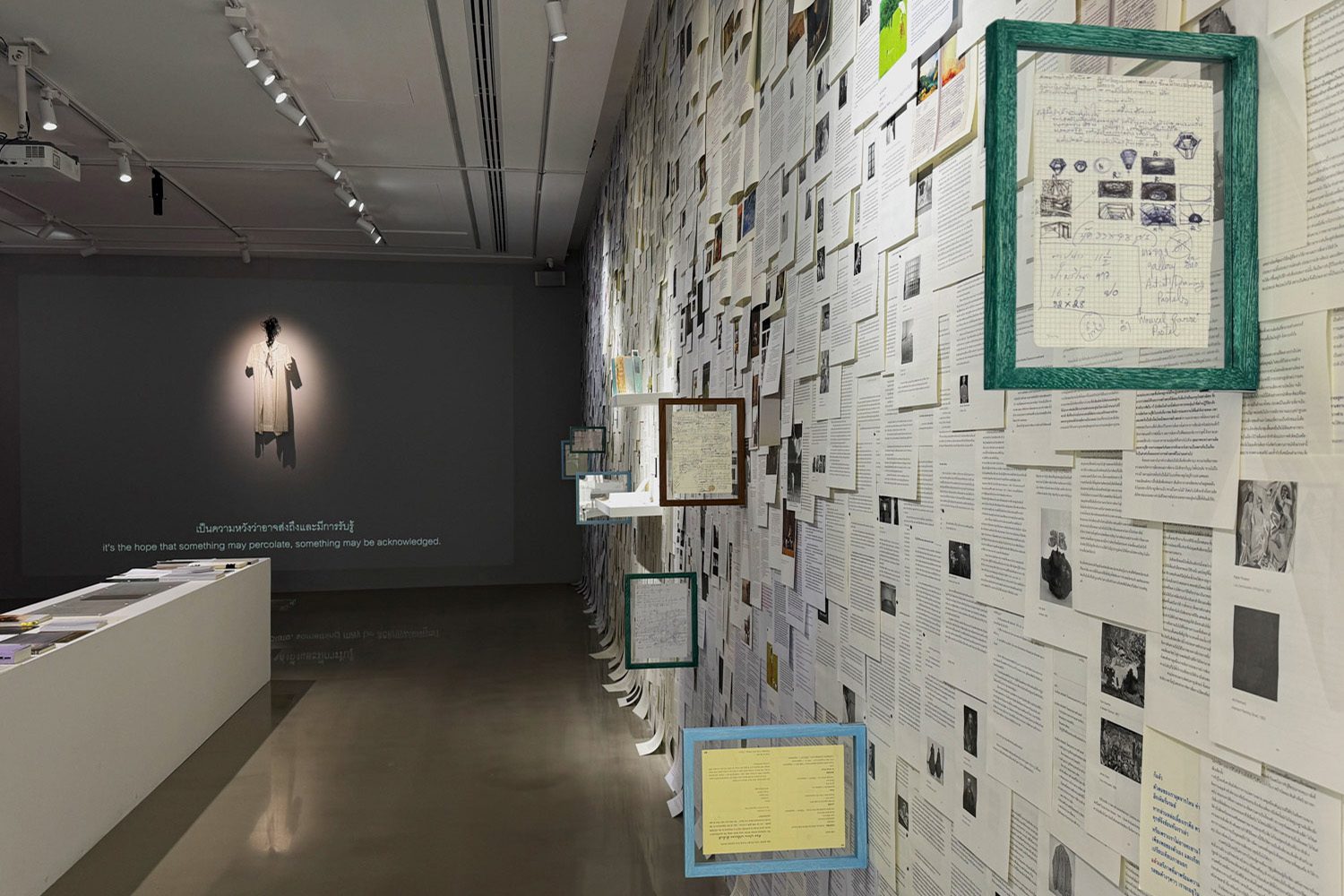
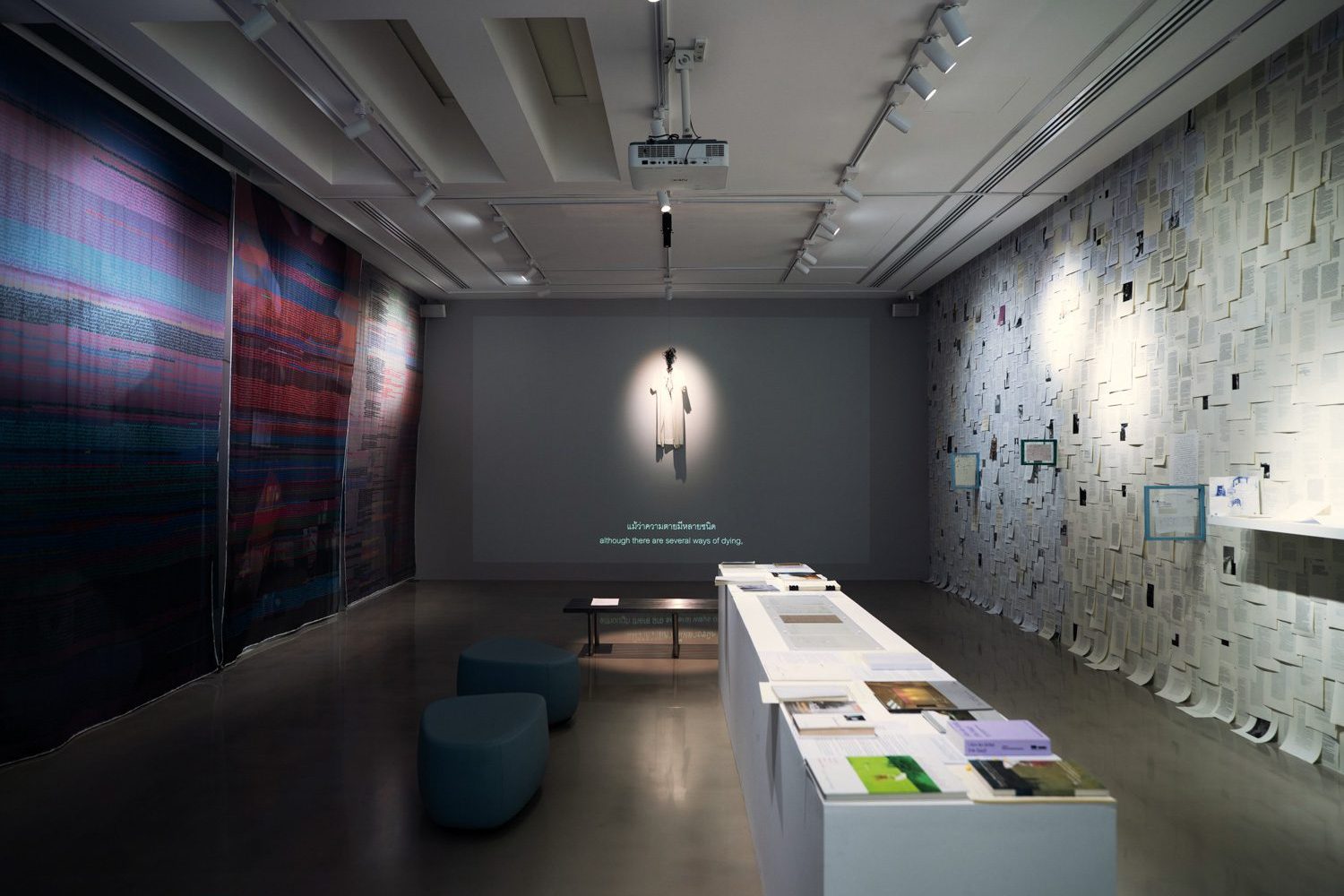
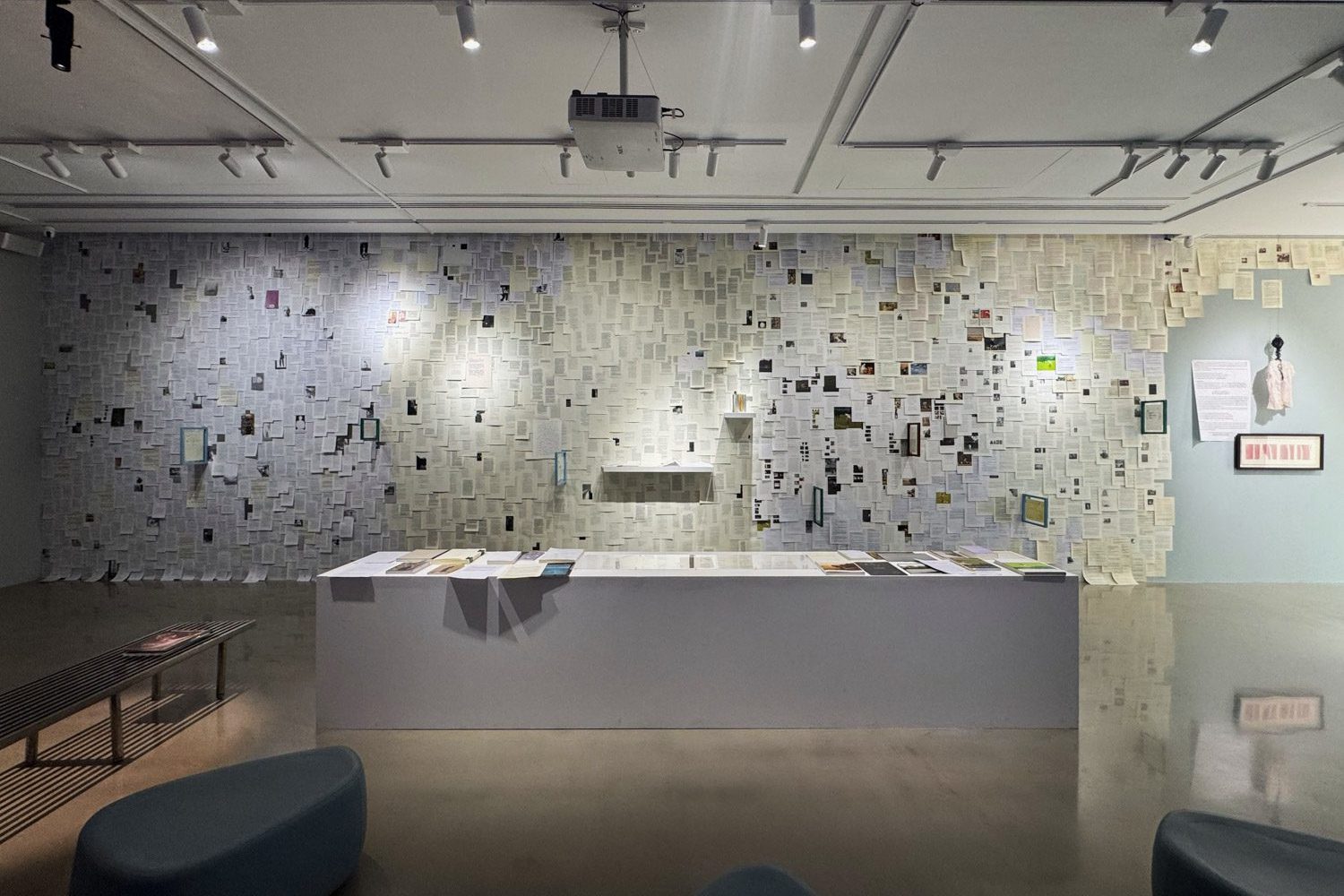
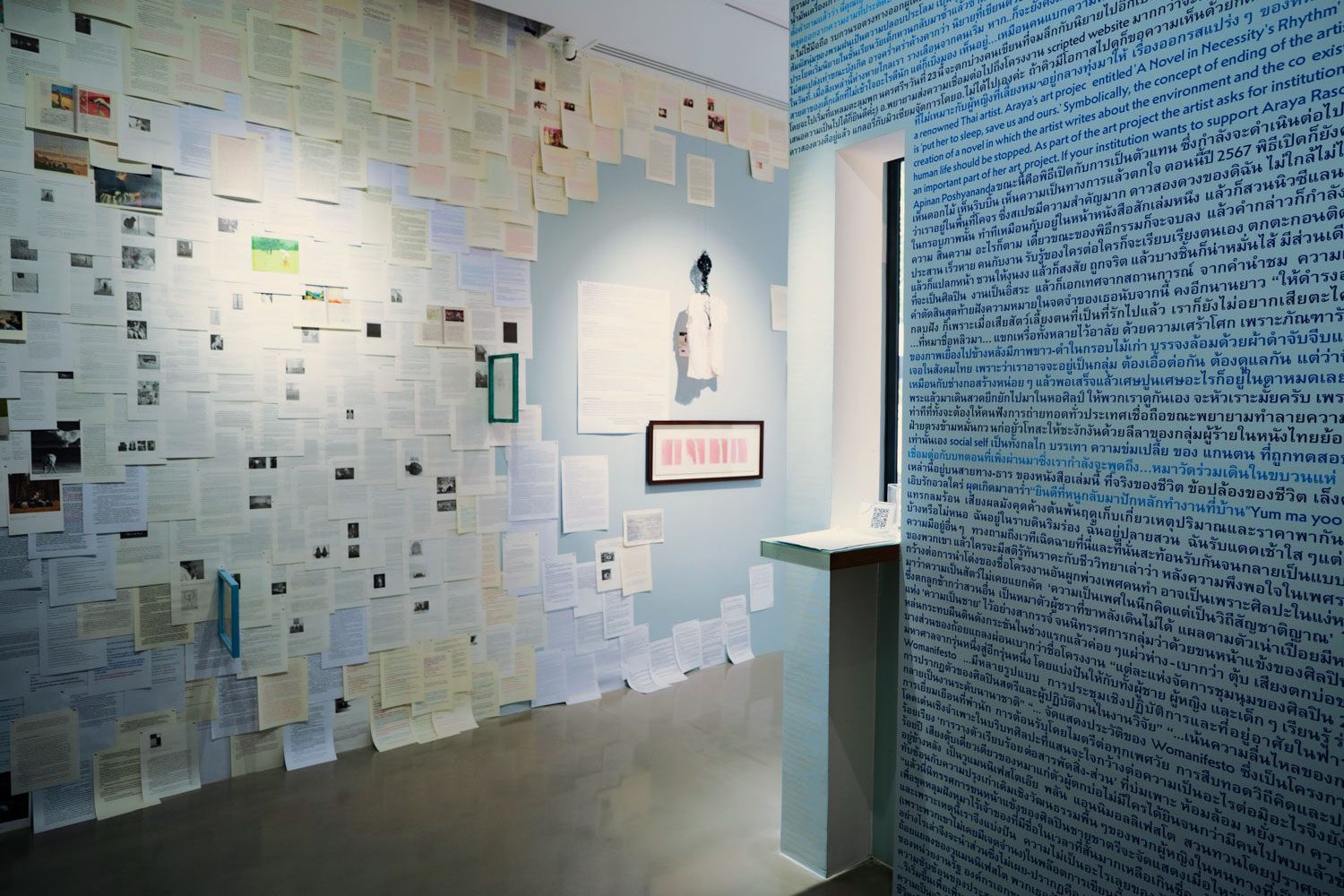
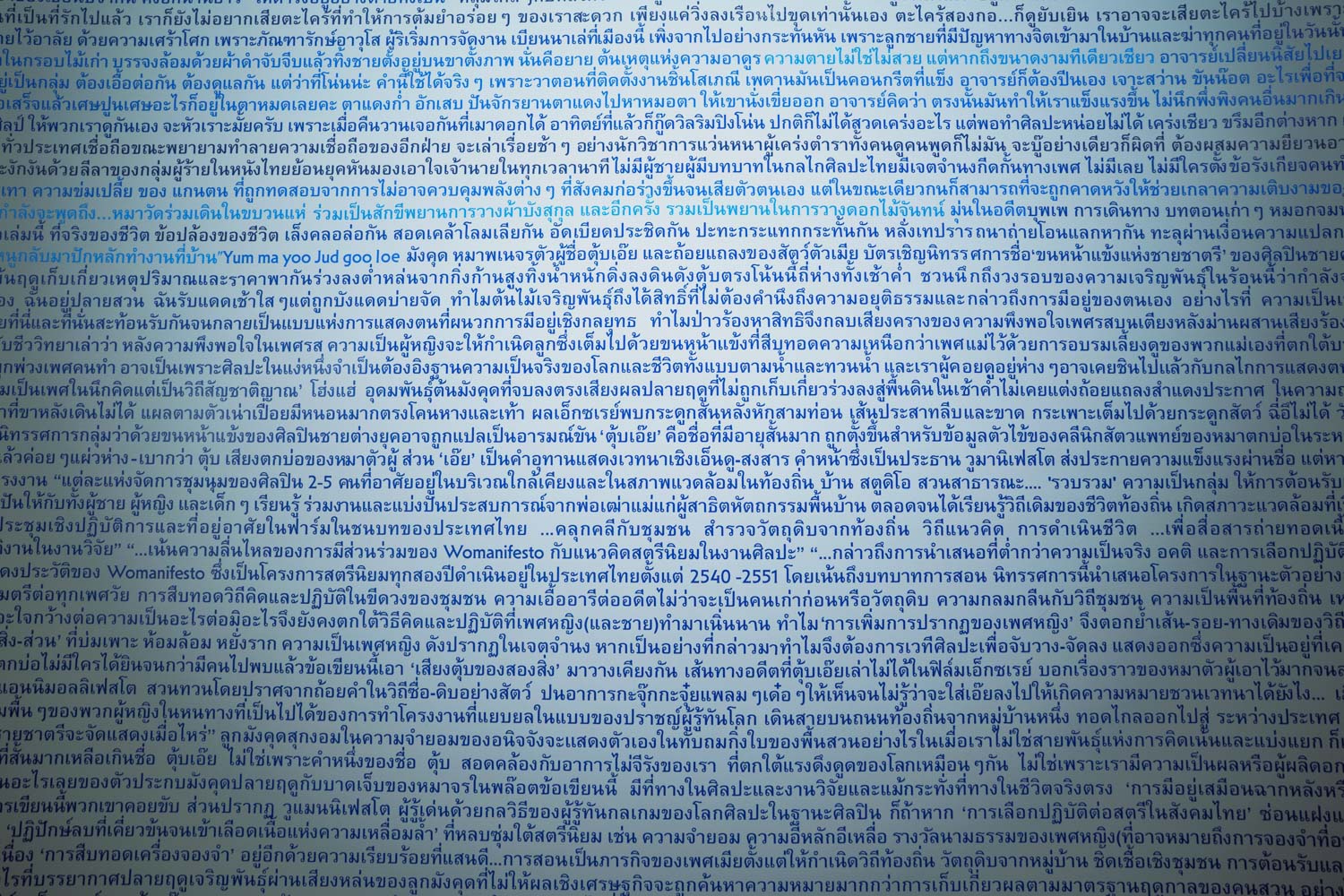
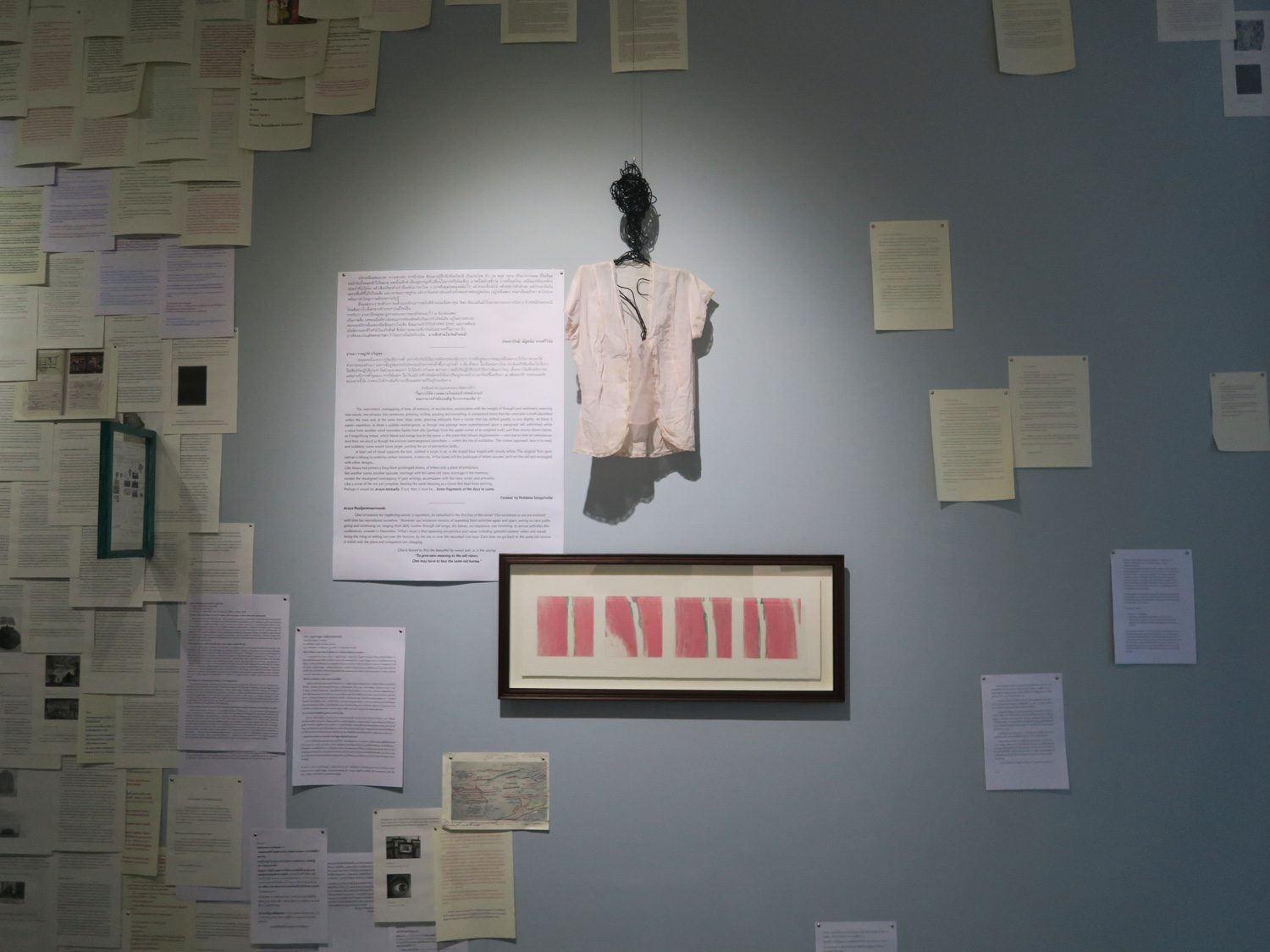
The exhibition room is enormous. Not like last time, when one had to wind one’s way in a little. But today, at 100 Tonson, there are so many words everywhere. Big ones, small ones, black ones, dark blue ones, light blue ones. I have never seen this many words before. Even the bitter gay tragedy from that famous publisher I just finished reading did not have this many words. Look at them. It looks as though the words are going to flood, swell, overflow, collapse, and crush me to death right here. Ugh. Just thinking about it makes it hard to breathe.
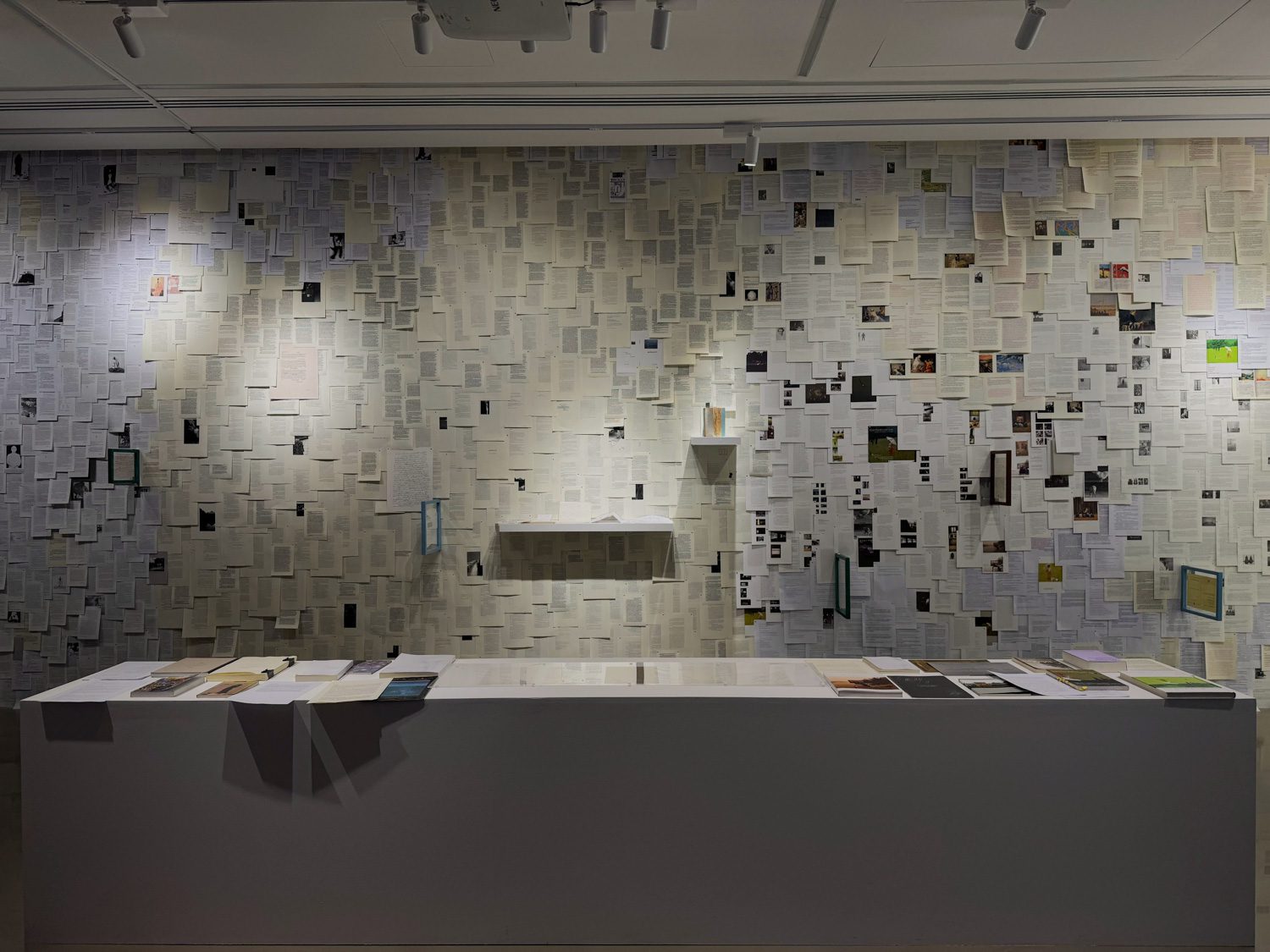
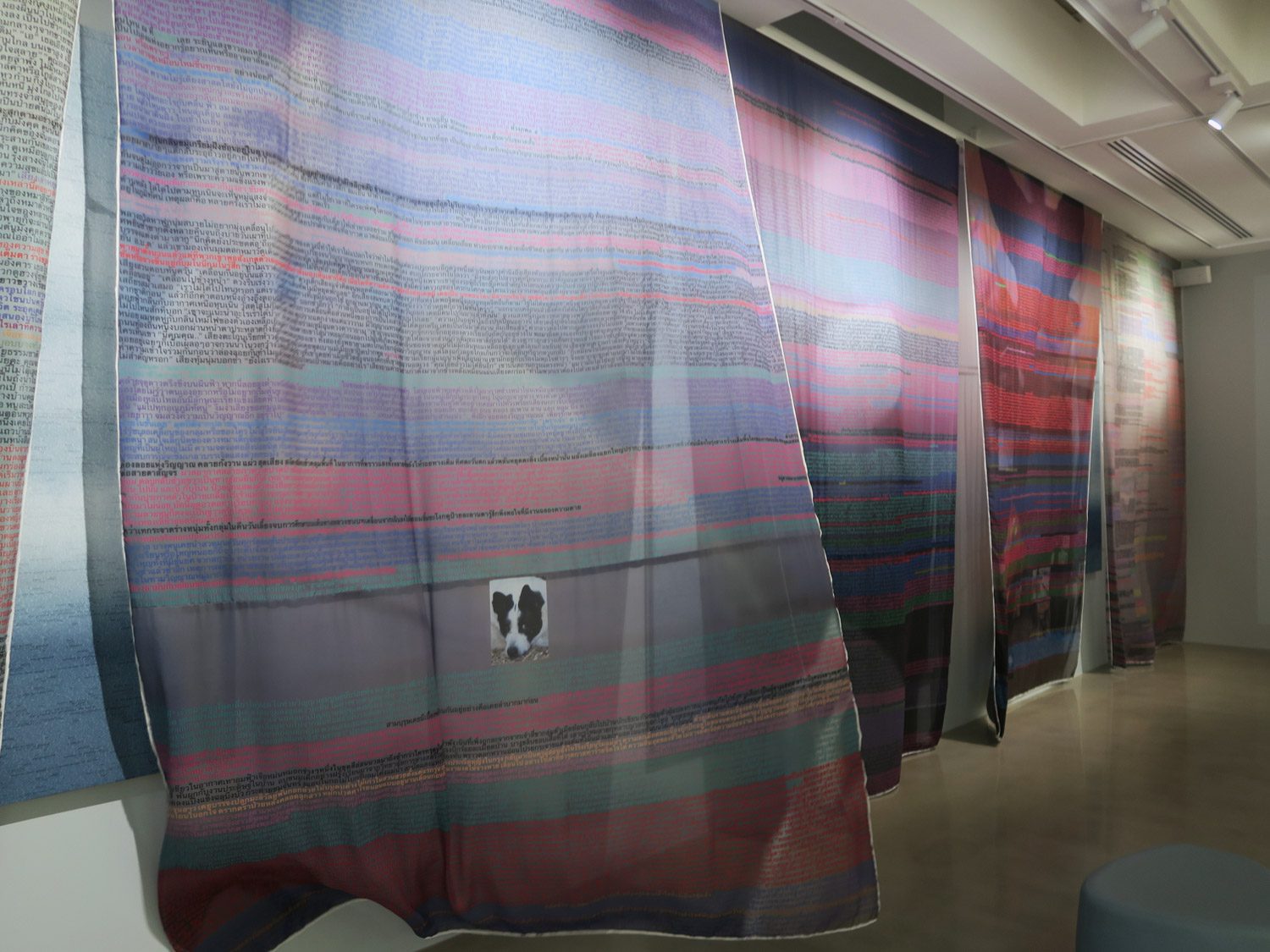
And then there are all those sheets of paper pasted on the walls. Where did they get the money to print all this? Or did they tear up actual books and paste them there like that? And over there, whatever that fabric is, it is fluttering so lightly. The fabric moves along with the hundreds of lines of multicolored text. Am I really supposed to finish reading all of this today?
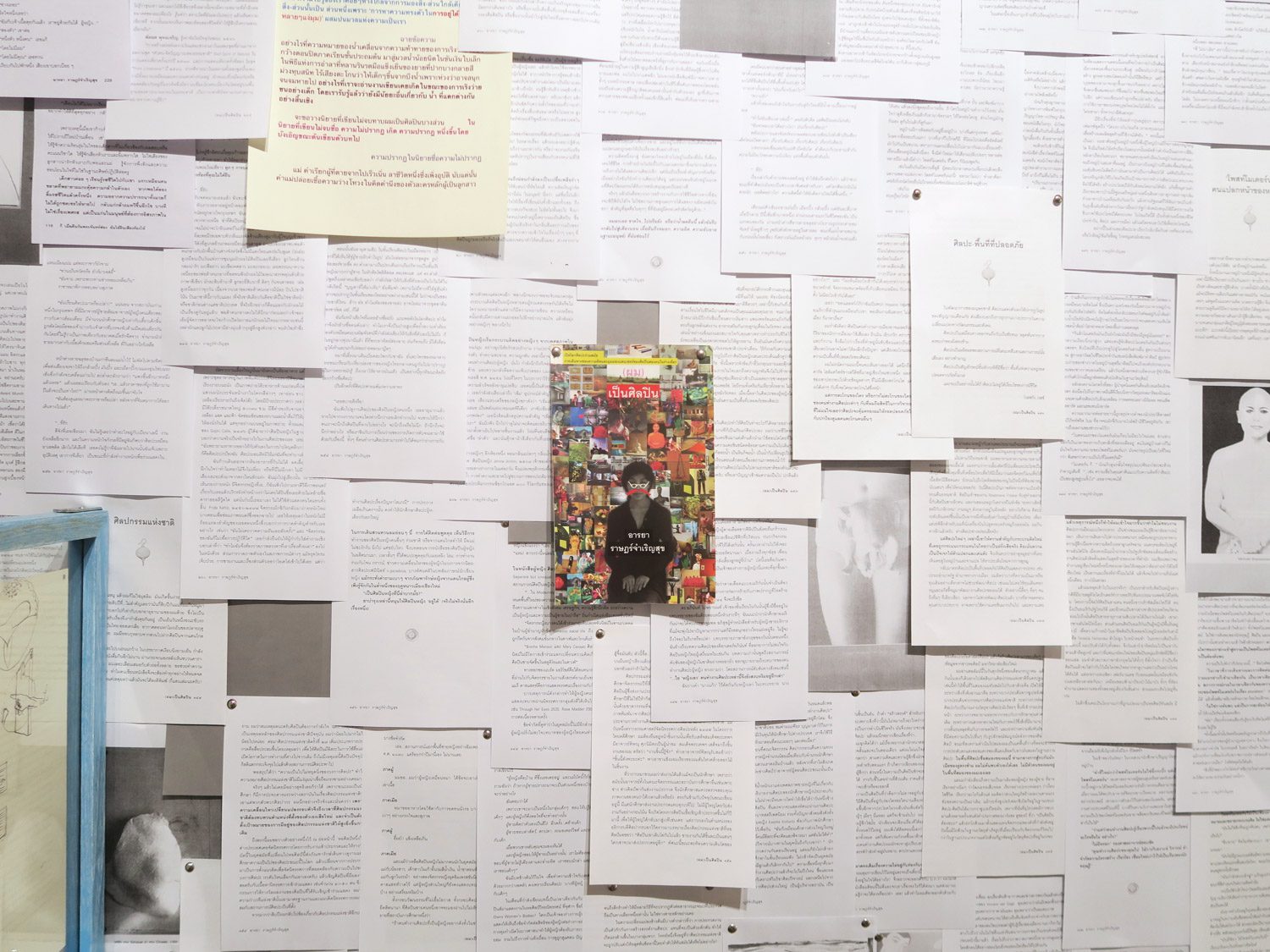
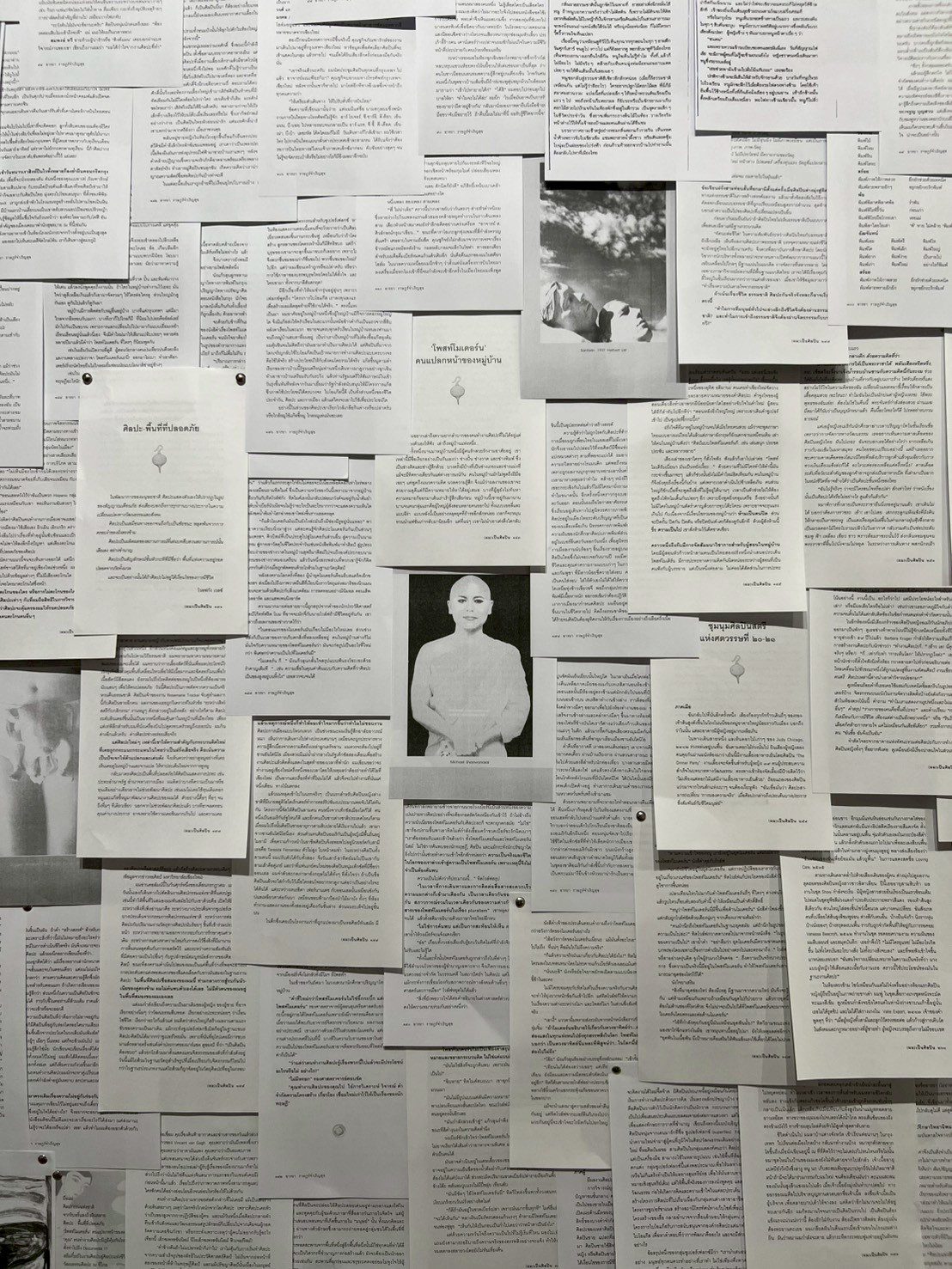
Photo: Sarunkorn Arthan
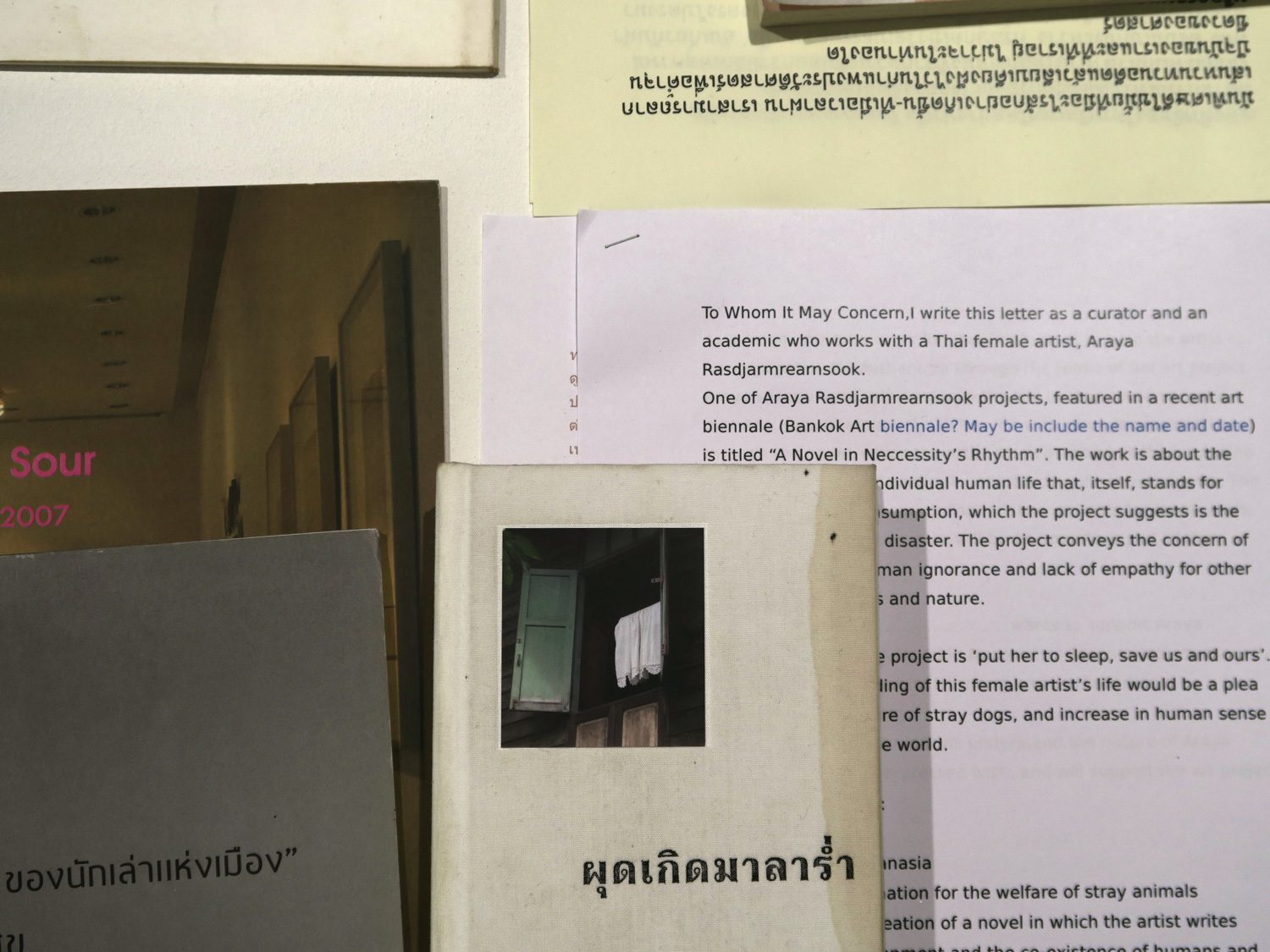
Oh! Is that the cover of I Am an Artist (He Said)? I think Maturity once tried reading it, but fell asleep almost immediately after a few pages. Who knows whether it was ever finished.
Wait… and who is that queer monk wearing such dark lipstick? I’m going to call the Buddha and report them.
Maturity (Interjecting)
I am reluctantly compelled, out of necessity, to cut right through the middle of this. Youth, after all, is always wide-eyed, easily excited by one thing after another, all surface and no substance.
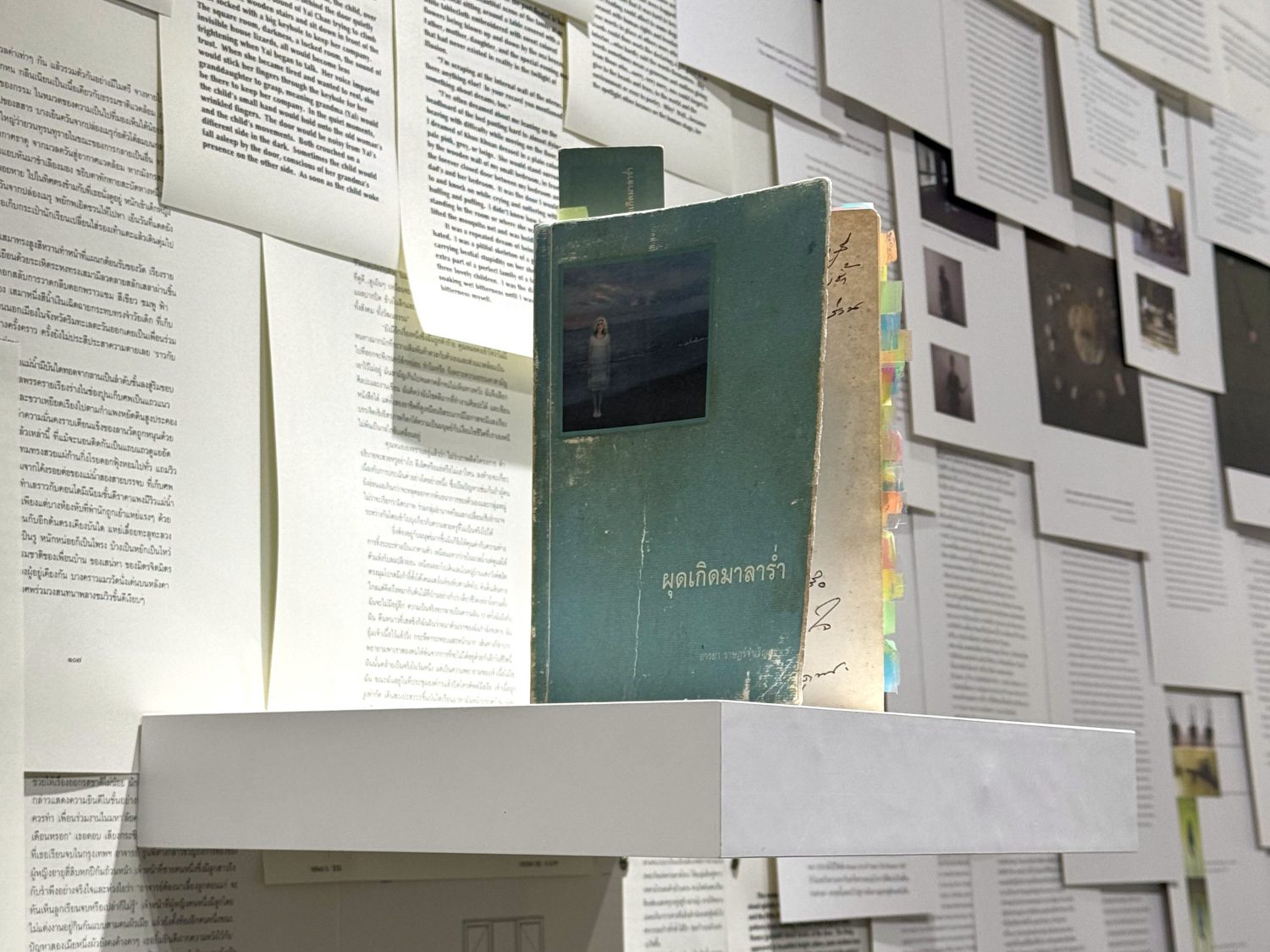
It would not be wrong to say that this exhibition reflects the curator’s view of Araya. He must have read Pood Kerd Ma La Rum while studying art history five or six years ago, and has since become as well-versed in ‘reading Araya’ as in ‘writing Araya.’ How do I know this, you ask? Perhaps because I know him from the same university, from which I myself graduated several years ago. (Come on, even if I am off by a little, surely that is fine, since I, too, am no stranger to the art of making things up as I go.)
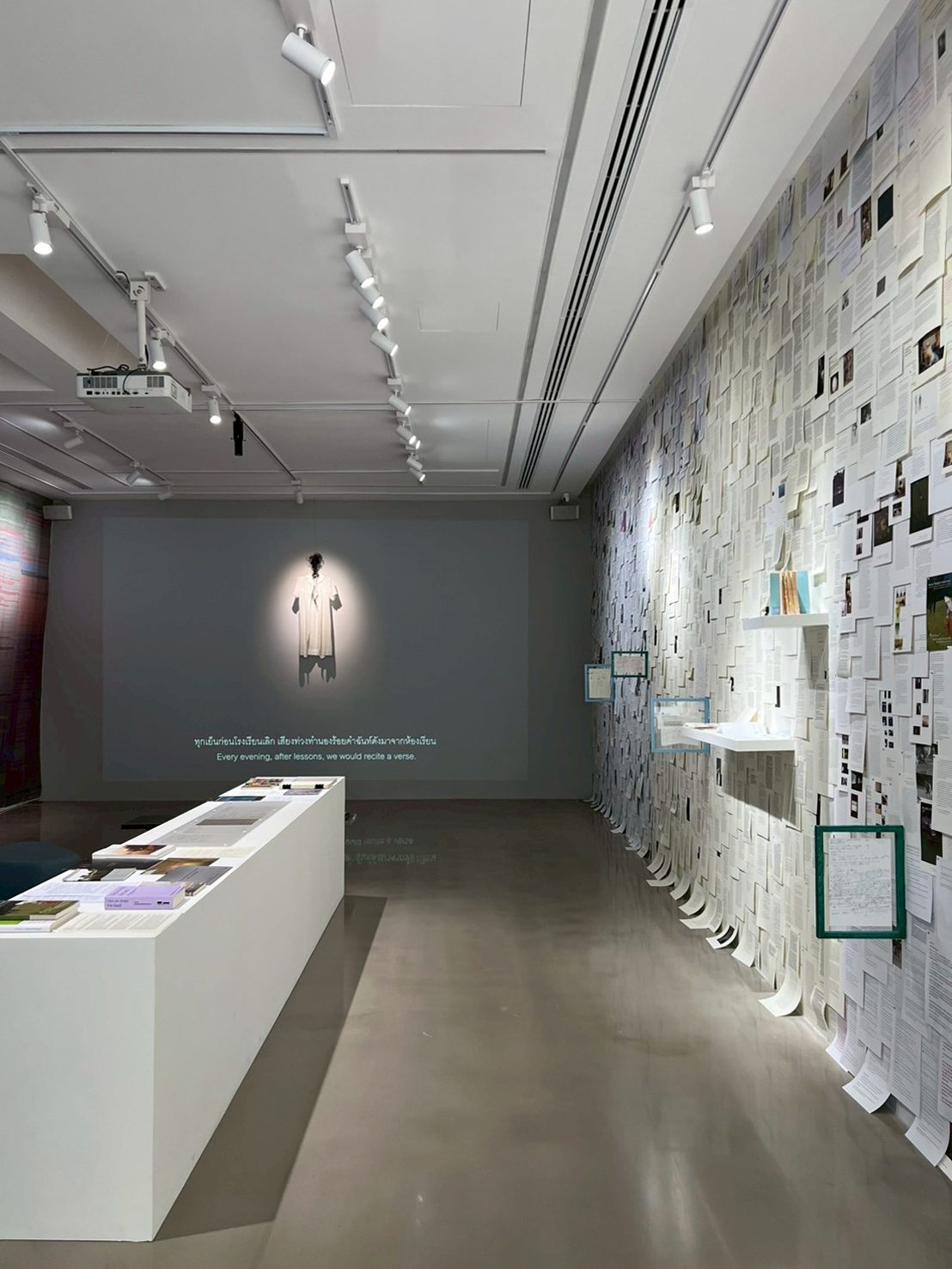
Photo: Sarunkorn Arthan
On the opening day of the exhibition, I rode there with Youth, racing from Thon Buri to Ploen Chit in half an hour. When we arrived and entered the exhibition room, there was no reception, no crowd, and most importantly, no Araya. I immediately sensed something strange, very strange indeed. Although it was not unpleasant. The space was quiet, calm, and perfectly suited to karma, a chance to gather myself and read the hundreds, thousands of words. (Just as that Youth had described.)
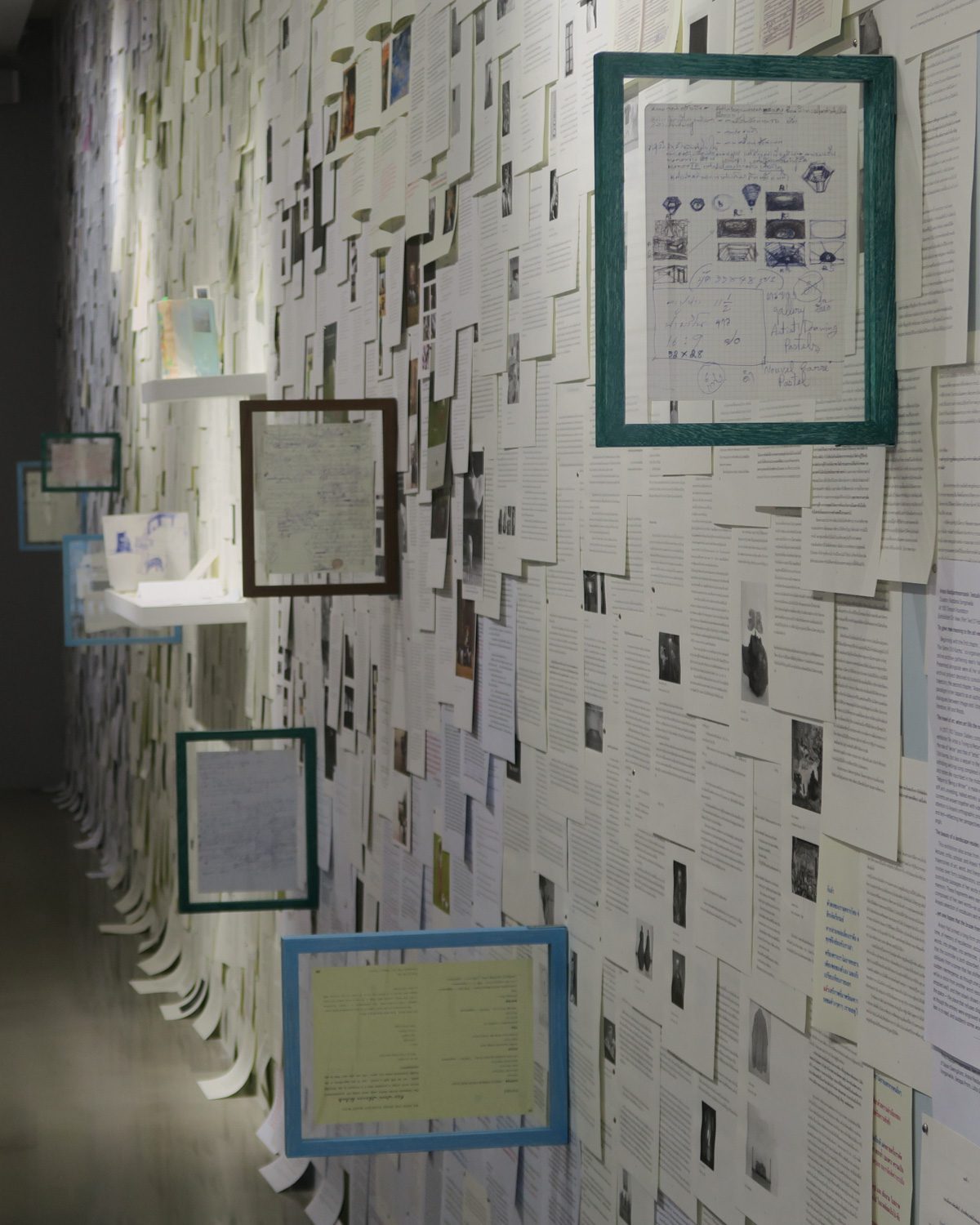
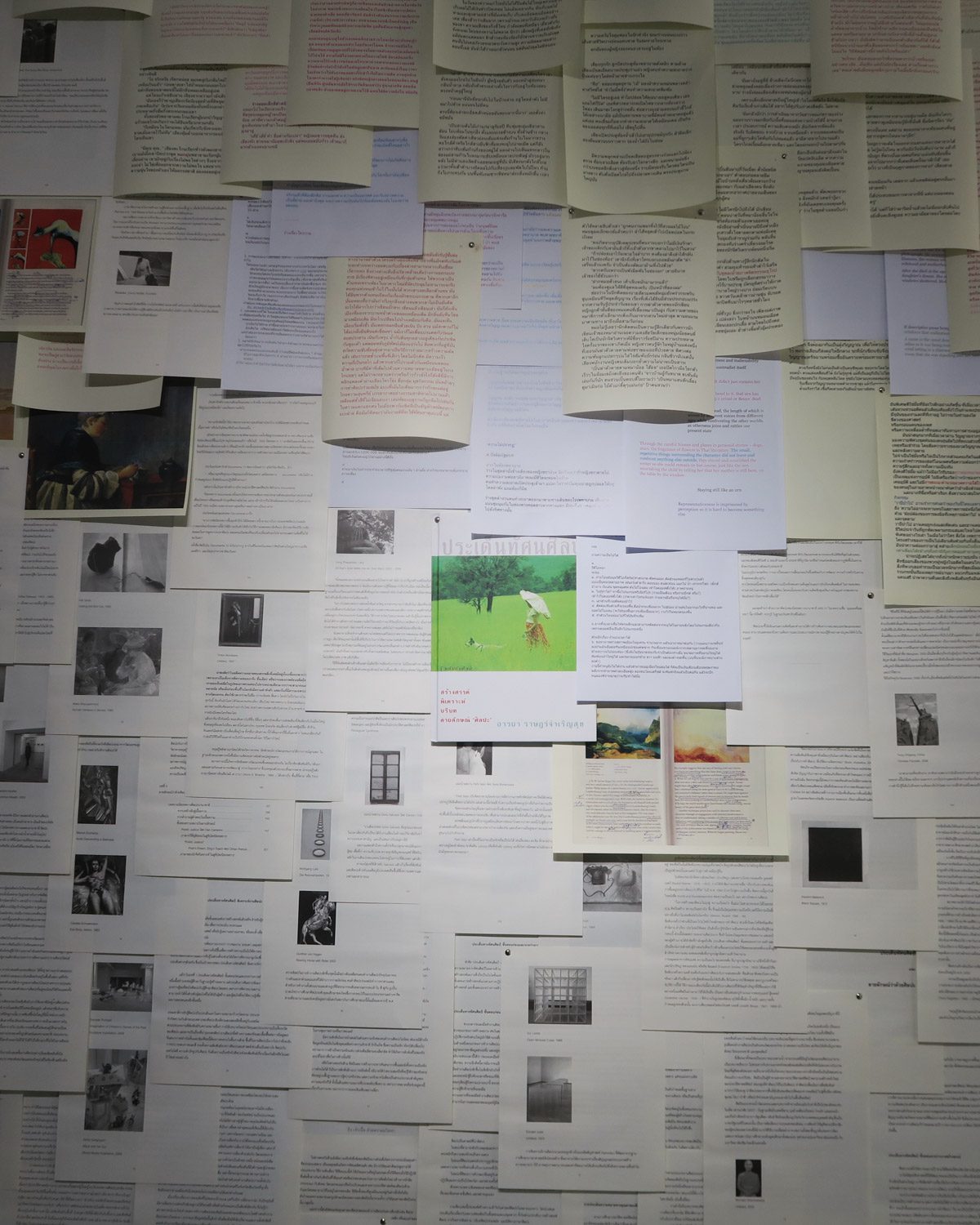
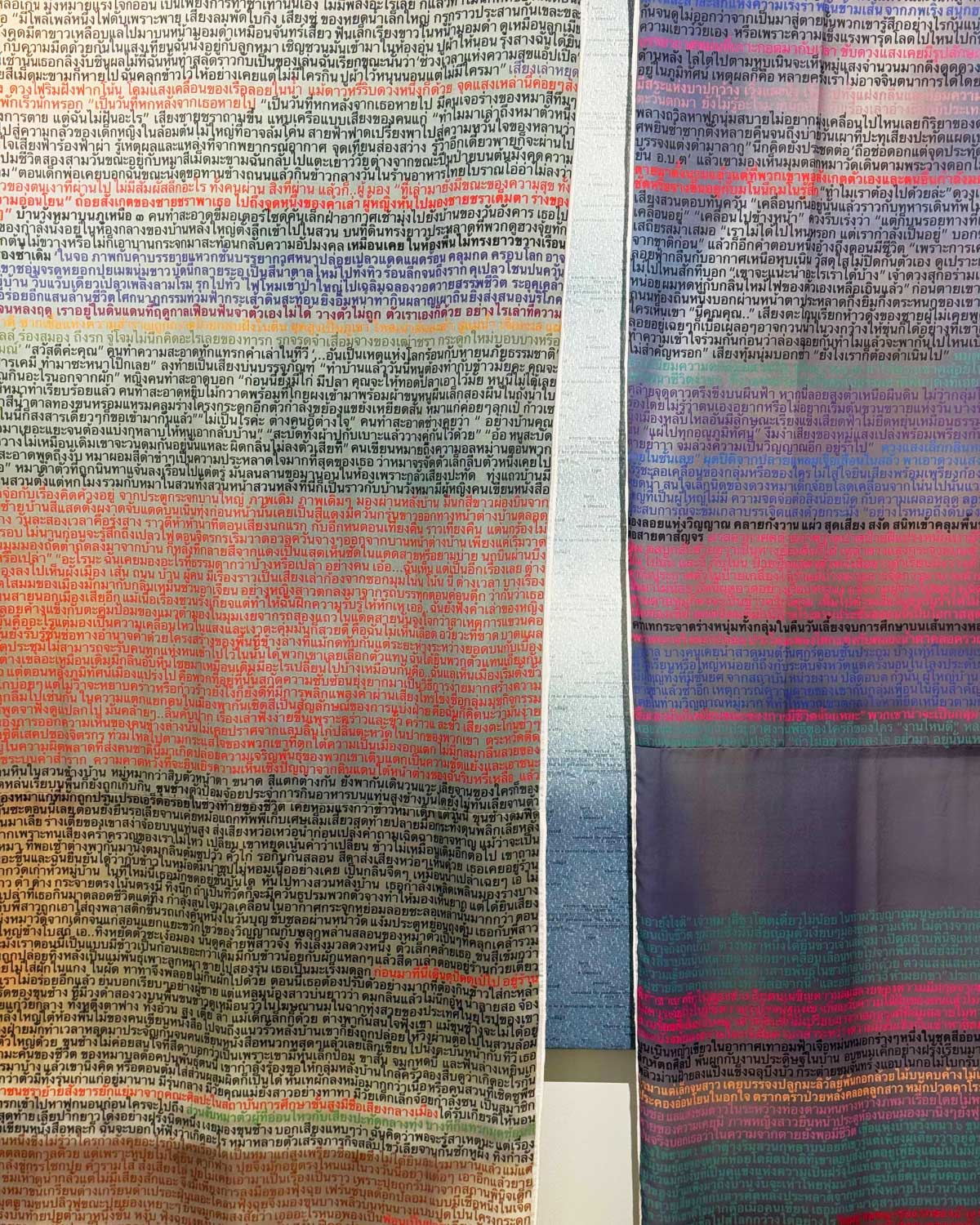
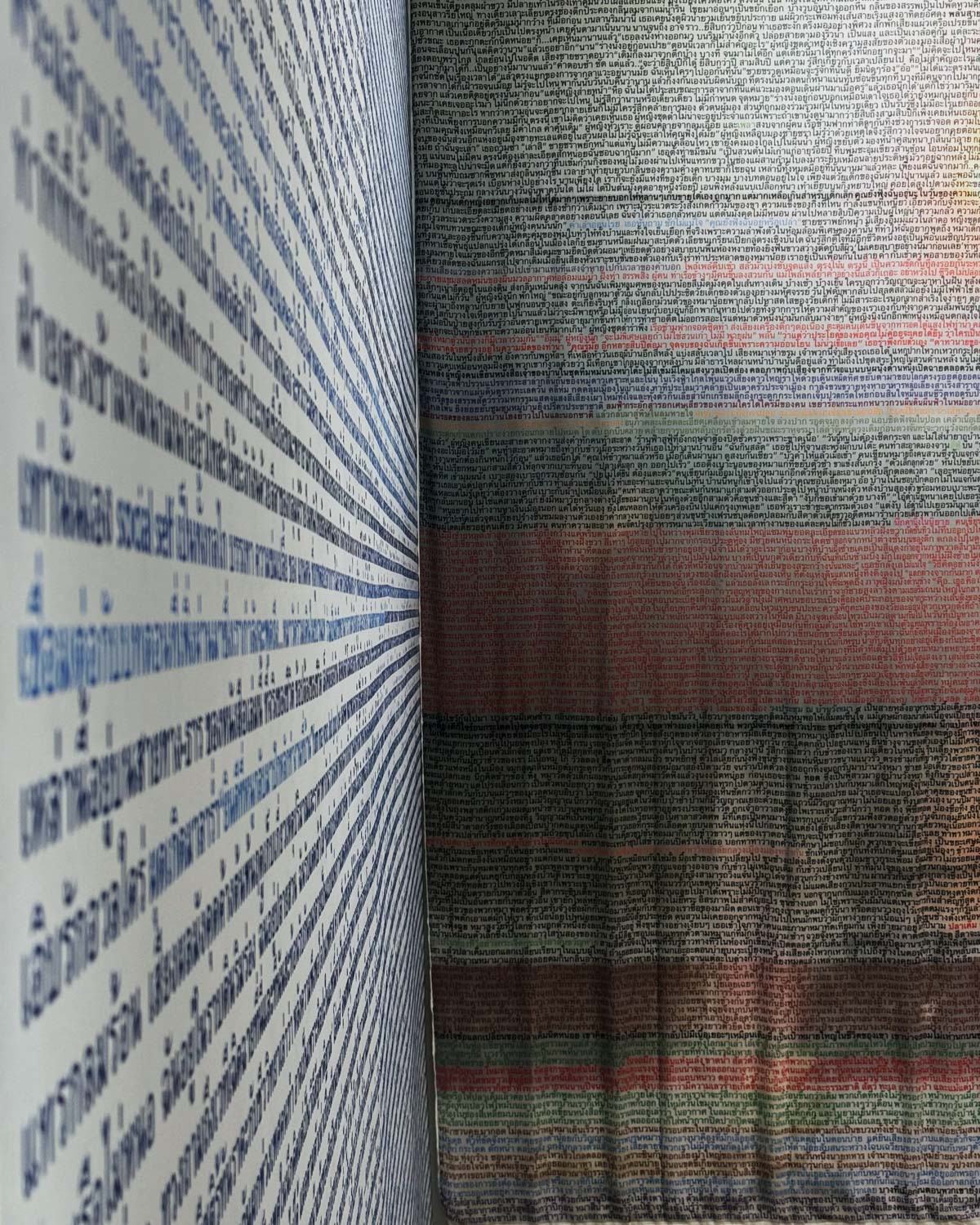
At first glance, I could not quite make sense of it. But after several more glances, I began to understand that the exhibition had likely been composed from all of Araya’s writings. In conversation with Earth, my senior and the exhibition’s curator, I learned that this was indeed the case. He had intentionally brought together her writings, from the academic texts Araya submitted to apply for her academic position to the literary works that first made her want to become a writer. (or perhaps the writings that first inspired her to write literature.) Even her unfinished novel, The Non Appearance, has been made to ‘appear’ here.
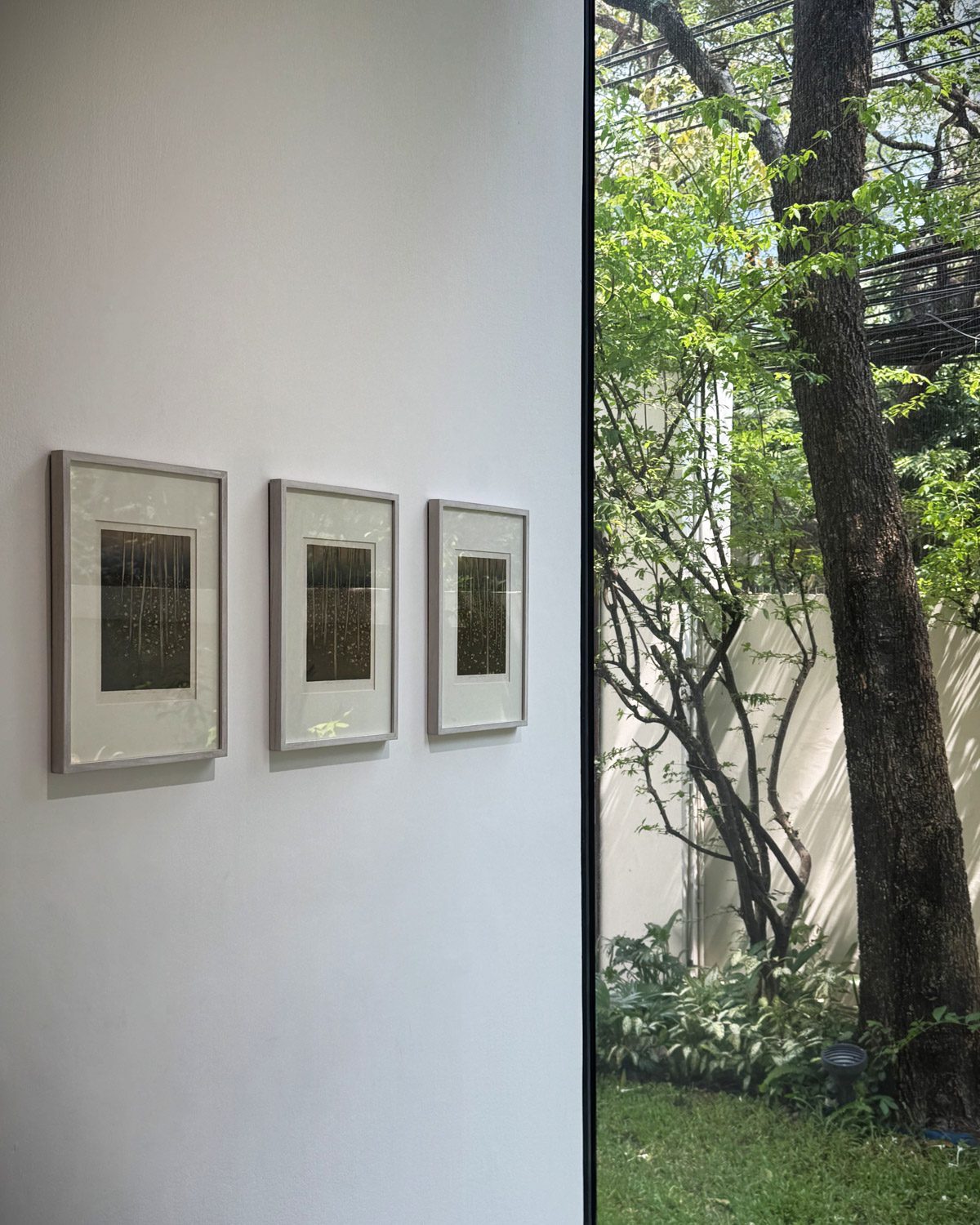
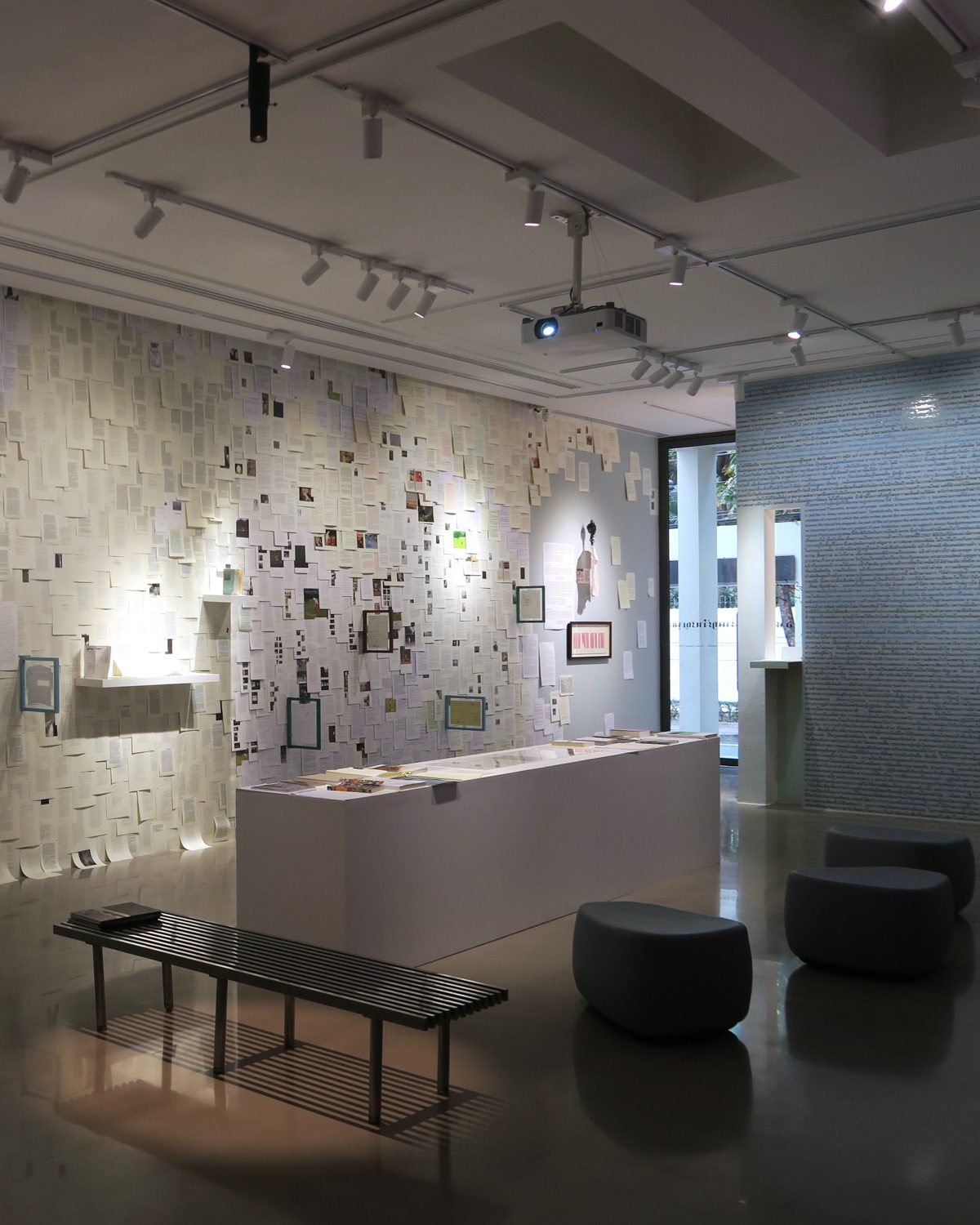
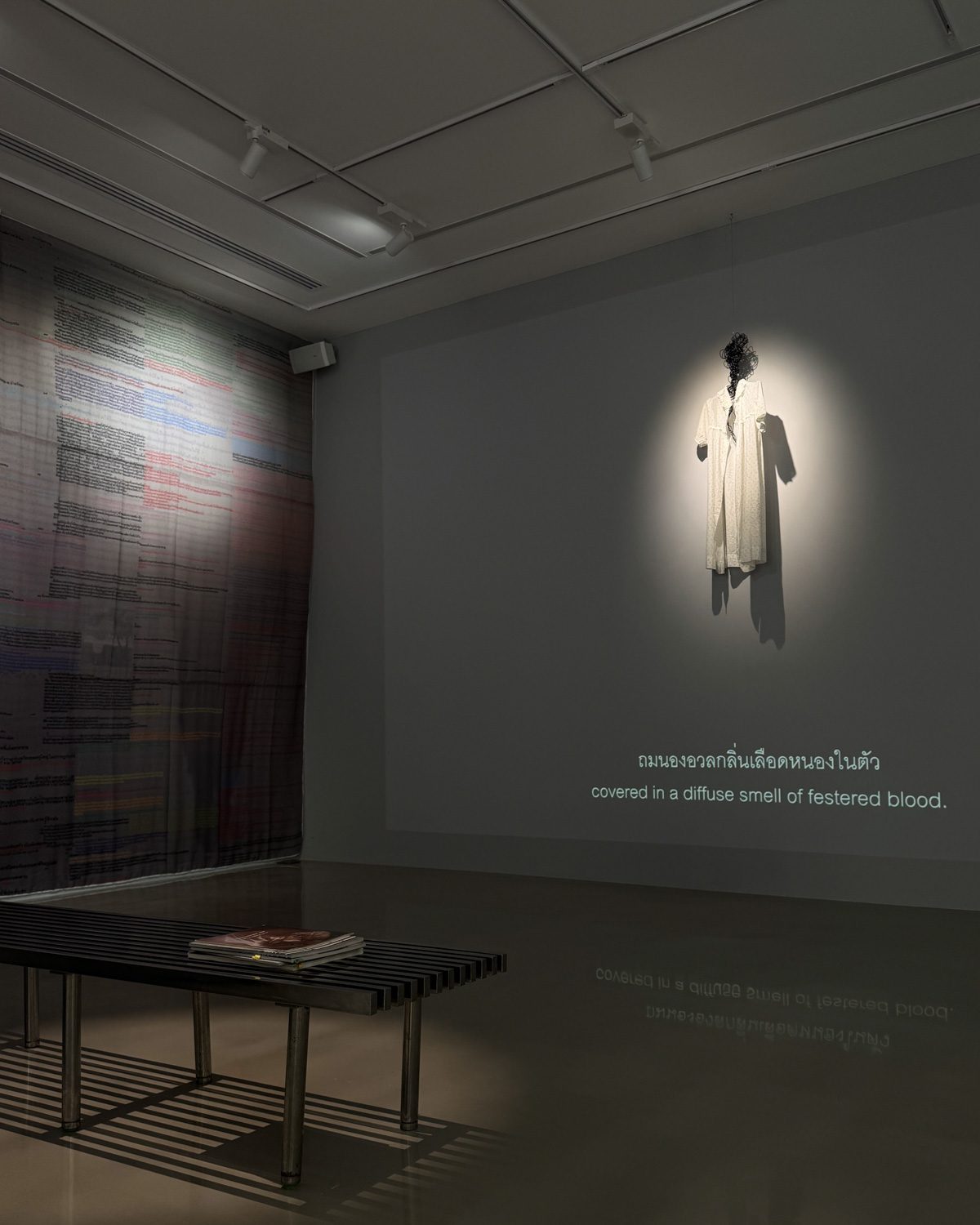
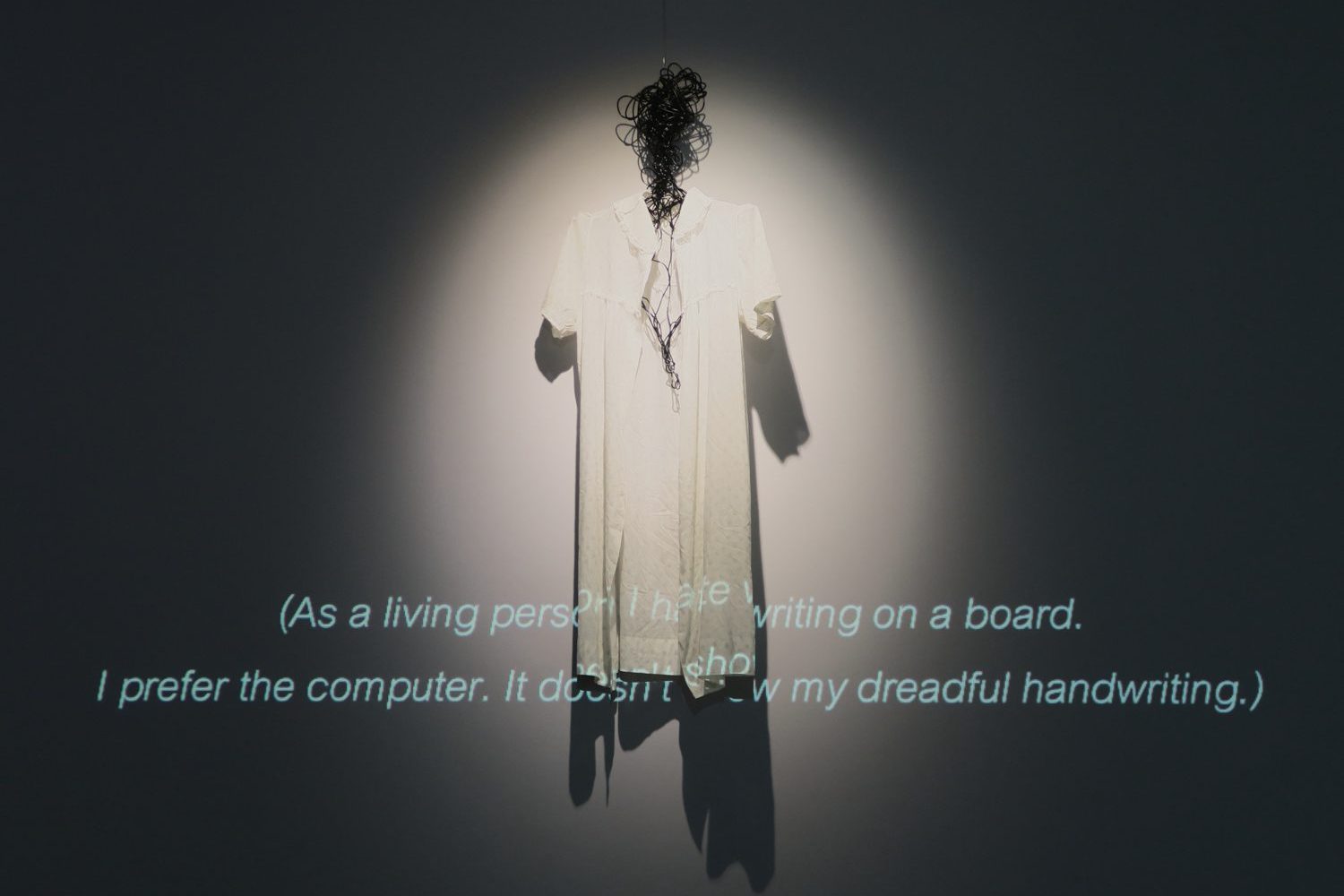
Although I certainly do not know or read Araya’s work more deeply than anyone else. (since I have really only read the one book.) And although I may still not yet be able to ‘read Araya’ deeply enough, or ‘write Araya’ with anything beyond a passable fluency, the space opened up by this exhibition still welcomes people like me, and those who have never read even a single word of her work. It invites us to use our hearts to observe Araya’s mind and sensibilities, to read with our ears the sound of subtitles from imageless video screens, to taste with our eyes the letters stained with ink and pigment on the artworks placed throughout the exhibition room. It allows me, the young, the ignorant, the astonished, to read Araya, to absorb death (a good kind of death), if only for a while.
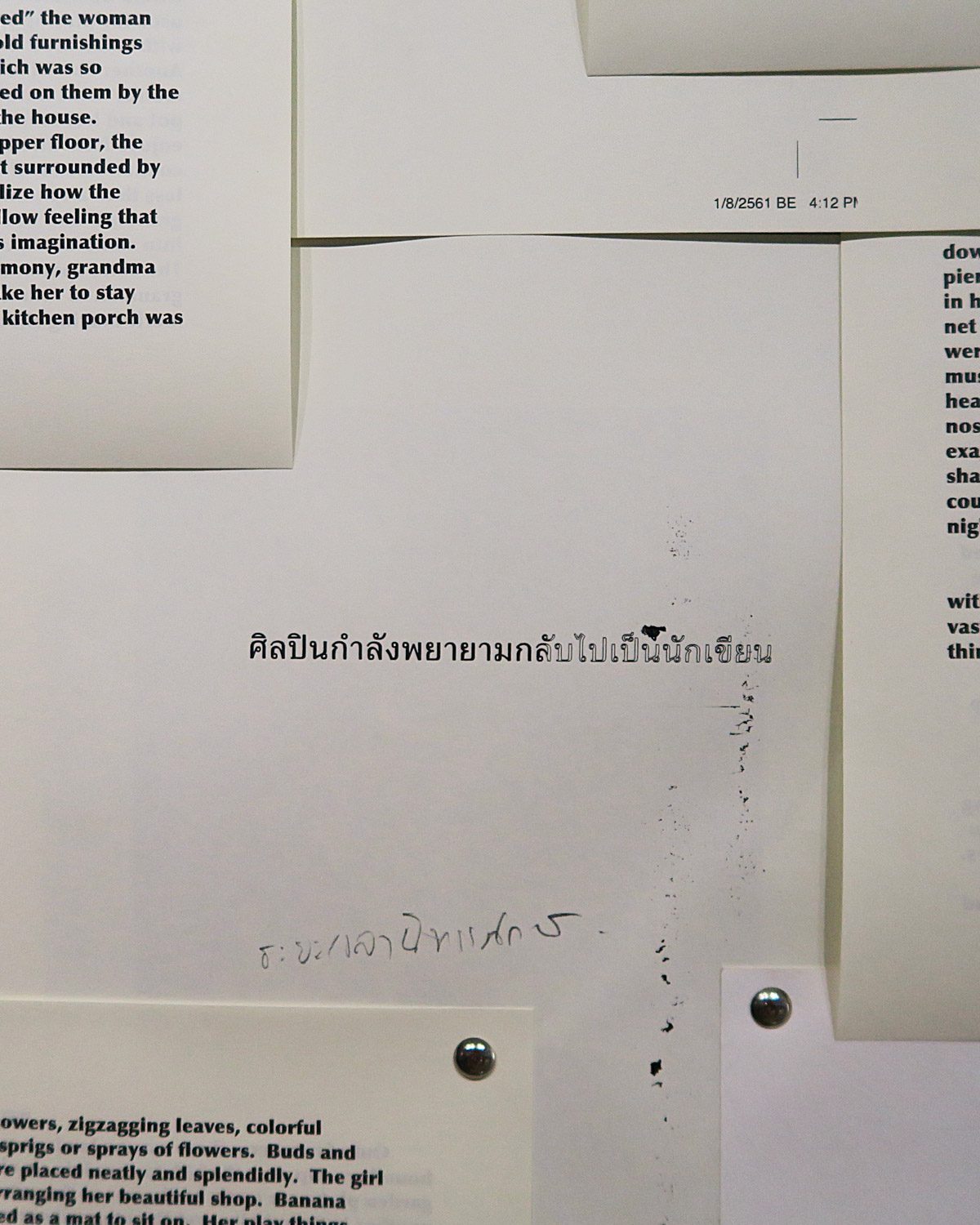
I have always thought of myself as a sponge. Not SpongeBob SquarePants, but a dishwashing sponge. Partly because I like washing dishes, but also because a sponge absorbs many things into its body, lets them soak into its flesh, flush across its skin, holds certain things in while releasing many others. In the end, I may simply be myself. I may still have Youth lodged somewhere in my nature. Or perhaps I am a writer. Perhaps I am imitating Araya. But in the end, I may be nothing at all, not even someone capable of holding a coherent thought about anything, at a moment when the world is entering a state of brain death induced by artificial intelligence. It turns out that, for a stretch of time, I stopped remembering, stopped being conscious of myself, and had drifted into becoming some unnamed kind of ‘-ist.’
Youth (Nudging)
Oh! There it is. I completely forgot. After everything I have written, I still do not know who, in the end, is actually the writer: I, the other I, you, AI, or Araya. I am starting to get confused. Let me go back and read it all again. Perhaps one day I will have an answer, we may yet become ‘something, sometime in the future.’
Araya Rasdjarmrearnsook: Textually is on view at 100 Tonson Foundation from February 21 to May 30, 2026.