
ENCOUNTER THE SCENE OF ‘DUST,’ THE BORDERLESS SLOW-MOTION COLLAPSE, THROUGH THE ‘BLUEPRINT OF THE APOCALYPSE’ BY KHAN NATHI, WHO CAPTURES A PART OF THE DUST IN THE AIR AND TRANSFORMS IT INTO ART
TEXT: KANDECH DEELEE
PHOTO: PREECHA PATTARA EXCEPT AS NOTED
(For Thai, press here)
Amid an increasingly volatile border crisis, structural tensions have spilled outward into violence across the horizontal plane. Invisible lines have asserted their reality through damage felt with painful immediacy. A dissonance of words has become a fuse, ignited again and again across the territory of both states. Yet on the other side of the border, another matter remains unresolved, chronic, and impossible to settle. It is not something that can be subdued through the same old forms of violence, nor something that can be disciplined into submission. It is something that begins in the mountain ranges before pressing into the heart of the city, something whose burden of responsibility cannot be swept beneath the ‘rug’ or displaced into any far-off ‘territory.’ It is something that underscores the need for cooperation in confronting what seems beyond control, unless we begin, first of all, by understanding it.
It is the matter of ‘dust.’
It is not that the problem of dust has never been discussed, nor that the media has ignored it. On the contrary, dust returns again and again, like a seasonal headline waiting for its appointed time to resurface. The unfamiliar numerical language of particulate measurements has, by now, entered common speech, reappearing on cue with each passing cycle of the year. In the end, it has become something people are expected to endure and adapt to. Each attempt to trace its causes only leads to dispersal. The lineages of dust that we try to grasp scatter according to its own micron-scale properties, everywhere, and yet are impossible to see.
Blueprint of the Apocalypse by Khan Nathi, or Kan Nathiwutthikun, begins with the attempt to reveal ‘dust’ as a condition of slow-moving collapse. The inability to confront the ‘contemporary climate crisis’ over the past several years has brought the image of doomsday ever closer. The apocalypse invoked in the title is therefore not merely the possibility of an end-of-the-world landscape that ‘may’ one day arrive, but a landscape of collapse that ‘is’ already unfolding.
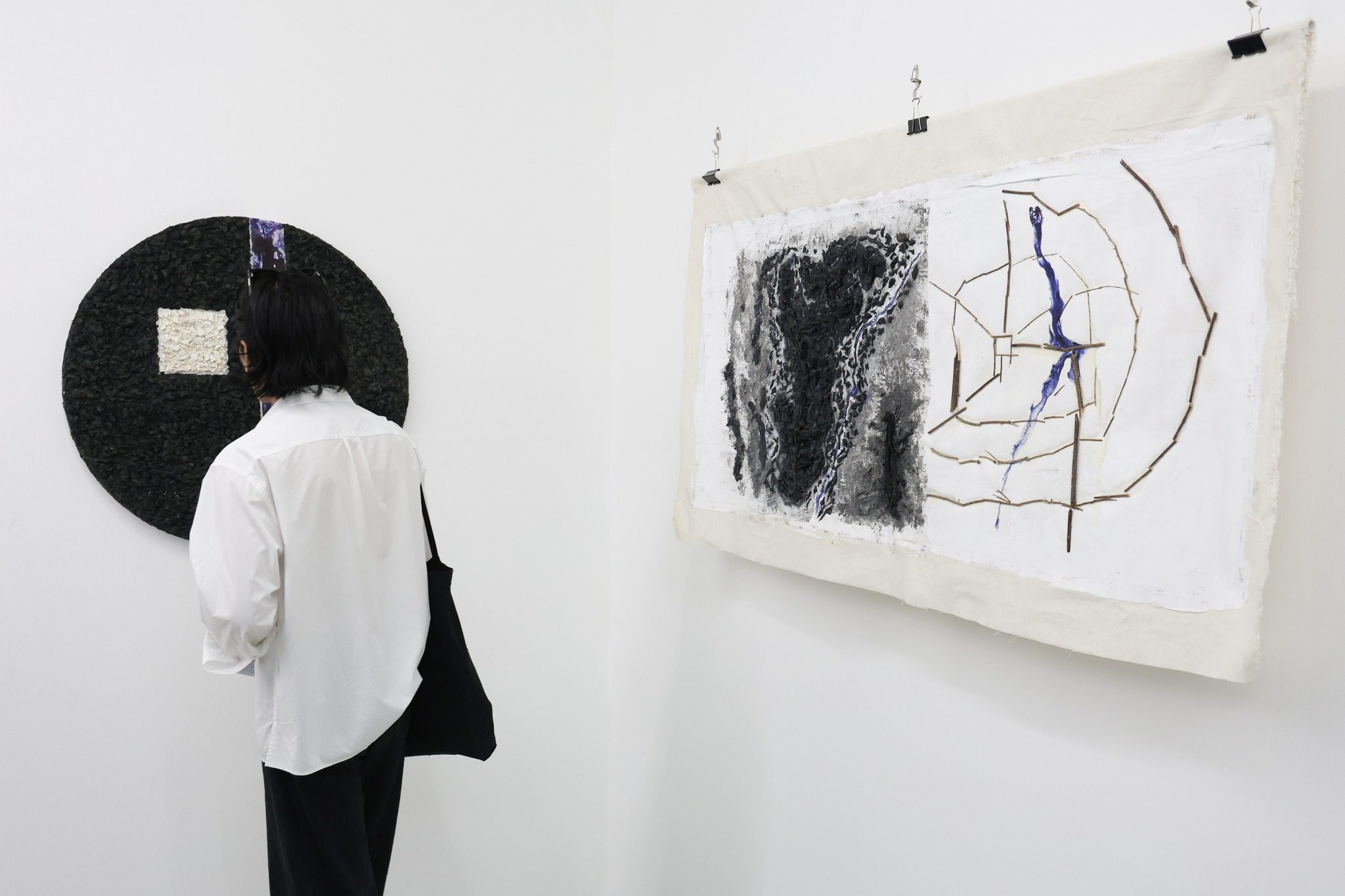
Photo: Vinai Dithajohn
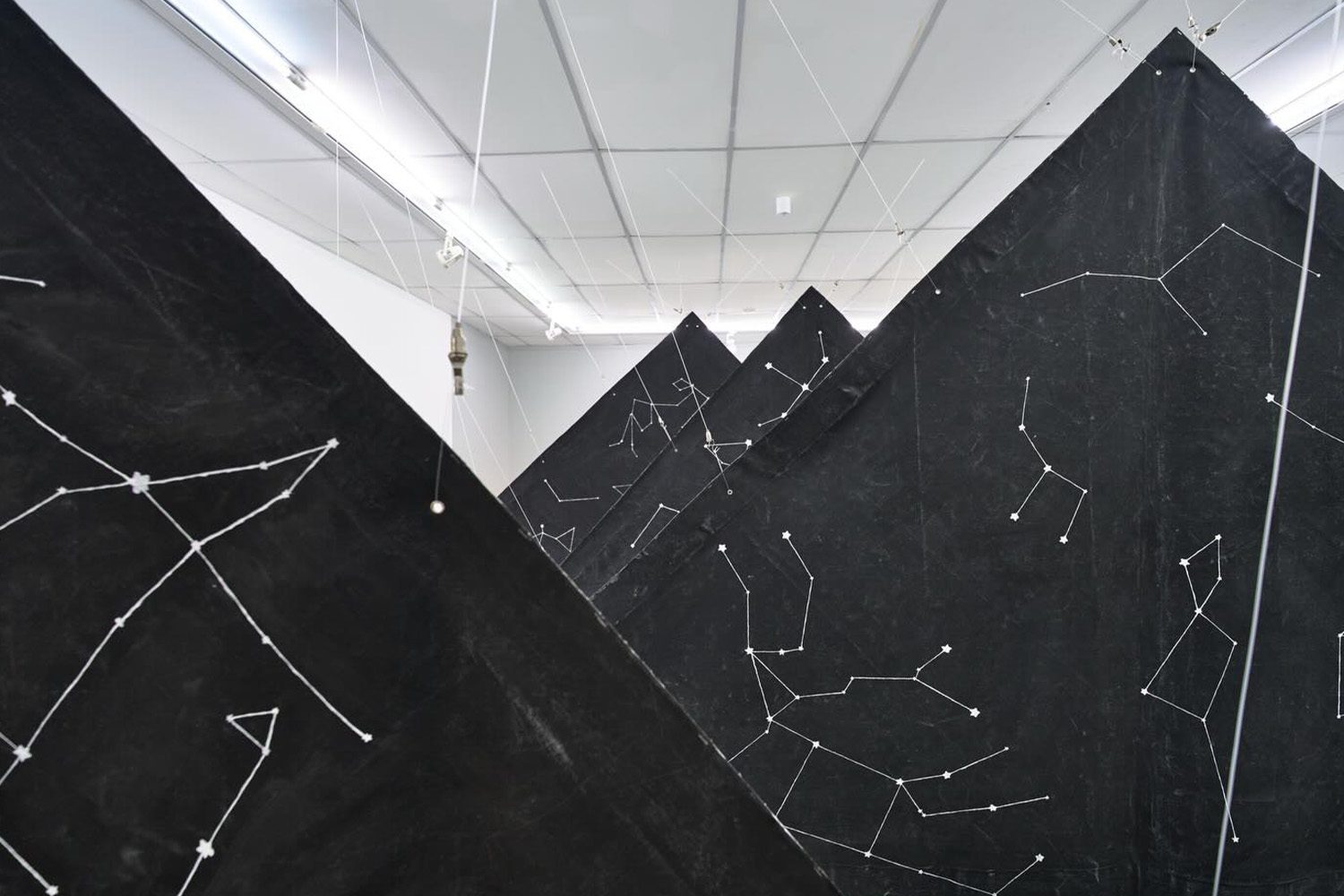
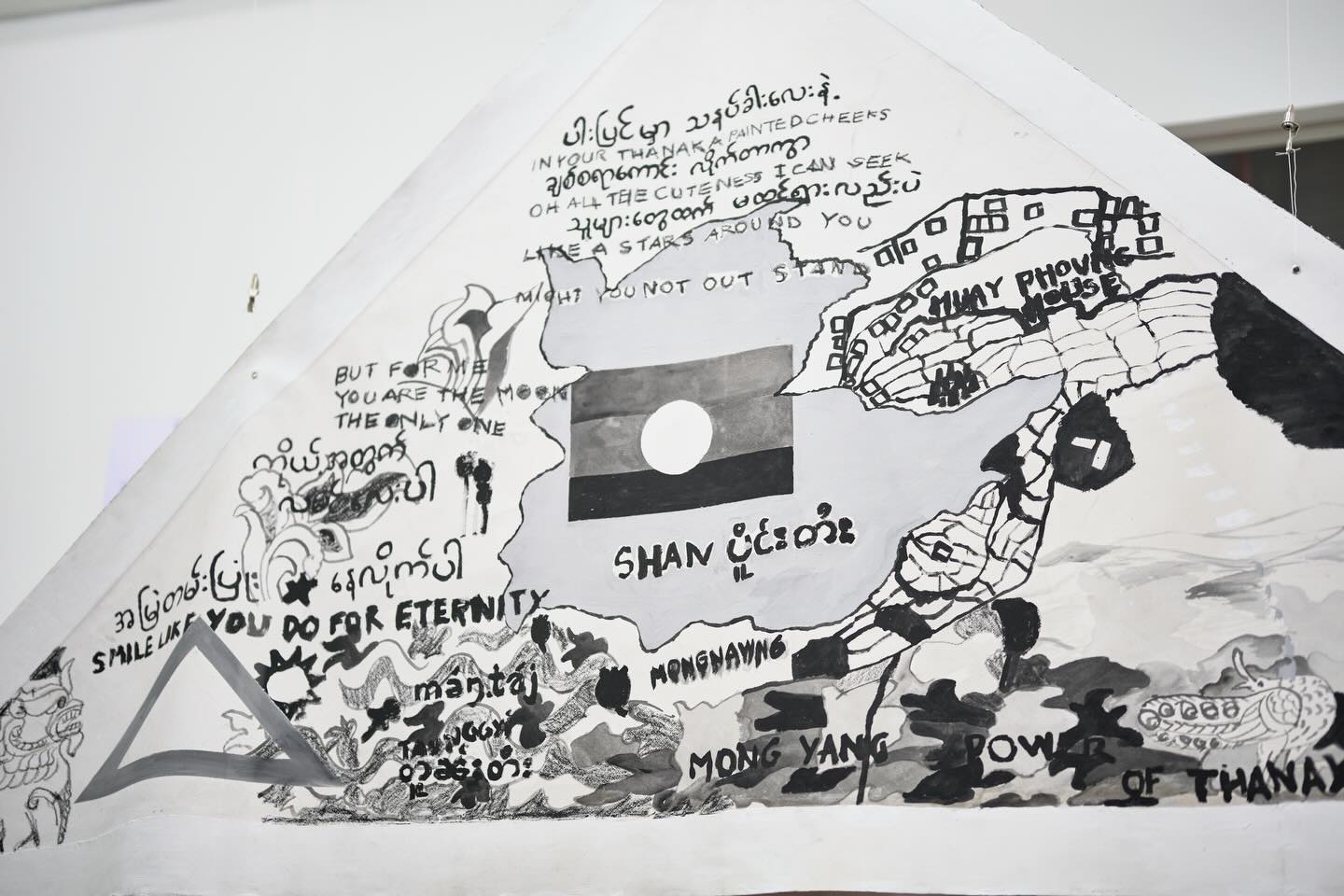
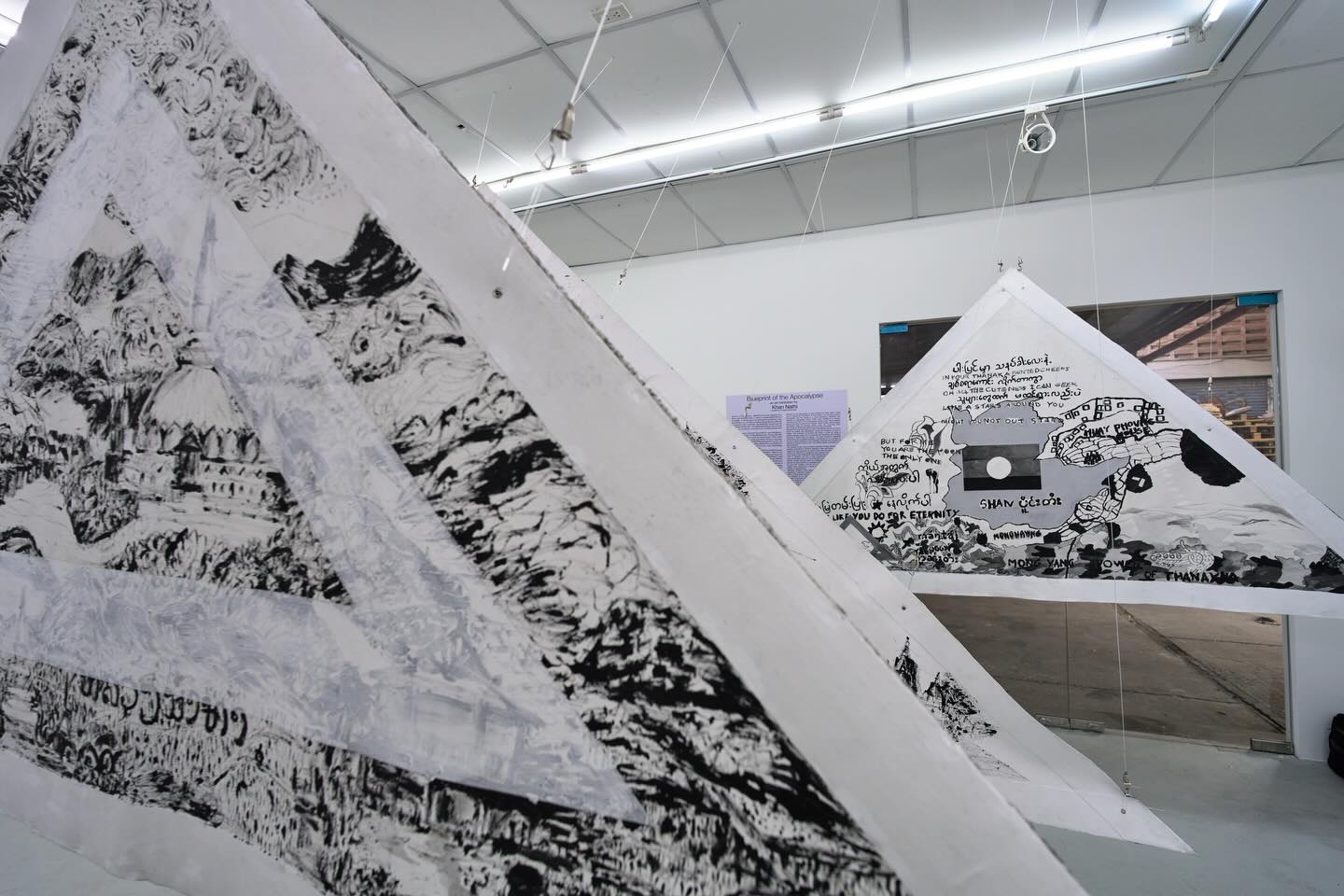
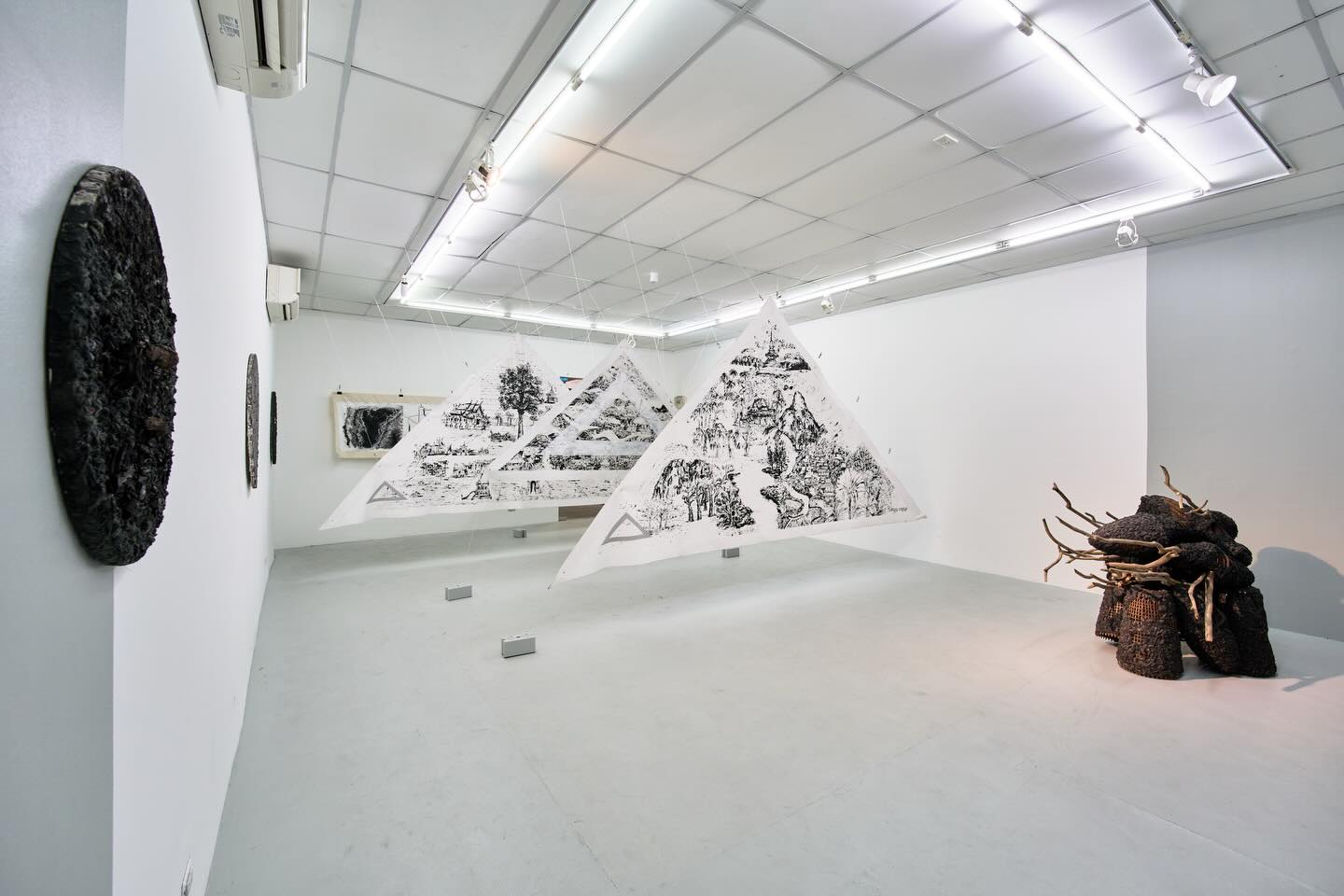
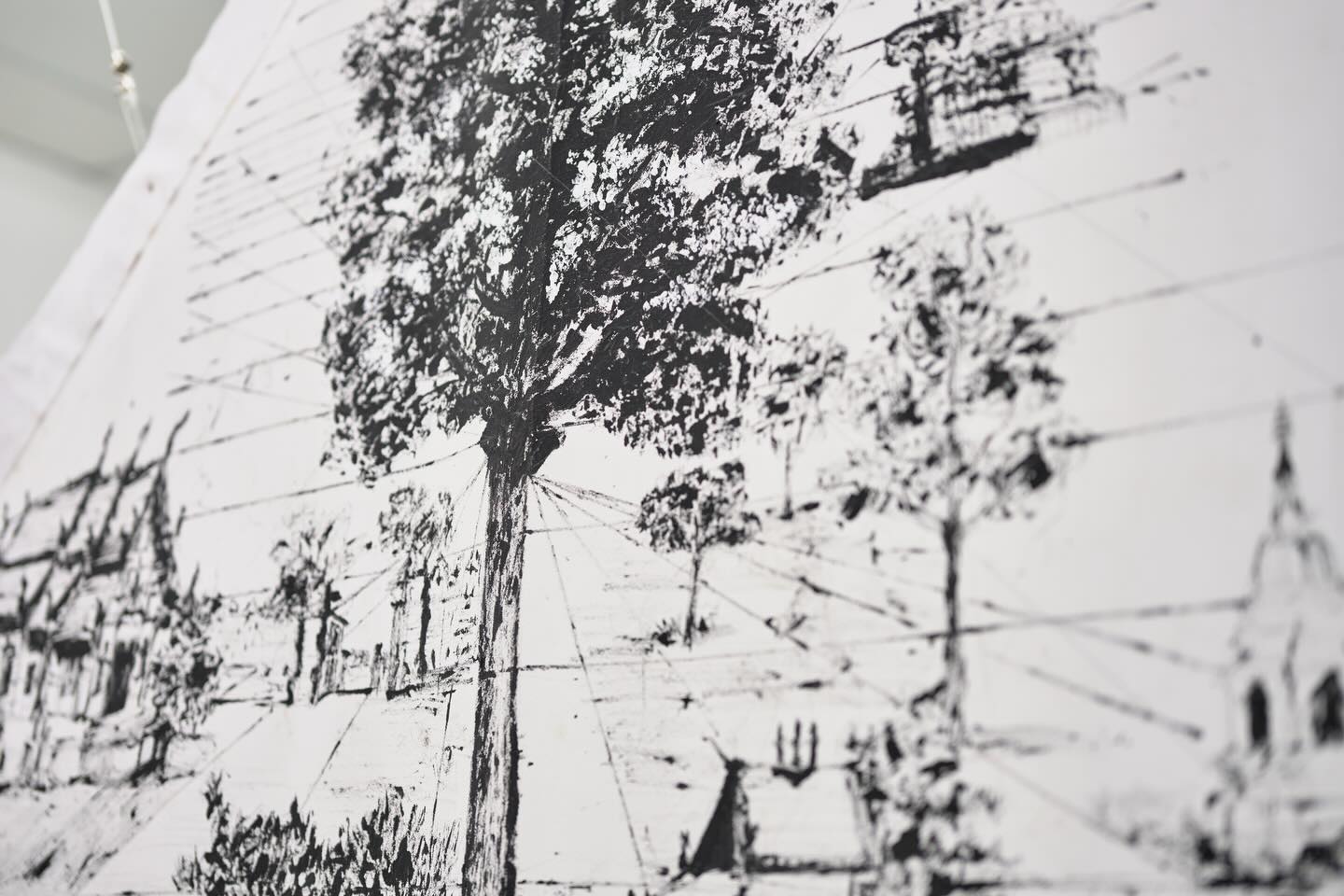
The first thing one sees, and cannot help but see, is a set of four triangular canvases stretched across the gallery. In their shape and overlapping arrangement, they conjure an imagined topography, superimposed on the long sweep of mountain ranges from the Tenasserim Range to the Phi Pan Nam Range, territories often cited as the source of the dust and, at the same time, among the places hardest hit by it. The installation forces the exhibition route into a winding path, dissolving the distance between viewer and work until the two seem to merge. One is drawn into the embrace of the valleys, a terrain where veils of mist are being replaced by plumes of smoke.
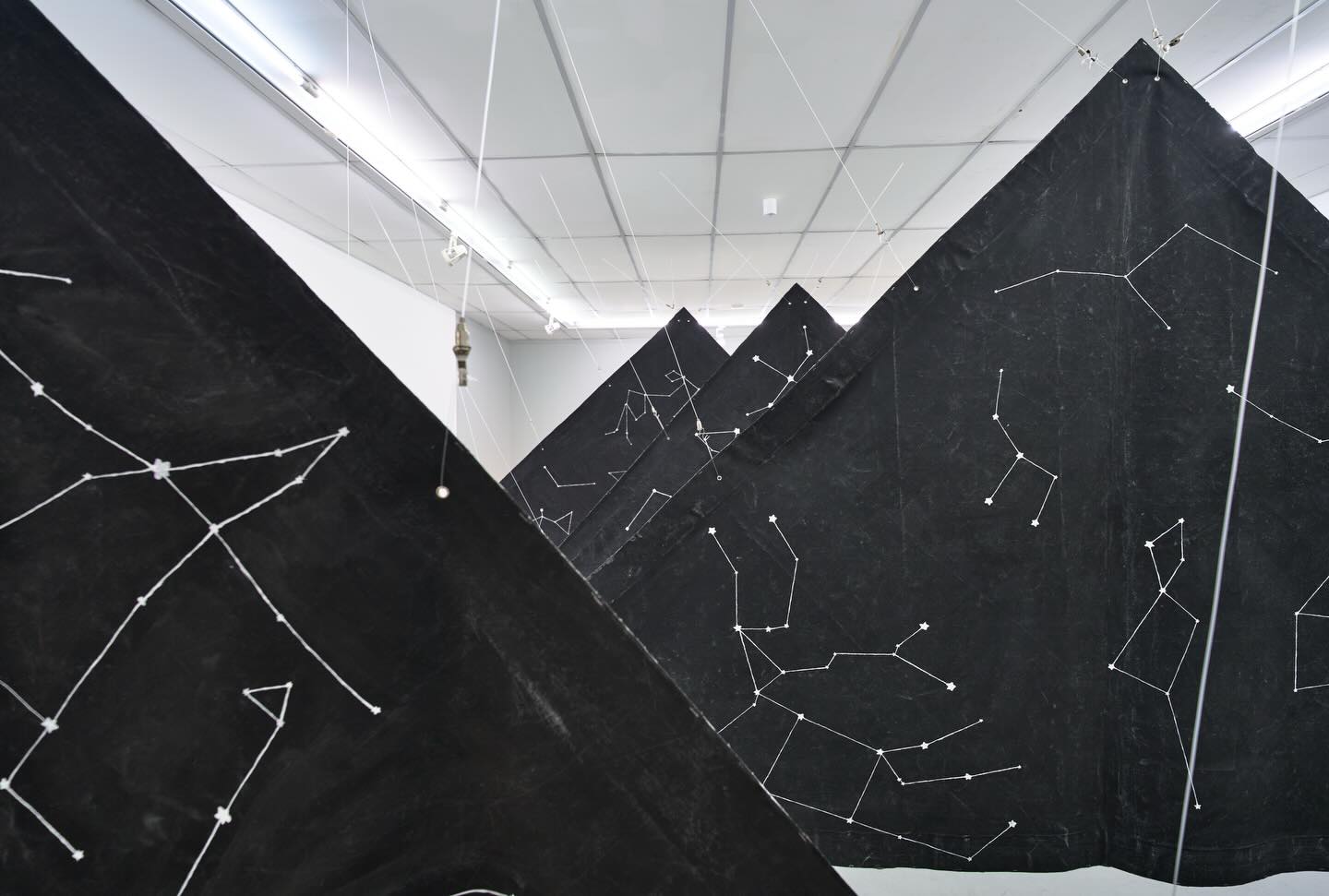
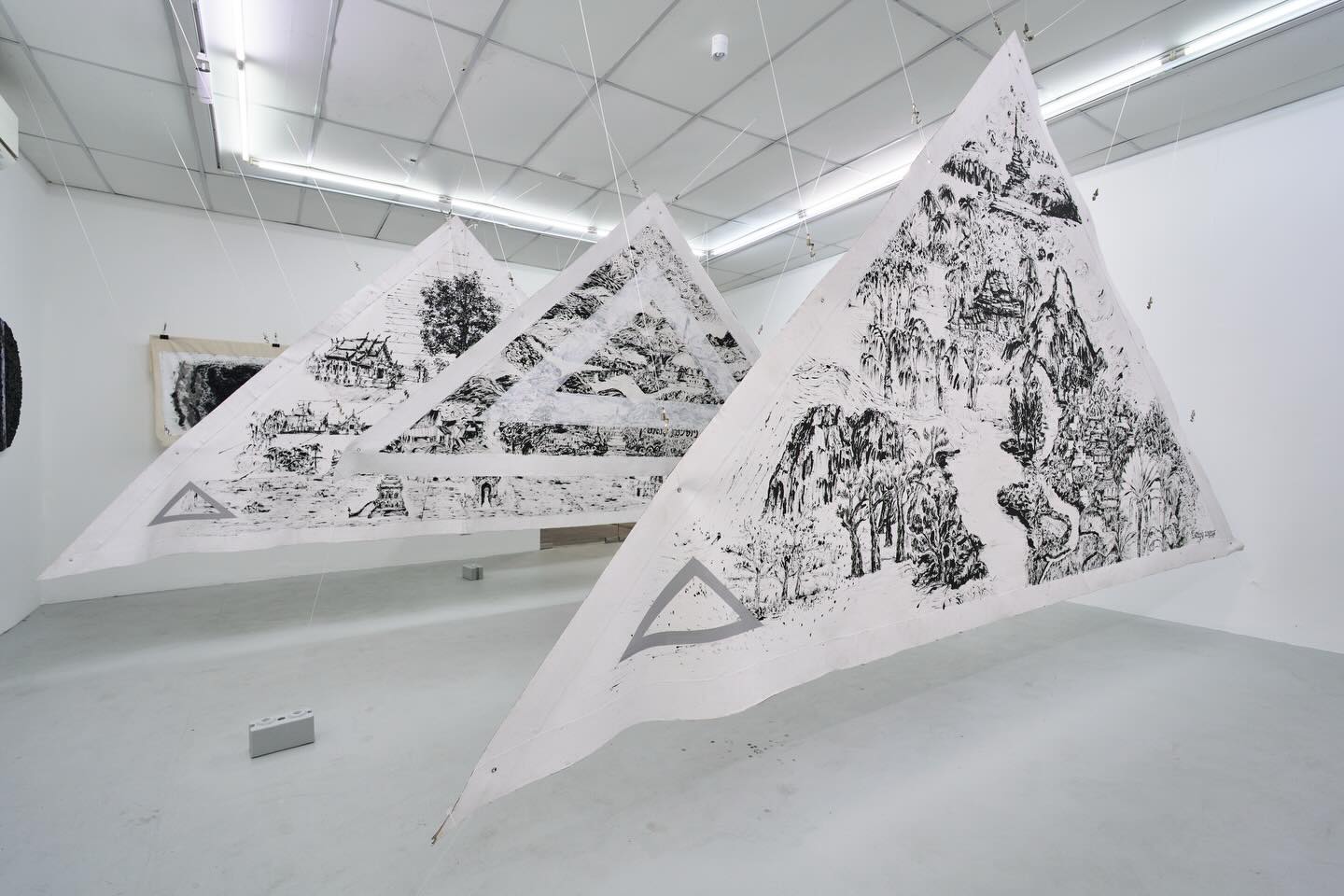
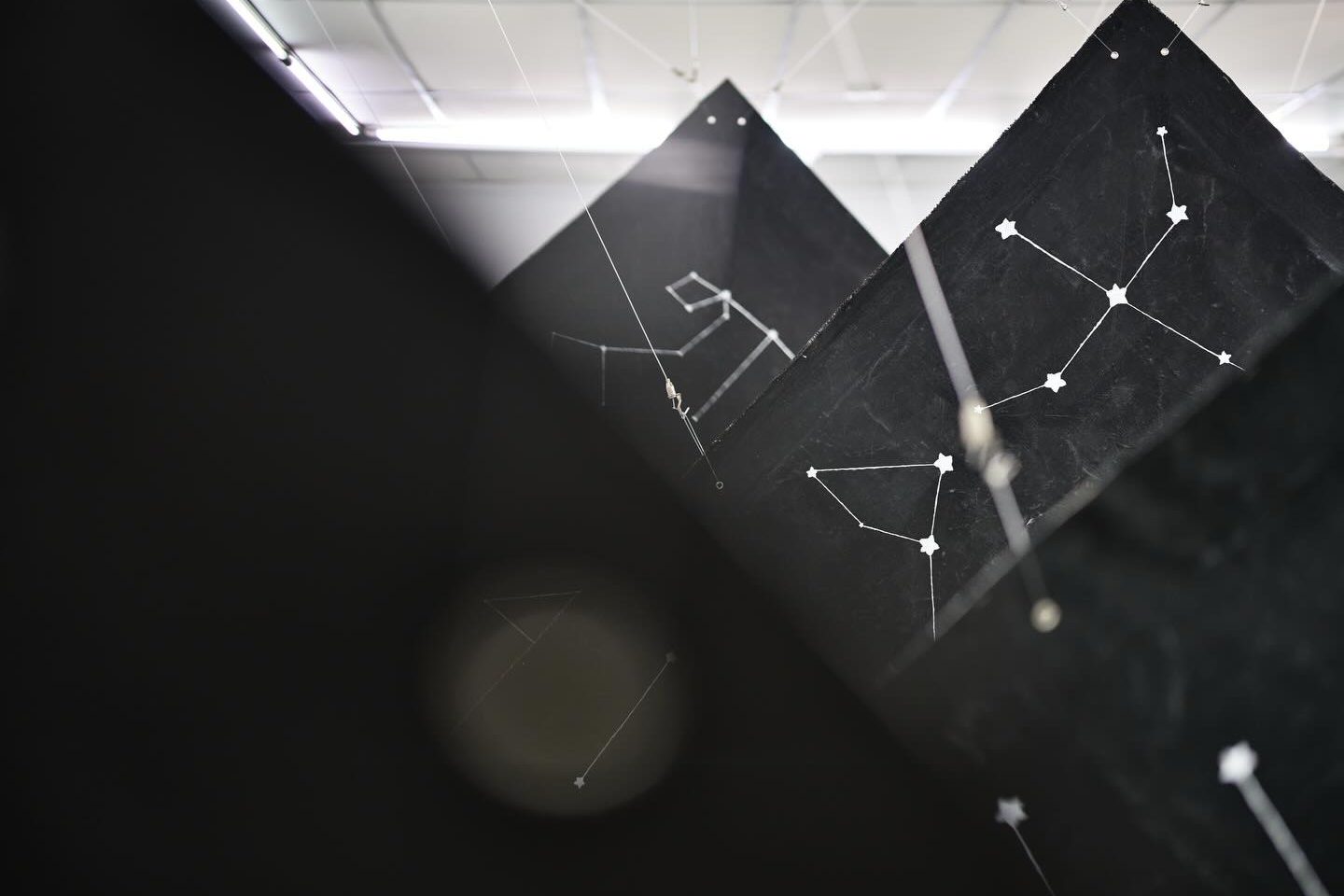
On one side appears a celestial chart marking auspicious and inauspicious hours, based on what the artist was told by a housekeeper from Myanmar. The star map becomes a succession of nights, in which darkness and starlight continue to paint across the valleys. The revolving passage of the stars reminds us that this intricate landscape predates human civilization itself. And once we enter it as inhabitants, good times and bad alike become part of a fate shared by both humans and the natural world. On the reverse are images of places shaped by the effects of this dust crisis: Shan State in Myanmar, Chiang Mai in Thailand, Luang Namtha in Laos, and Xishuangbanna in China. All of these major territories have been affected by the haze. Rendered in rough black incisions, maps, flags, cities, and natural landscapes convey the reality that all are being coated in dust. What emerges here is not simply a depiction of physical forms, but an image of dust as it encroaches, settles, and spreads across everything in its path. The dust we have created has become the one drawing the picture: a picture of collapse, a picture of death.
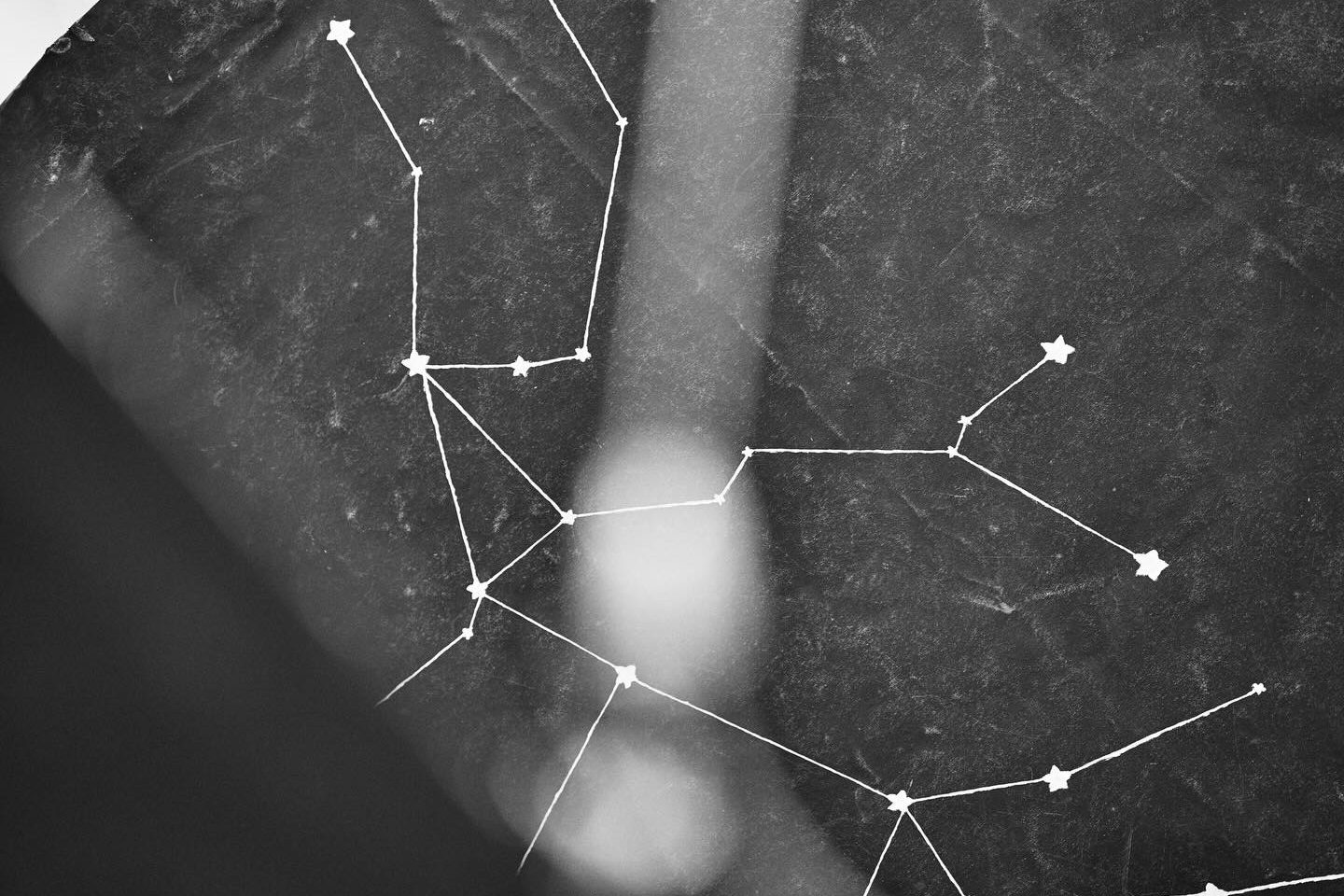
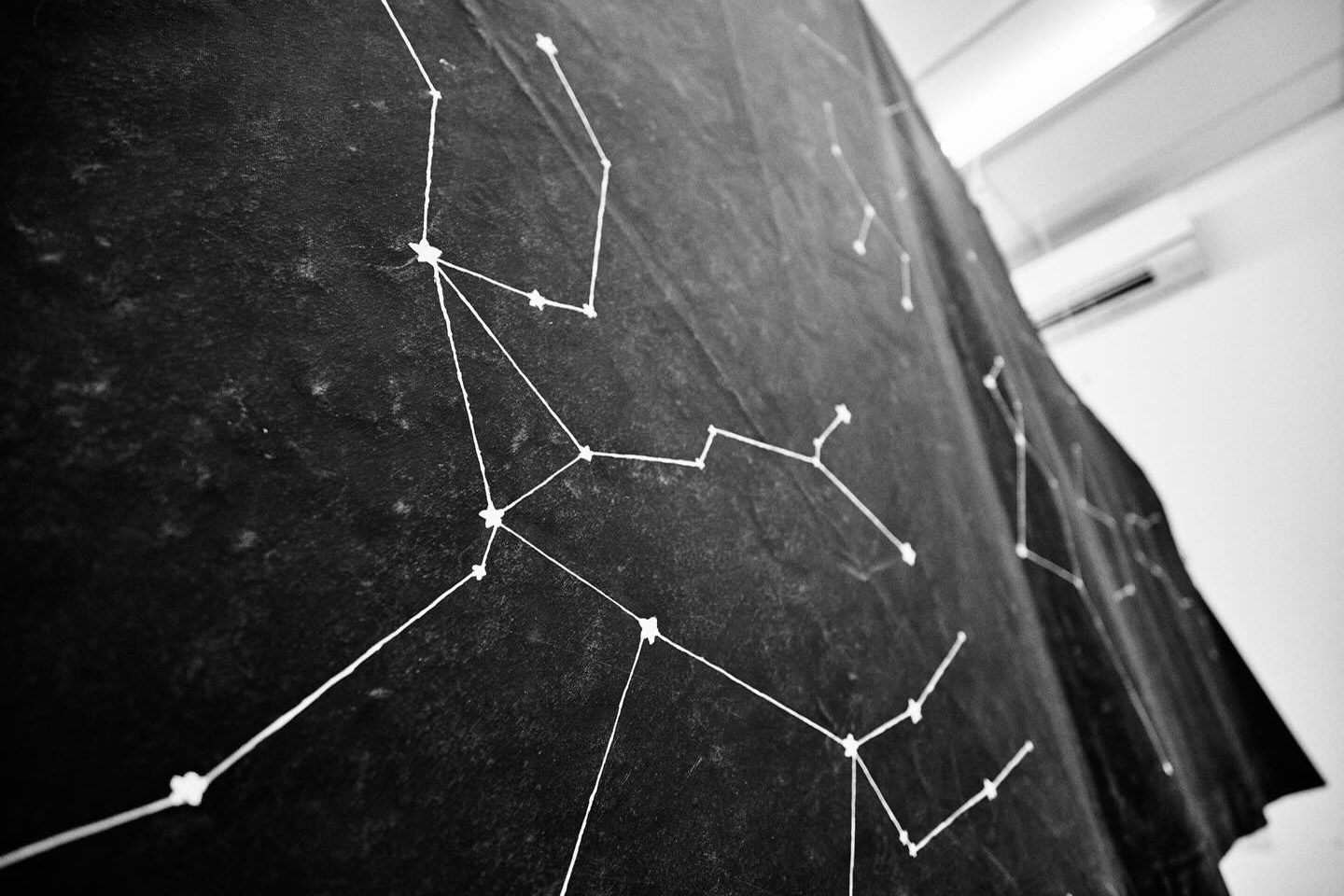
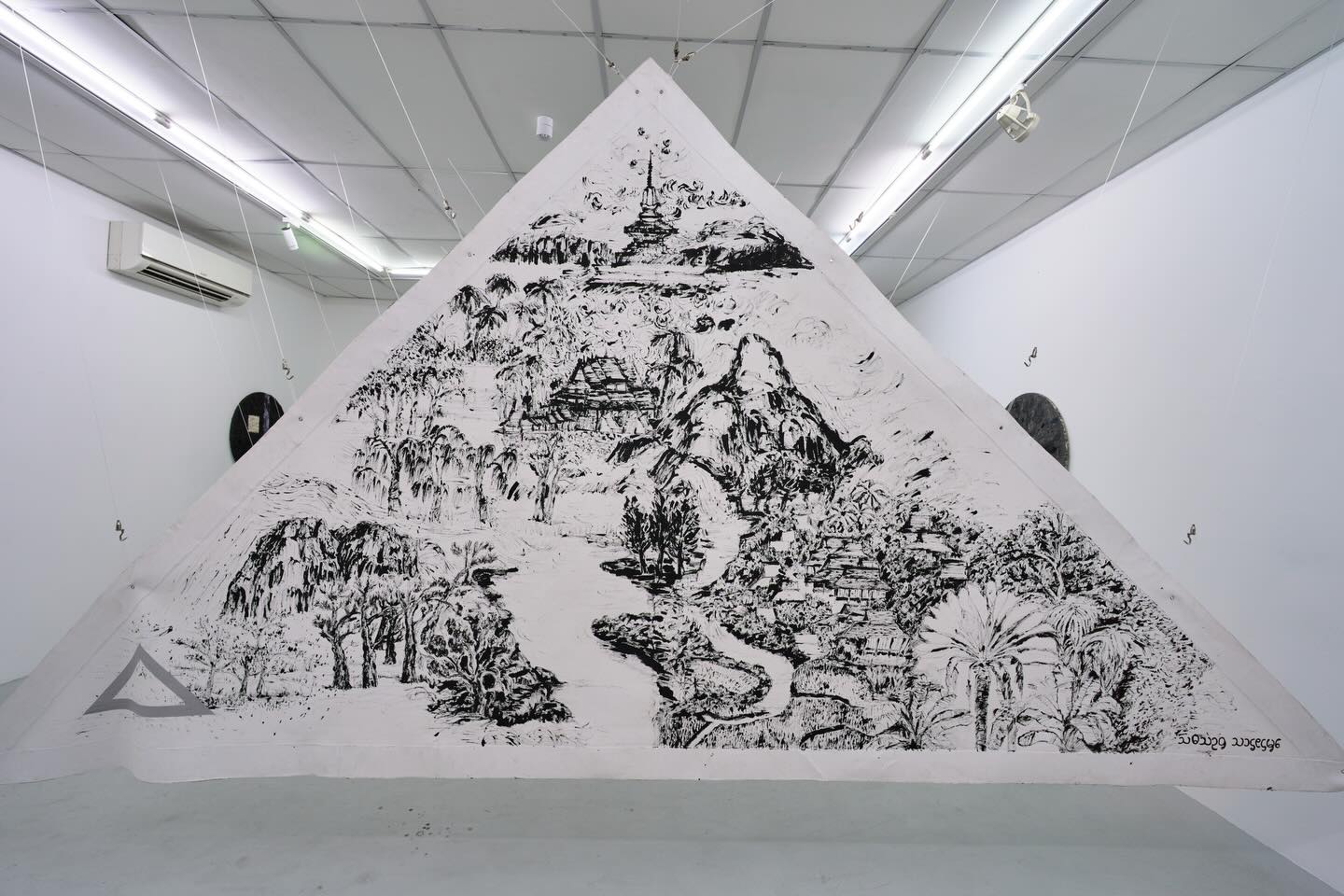
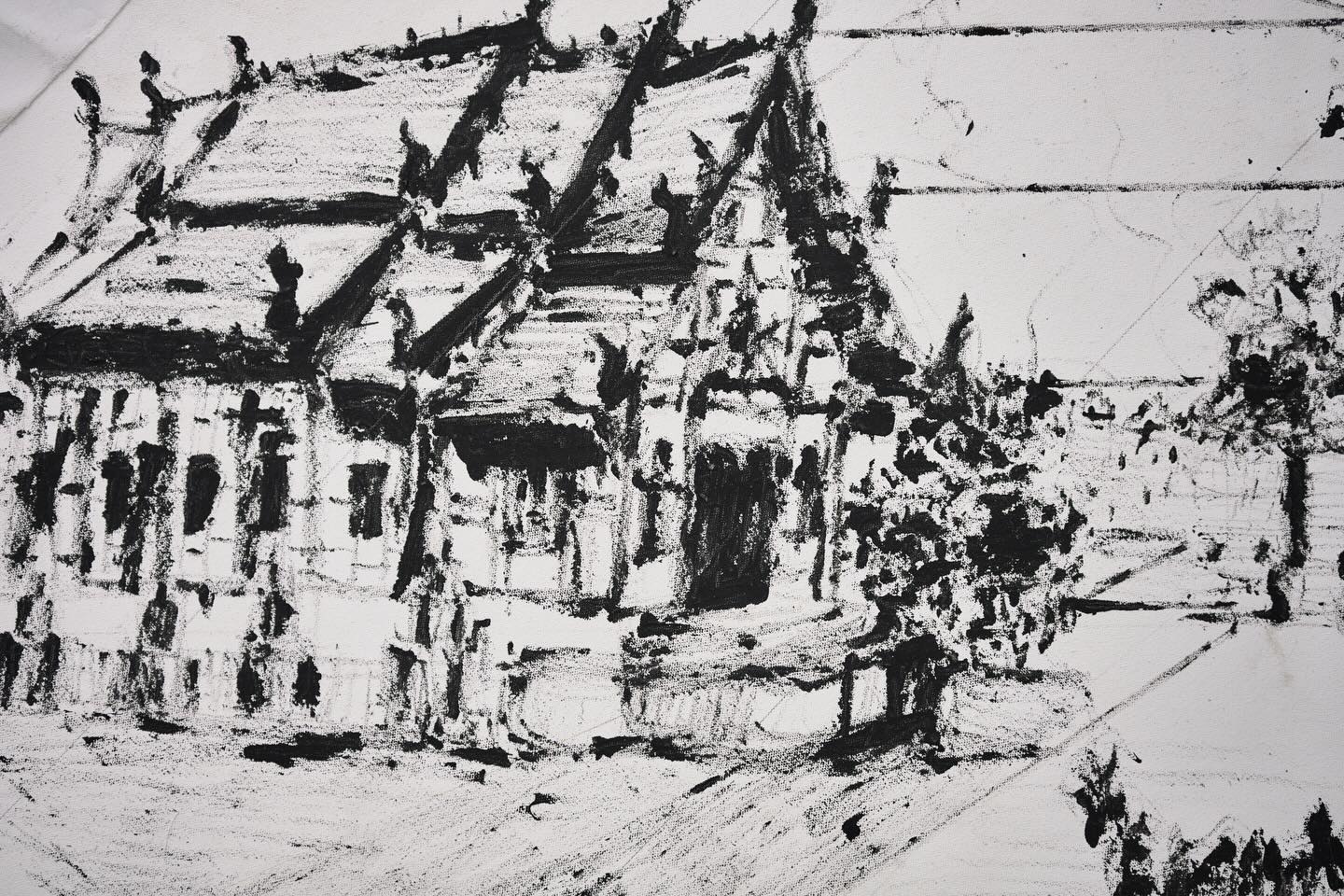
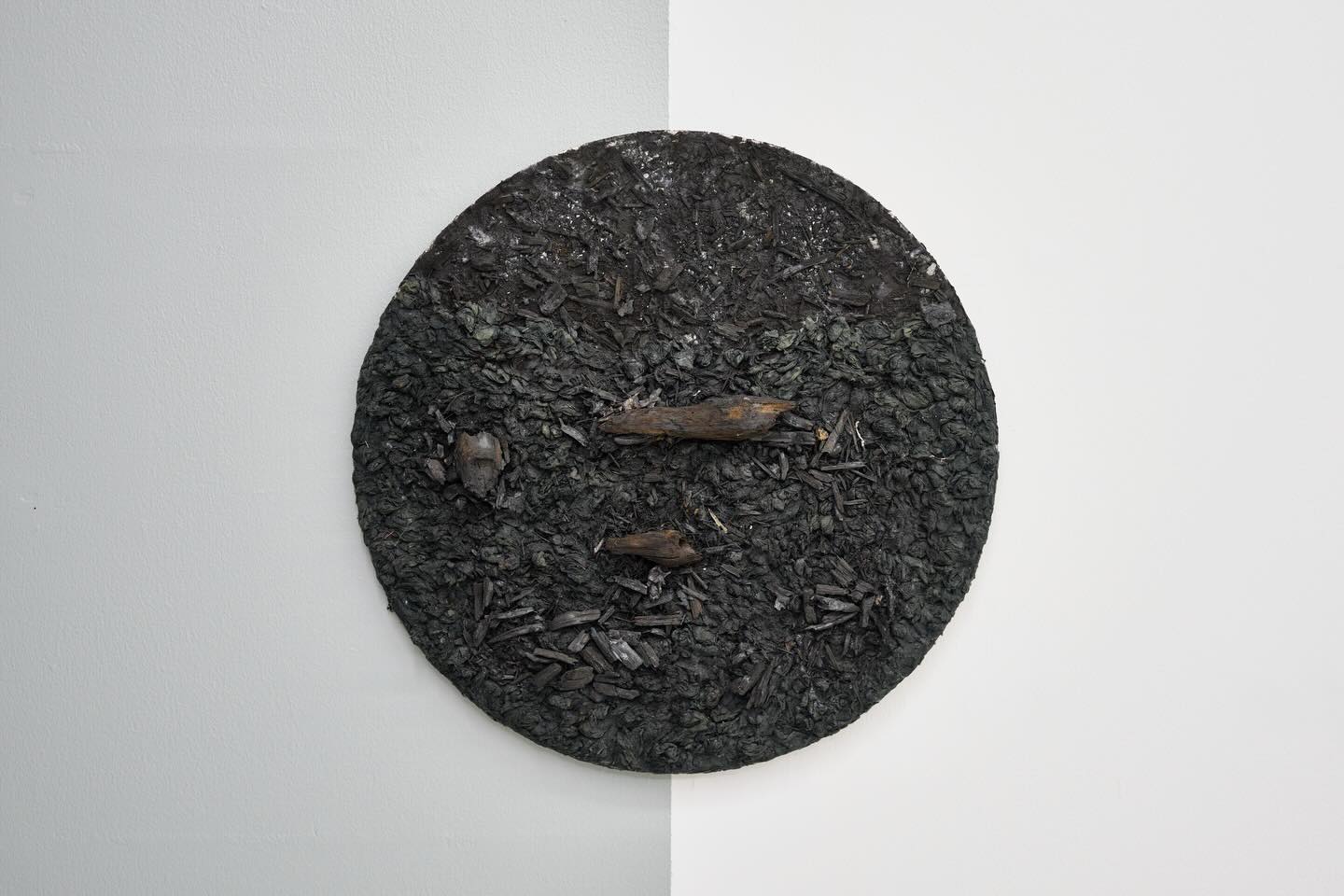
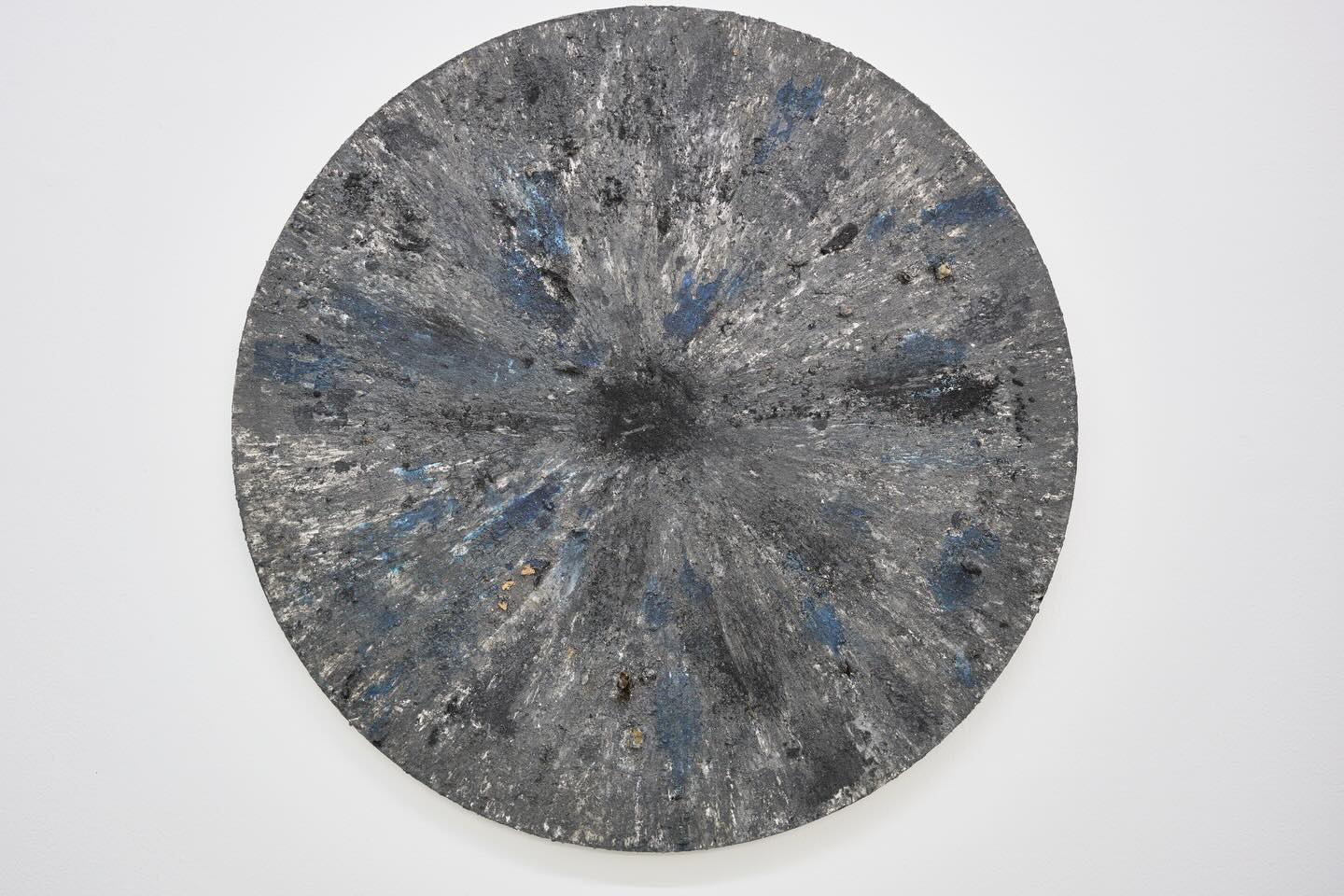
Beyond the last mountain ridge, five smoke-coloured works line the wall, presenting the ash left behind by burning. Dust reveals itself through surfaces that are coarse, dry, brittle, and cracked, as though ready at any moment to lift off and invade the mucous membranes of the viewer’s nose. As the artist recounts, she entered areas once ravaged by forest fires to collect charred wood and ash for use in the work1. In this sense, she quite literally ‘captures’ the dust suspended in the air and brings it onto the canvas in the name of art. What cannot be seen with the naked eye thus takes form through accretion, through settling, stagnation, and buildup. The true outline of that which threatens this region, without regard for any border, is thereby made visible. That all five canvases appear in abstract form only underscores how little of it we are able to grasp at once. Its force is too immense to be apprehended in its entirety. One might even say that we are already inside its vast belly. What we see before us is only a portion of its stomach wall, quietly digesting us bit by bit. Dust calls out to dust. The particulate matter clinging to the surfaces of the five canvases seems to confront the dust already accumulating inside our own bodies. As we look, we feel threatened by the strain of breath itself. Its mass slips into our throats, lodges in our lungs, and slowly erodes the span of our lives from within.
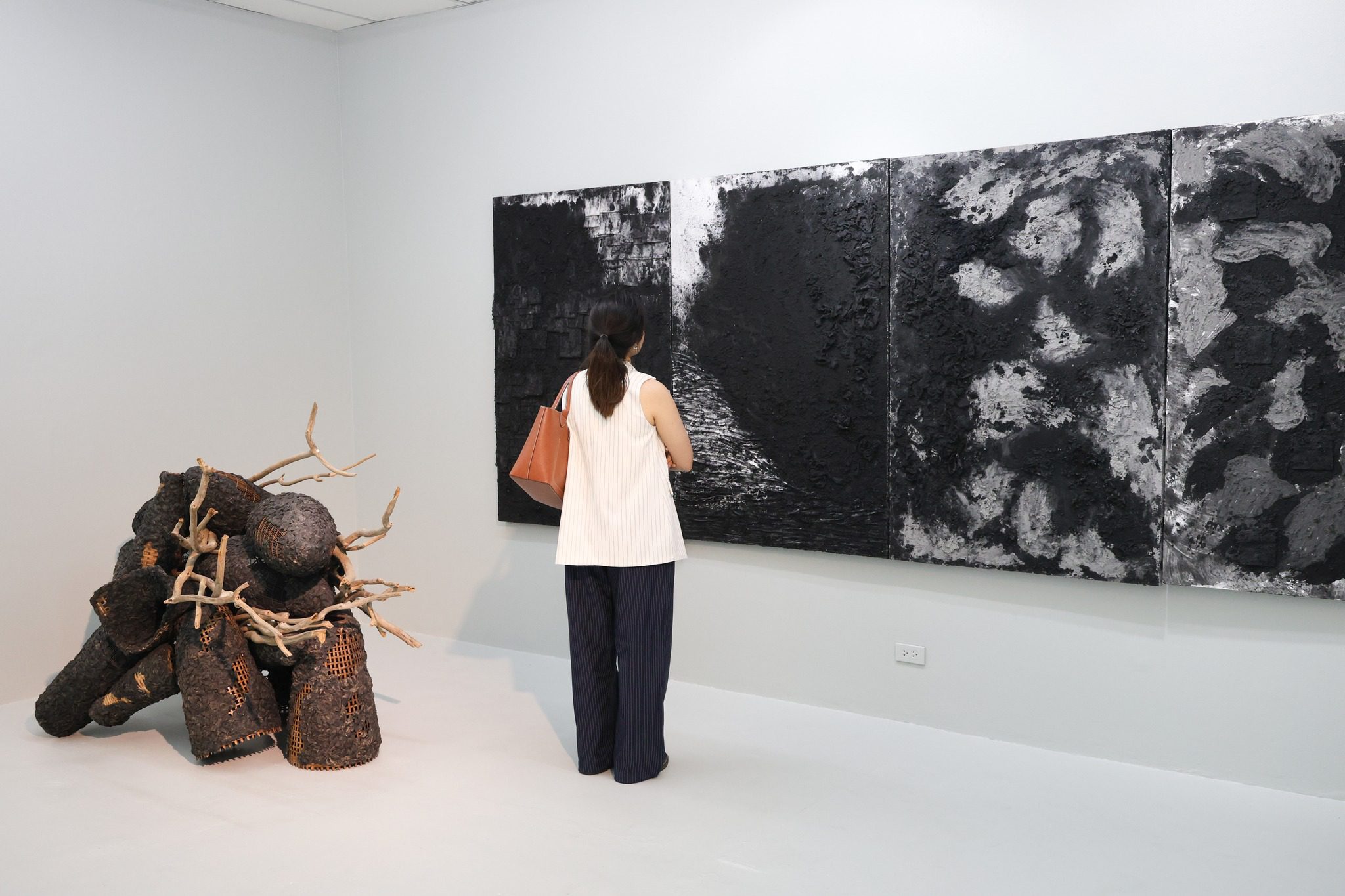
Photo: Vinai Dithajohn
Beside these paintings of dust-forms stands a sculpture assembled from vernacular woven utensils, placed in the corner of the room. Fish traps and sticky rice steamers have been joined together, their surfaces stained with a dense black coating of dust. On one level, the work points to the way dust spreads, settles, and contaminates the objects woven into everyday human use. But taken further, it suggests that it is not only our bodies that are being invaded. Our ways of life, too, are under assault, like the fish traps and steamers now caked in dust. However many methods we devise to keep dust from entering the body, the land and the water are no less affected. Mercury has, for instance, been detected in fish as a result of dust deposition2. No matter how natural their source may seem, the sticky rice steamed in these baskets and the fish caught in these traps cannot escape the grip of contamination. Dust thus finds its way back to destroy us once again, even if our bodies are not the first ground on which it lands. At the same time, we are also the ones who have left the wisdom and inherited knowledge of our ancestors to ‘gather dust,’ unable to preserve it or pass it on to the next generation. Ultimately, the lineage in which we once took pride may well come to an end here, where everything is left ‘covered in dust.’
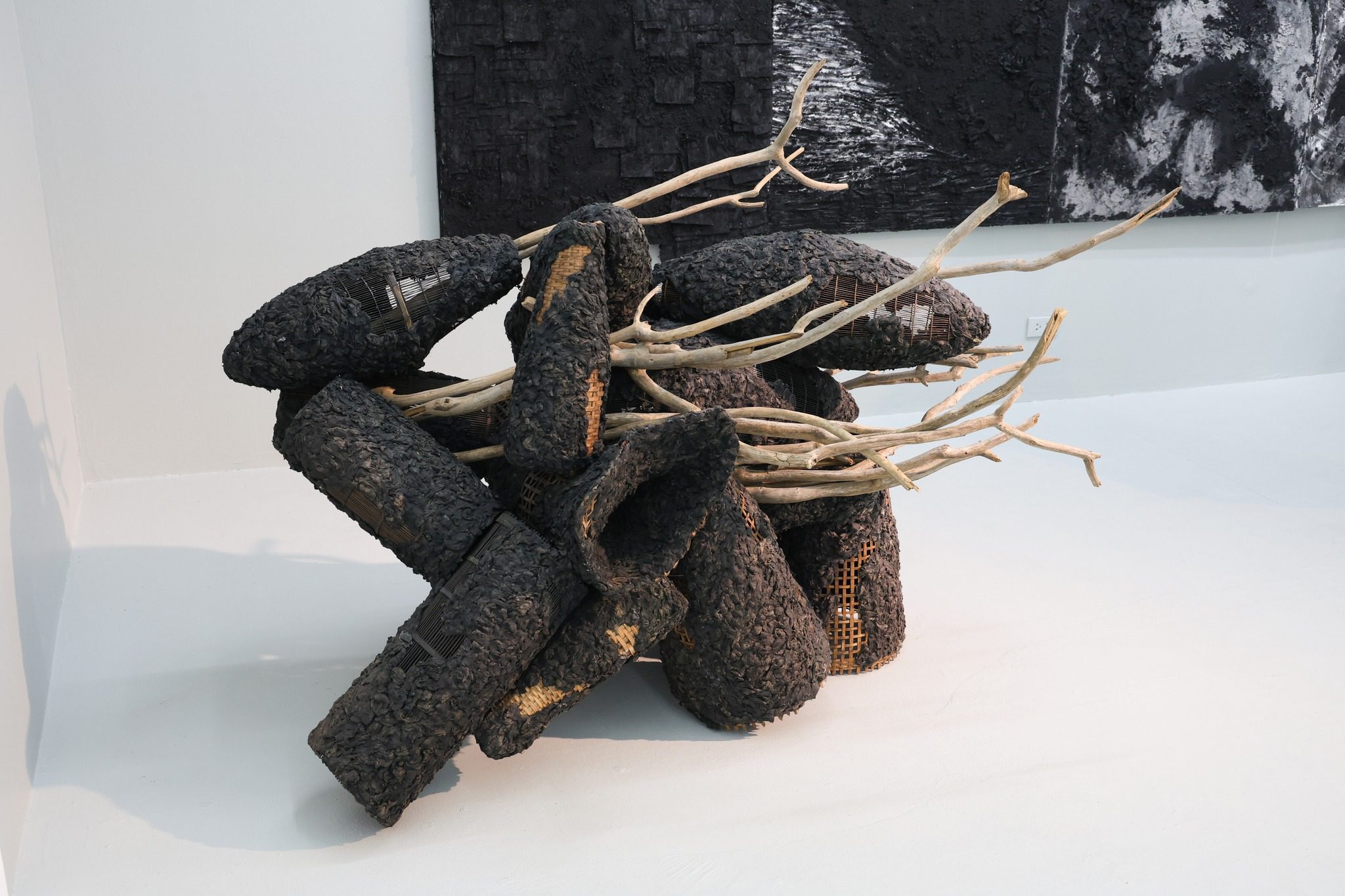
Photo: Vinai Dithajohn
These woven objects also evoke the image of air filters, both those within us, such as the nasal cavity and the lungs, and those outside us, such as air purifiers, which have become best-selling items and are often sold out3. The openings formed by the interwoven bamboo strips become a key property of this craft tradition, playing on the tension between containment and release. The fish trap and the sticky rice steamer thus resemble filters regulating the level of dust in the air. As dust accumulates until the cavities between the woven strips are clogged, they begin to register exhaustion and defeat. They may hold out to a degree, but so long as change at the multilateral level does not take place, neither lungs nor filters can prevent dust from crossing into our borders. The image of these woven objects, stained only by residue, thus overlaps with the image of lungs filled with black deposits, warped and swollen into tumorous masses of destruction.
In the end, the dust crisis emerges as a challenge to a region already crowded with tensions pressing against one another along the lines of the border. Dust reveals this region as a continuous landscape, wholly interconnected. Its fate is therefore something all of us must inevitably confront together. The problem of dust may not be one that can be resolved through the decisive authority of any single state. Even if it can be traced to a particular place of origin, its complex and overlapping networks make clear that responsibility cannot simply be cast onto the source alone4. The dust crisis, therefore, calls for multilateral cooperation, for states to turn toward one another and communicate. If borders continue to be used as an excuse, if the problem is treated as something beyond one’s own fence, if responsibility continues to be brushed aside from one side to the next, then the dust blanketing us will no longer be dust born of burning, but the dust of collapse, rising from the disintegration of the region itself.
Blueprint of the Apocalypse is on view at VS Gallery from 21 February to 12 April 2026.
_
1 Suwitcha Chaiyong. (2025). Art from ashes. Bangkok Post.
https://www.bangkokpost.com/life/social-and-lifestyle/3223829/art-from-the-ashes
2 Nattakan Amatayakul, “Not Only Bangkok: PM 2.5 and Its Companions Are Borderless Threats Everywhere,” featuring Tanapon Phenrat, The Momentum, 2019.
3 Ponnachai Areephoemphon, “PM 2.5 Drives a Surge in Air Purifier Sales: The Mall Reports 900% Growth, While Central Says All Models Across All Price Ranges Are Sold Out,” The Standard, 2019.
https://thestandard.co/air-purifiers-market-growth-because-pm25-crisis/
4 One study, for example, suggests that part of the dust pollution affecting Upper Northern Thailand in recent years may be linked to the Hongsa Power Plant in Laos, which began operations in 2015. Thai capital was itself involved in the investment of the project, underscoring that the dust crisis is structurally complex and requires cooperation between states at the policy level, rather than being attributed to the responsibility of any single party. Nor is this the sole source of the dust currently affecting the region. For further discussion, see Darunee Paisanpanichkul et al., Research Project to Prepare Communities for Assessing Health Impacts among Communities at Risk from Border Area Development Projects: The Case of Impacts from the Hongsa Power Plant in Nan Province (2018).