FROM THE DICTIONARY ON THE SHELF TO THE PAPER THAT OVERFLOWS, ‘THIS PAGE IS INTENTIONALLY LEFT _____.’ AN EXHIBITION THAT OPENS UP SPACE FOR EMPTINESS TO WORK INSTEAD OF WORDS
TEXT: KANDECH DEELEE
PHOTO: KETSIREE WONGWAN
(For Thai, press here)
It is noticeable how many of Bangkok Kunsthalle’s past exhibitions have engaged directly with the building’s spatial and material identity. Nostalgia for Unity revisited the fire that once consumed the structure, while Poetics of Horizontality reassembled fragments of its remains, including brick, stone, cement, sand, charred surfaces, and mildew, into a grid-like installation. Yet these traces of damage and decay do not, on their own, encompass the building’s full meaning. In another chapter of its history, this site housed Thai Watana Panich Press, a publishing house that played a pivotal role in Thailand’s print media industry, producing textbooks and educational materials that extended knowledge from the center to the rest of the country. The building, then, is not merely ‘bound’ to its physical shell; its significance also ‘expands,’ unfolding across other forms.
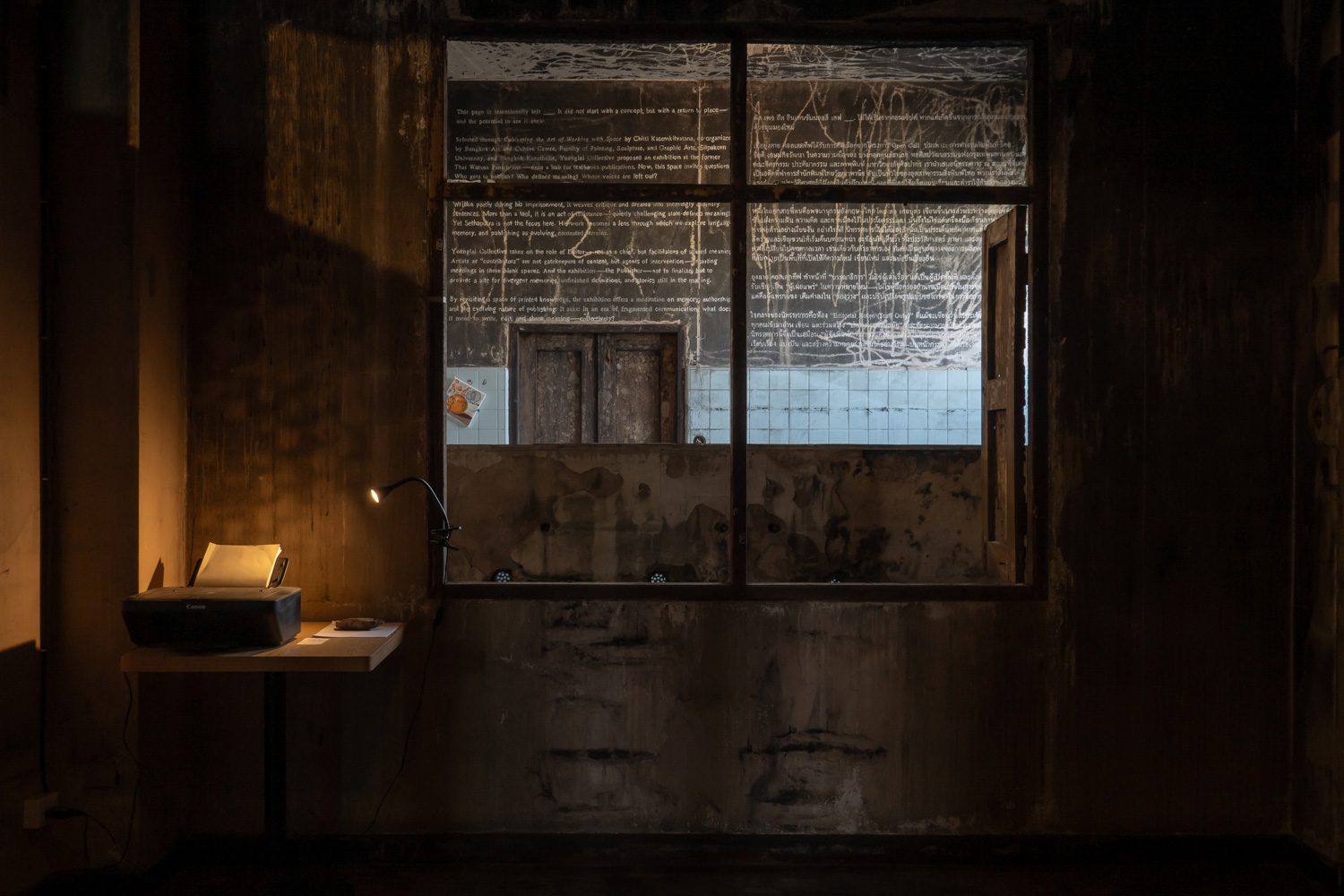
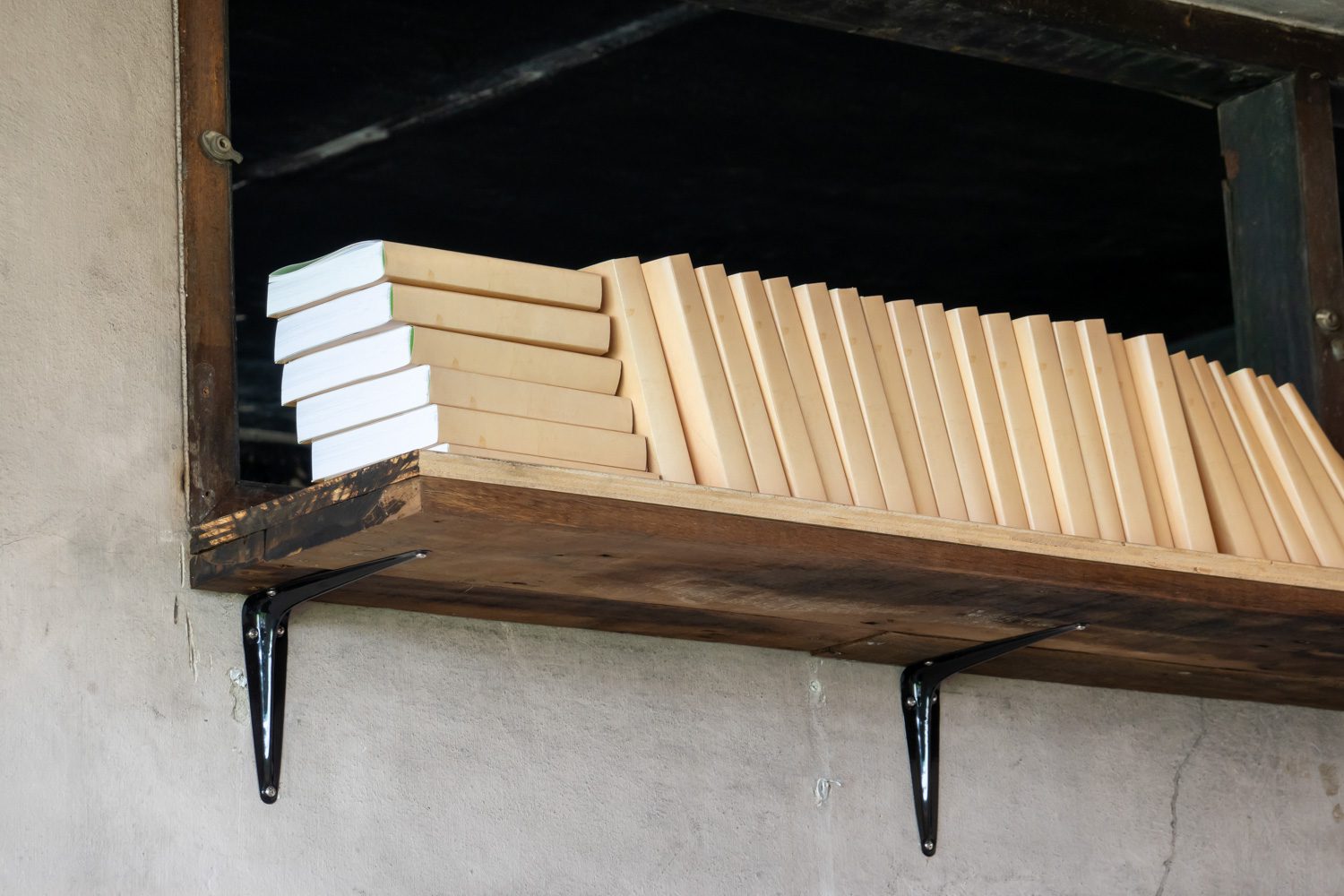
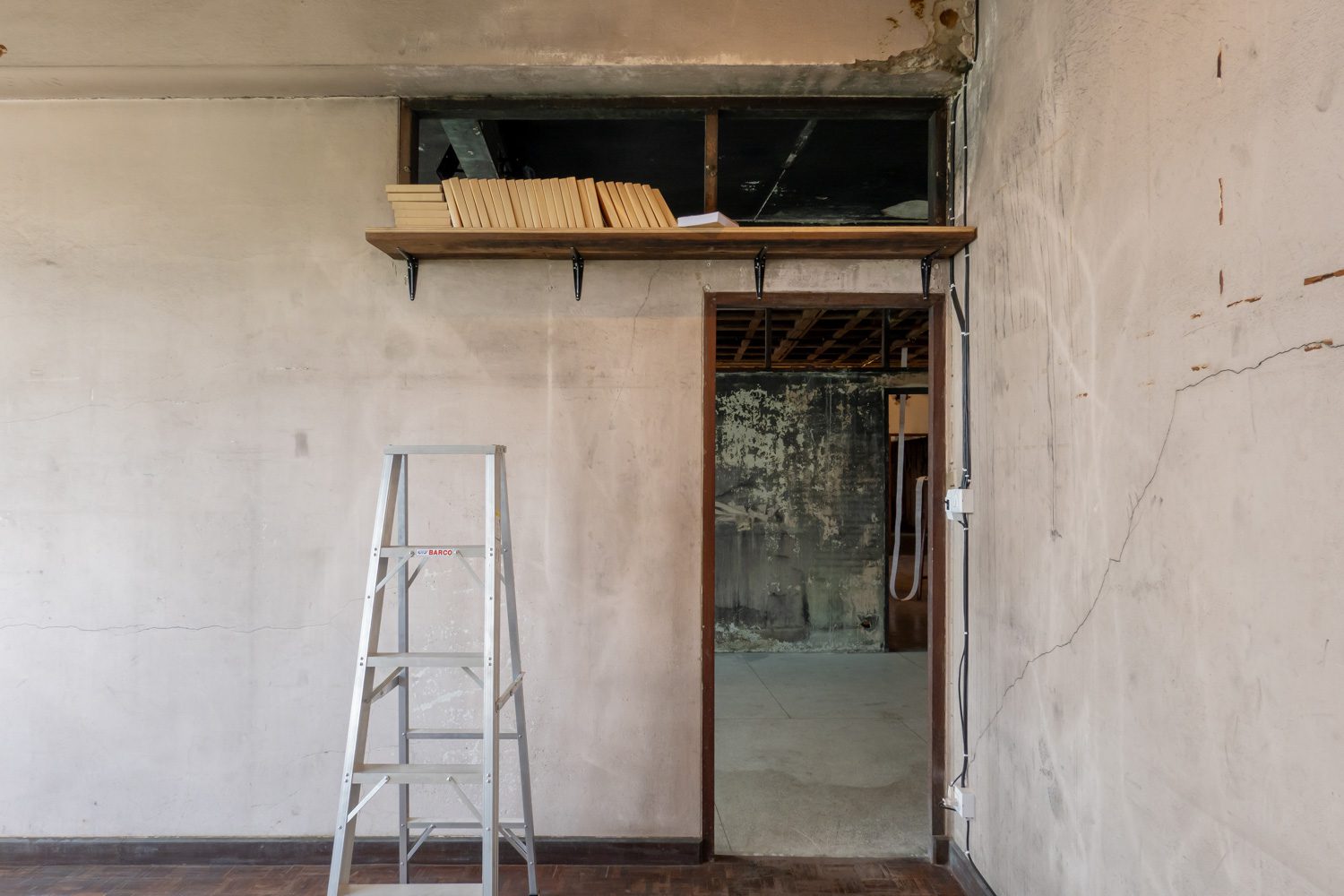
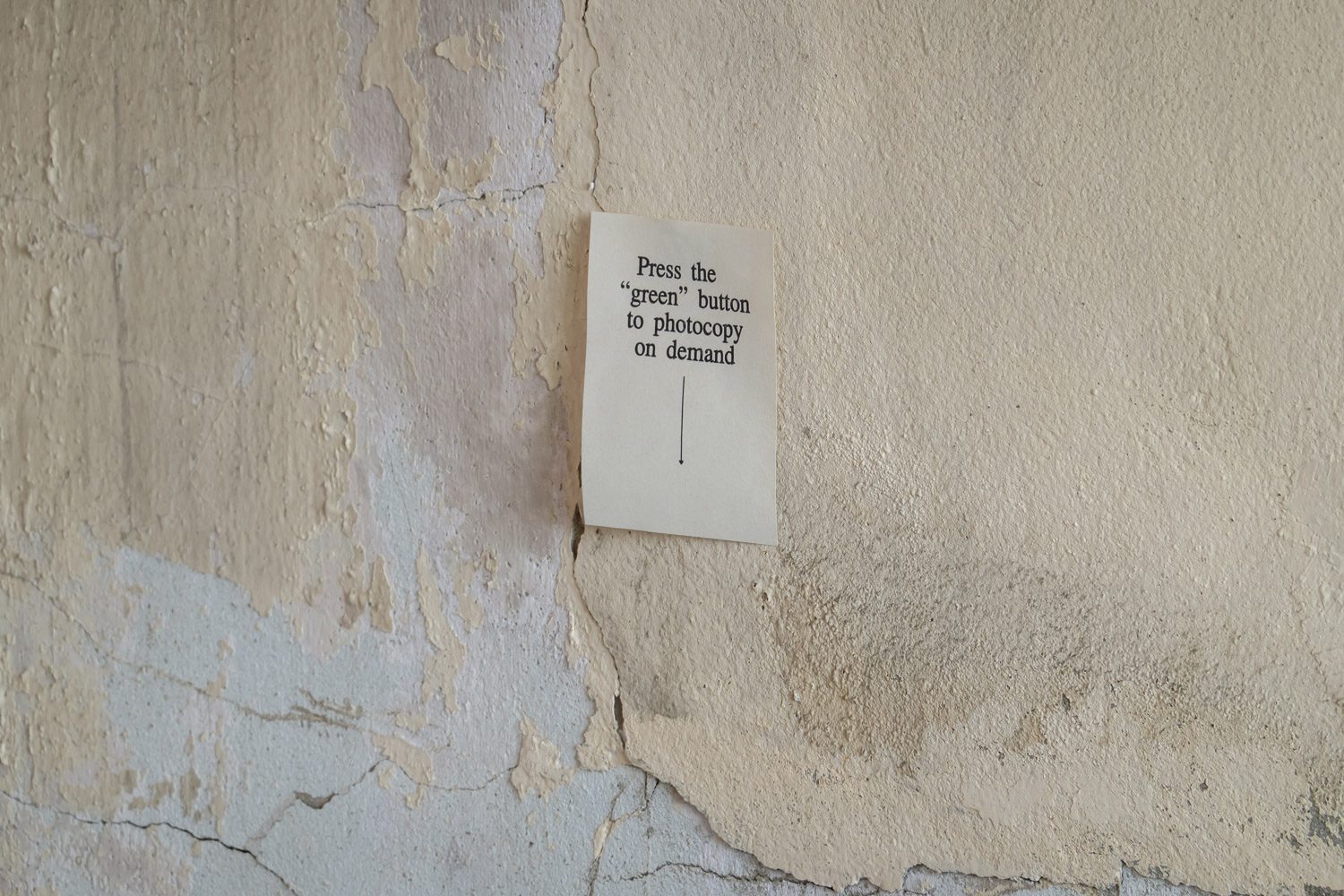
The exhibition, ‘This page is intentionally left ____.’, turns its attention to this legacy, revisiting the former Thai Watana Panich premises through the lens of its historic role in publishing. Curated by Yoonglai Collective1, the show opens with New Model Thai-English Dictionary (2025) by Theetat Thunkijjanukij. Here, absence becomes the first encounter: the gallery appears empty, and visitors often pass straight through, noticing only a lone photocopier stationed at the far end. Like the other works in the show, it invites them to print out a text. Only then does the piece begin to reveal itself. The document explains that Theetat has painstakingly transcribed all 32 volumes of So Sethaputra’s Thai-English Dictionary, whose first edition was printed in this very building. Rather than arranging his copied set in a conventional display, Theetat has placed it high above the gallery’s entrance, a threshold already crossed, prompting viewers to turn back and tilt their gaze upward toward what they had overlooked.
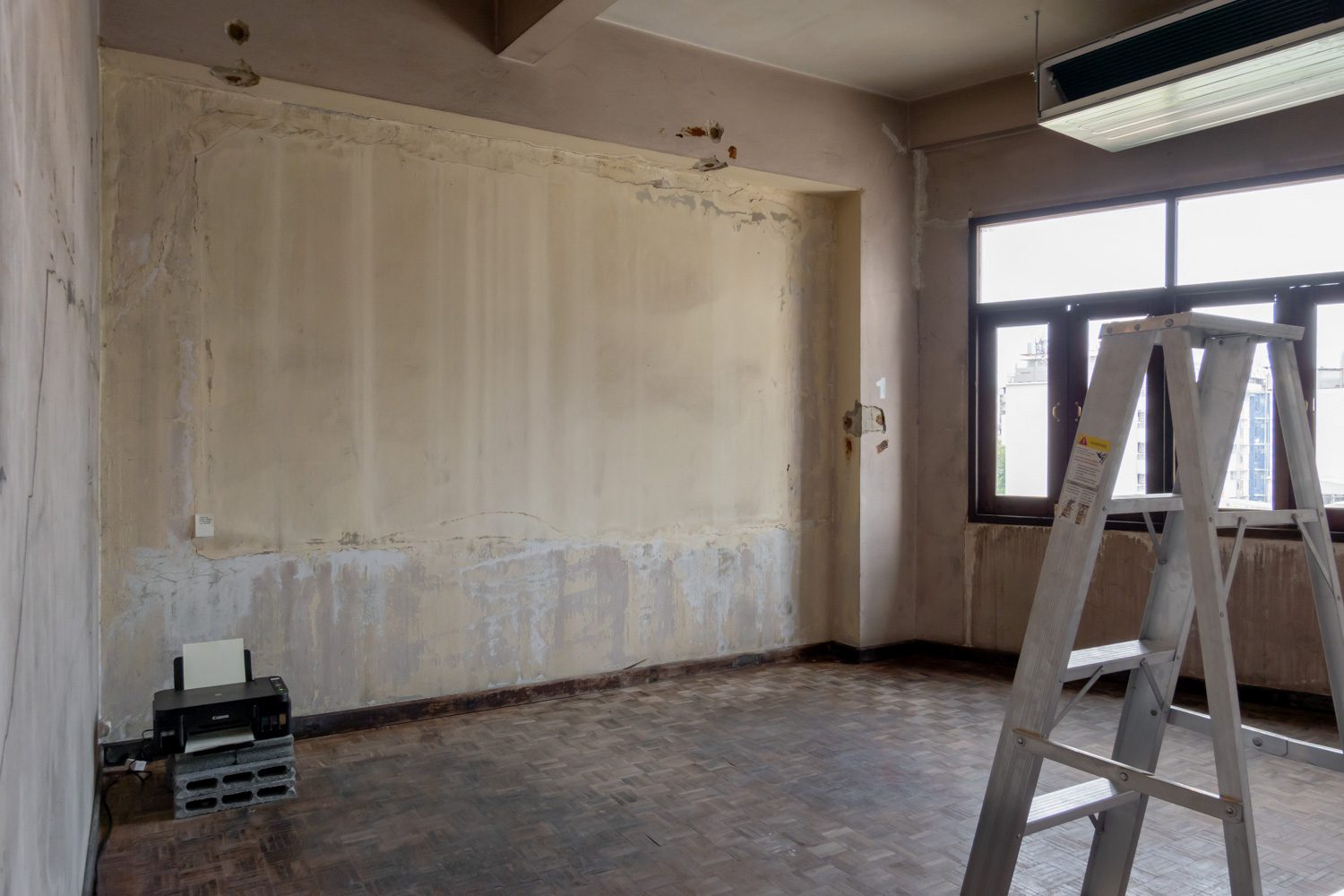
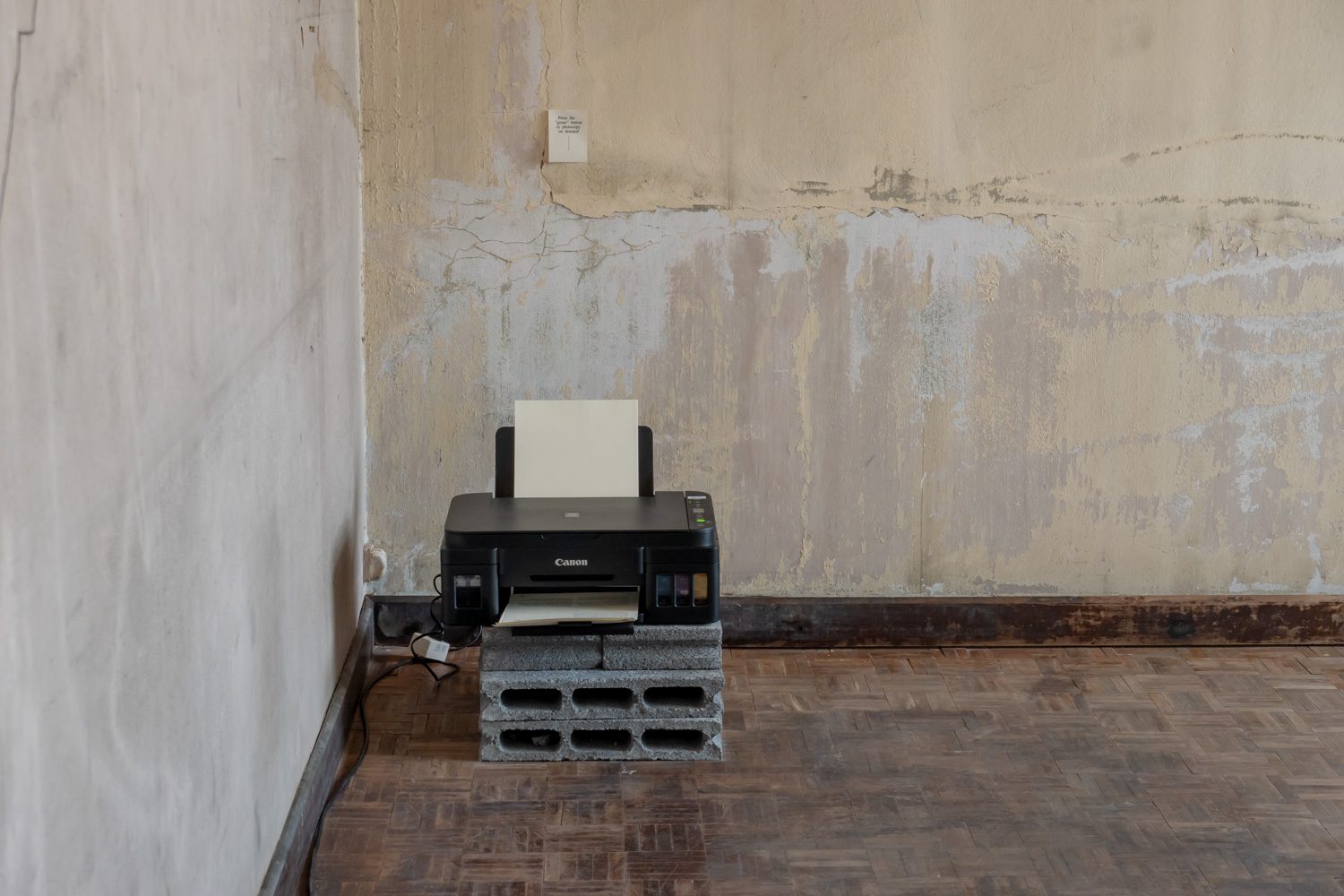
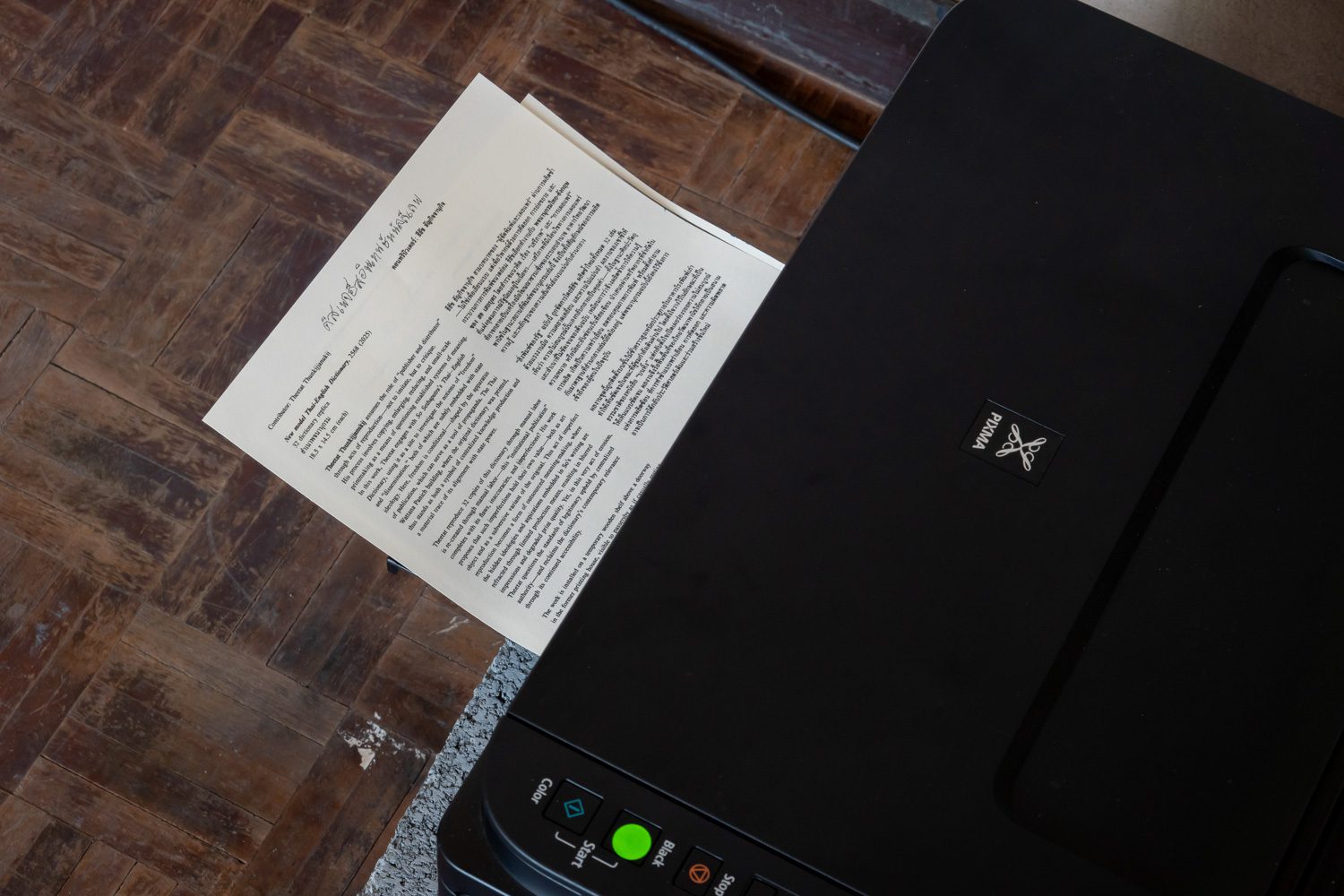
Although the accompanying text states that Theetat intended to play with the notion of a ‘book on a shelf,’ what transpires for viewers feels markedly different. A shelf is something that demands recognition, perpetually calling for reverence. Here, the dictionaries perched above the doorway, so easily passed beneath without notice, reflect back on the very idea of the dictionary as a ‘gateway’ to language itself. One section of the exhibition text notes that So Sethaputra’s dictionary, despite its unassuming appearance, ‘weaves together dreams, political opinions, and personal feelings.’ Stepping into this room, which seems to have been ‘deliberately left empty,’ becomes an act of crossing into a territory defined by the dictionary’s linguistic domain. The dictionary, then, is not merely a tool for one-to-one equivalence. In the act of translation, it introduces layers of detail, some we can recognize, others we don’t. The dictionary conceals itself as a neutral linguistic instrument, even though it is far from transparent. The apparent seamlessness of its functions depends on erasing any trace of its own presence while quietly ‘guiding’ its users. Perched discreetly above the threshold, it is an unassuming gatekeeper that governs entry and exit, inside and out, all at once.
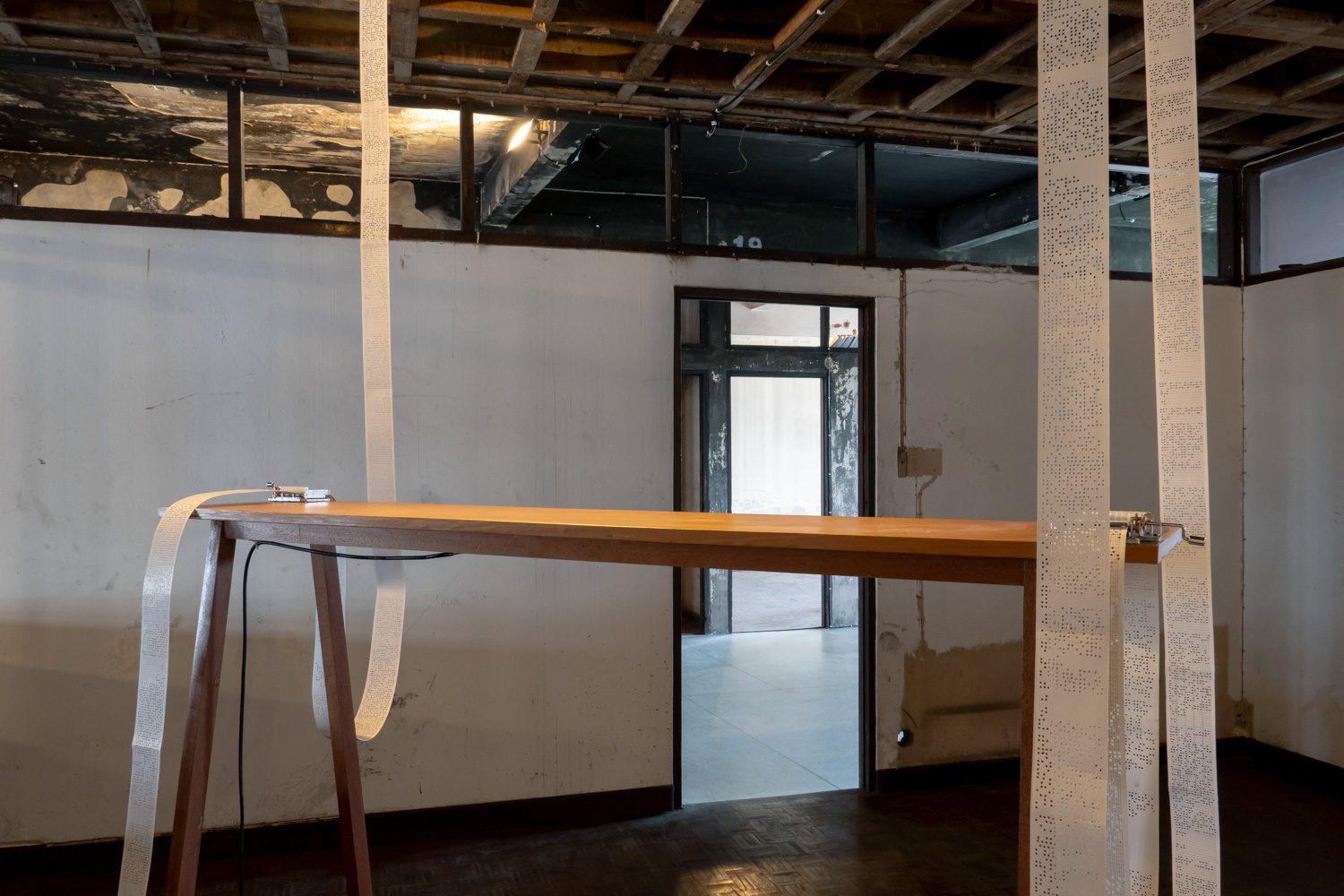
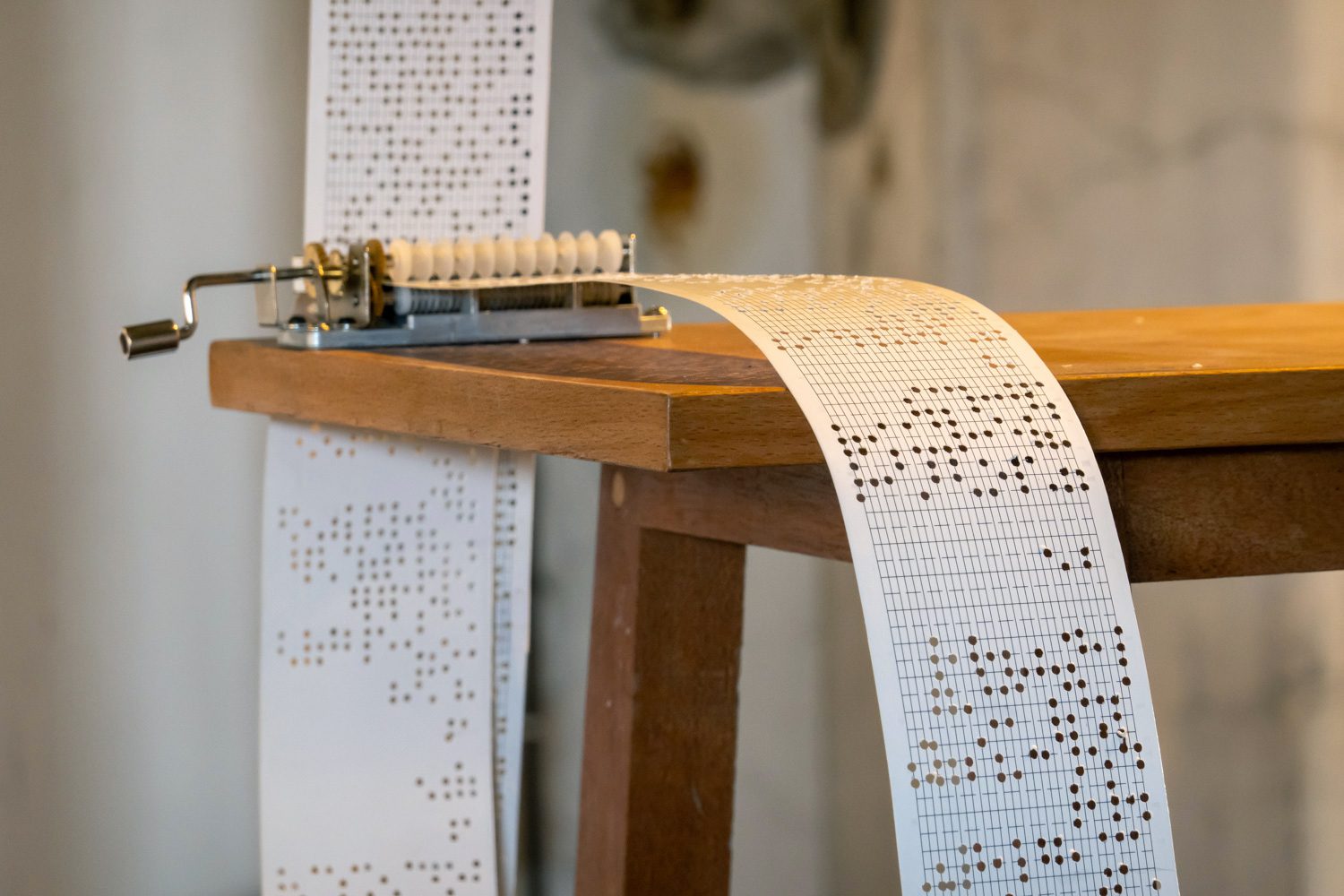
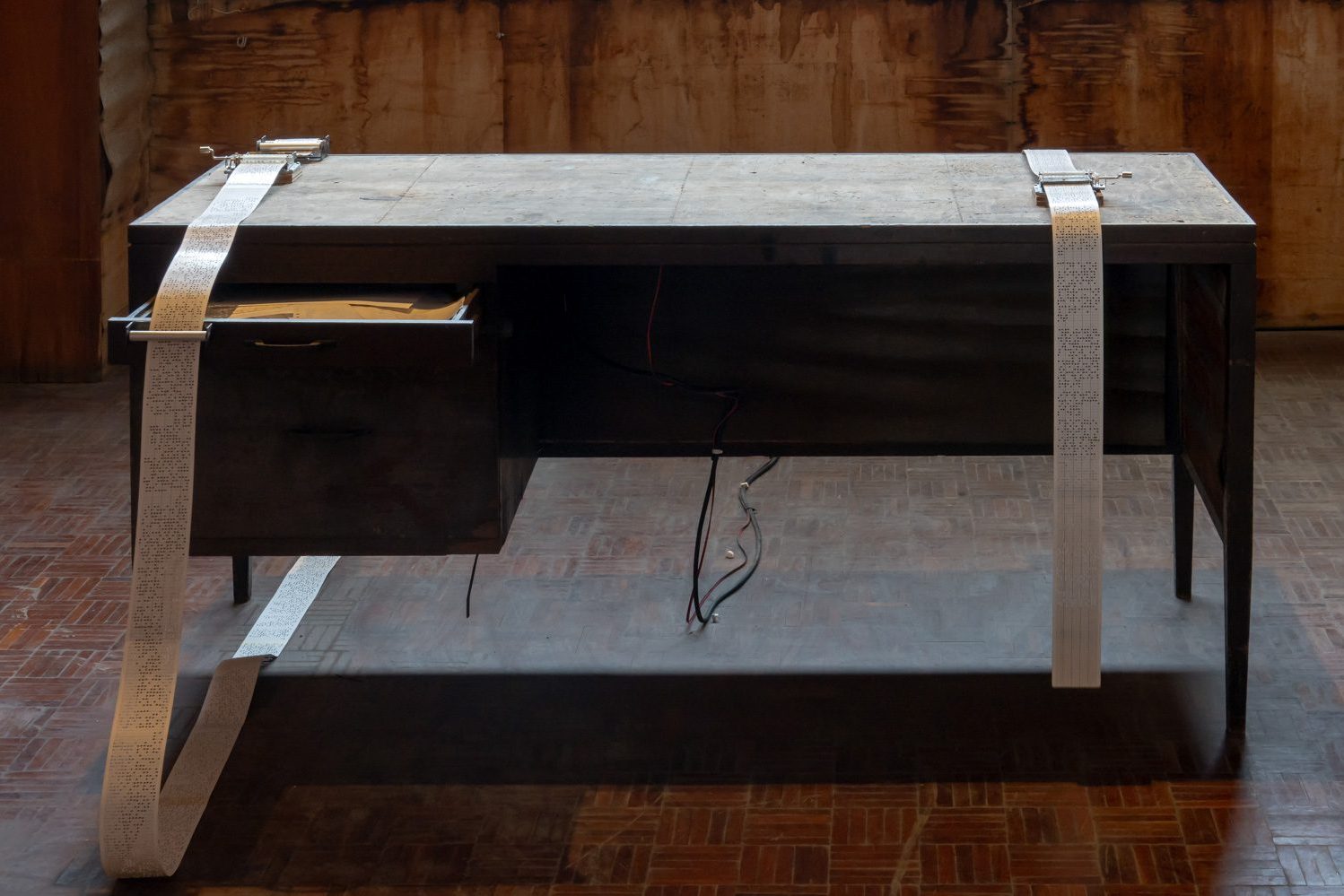
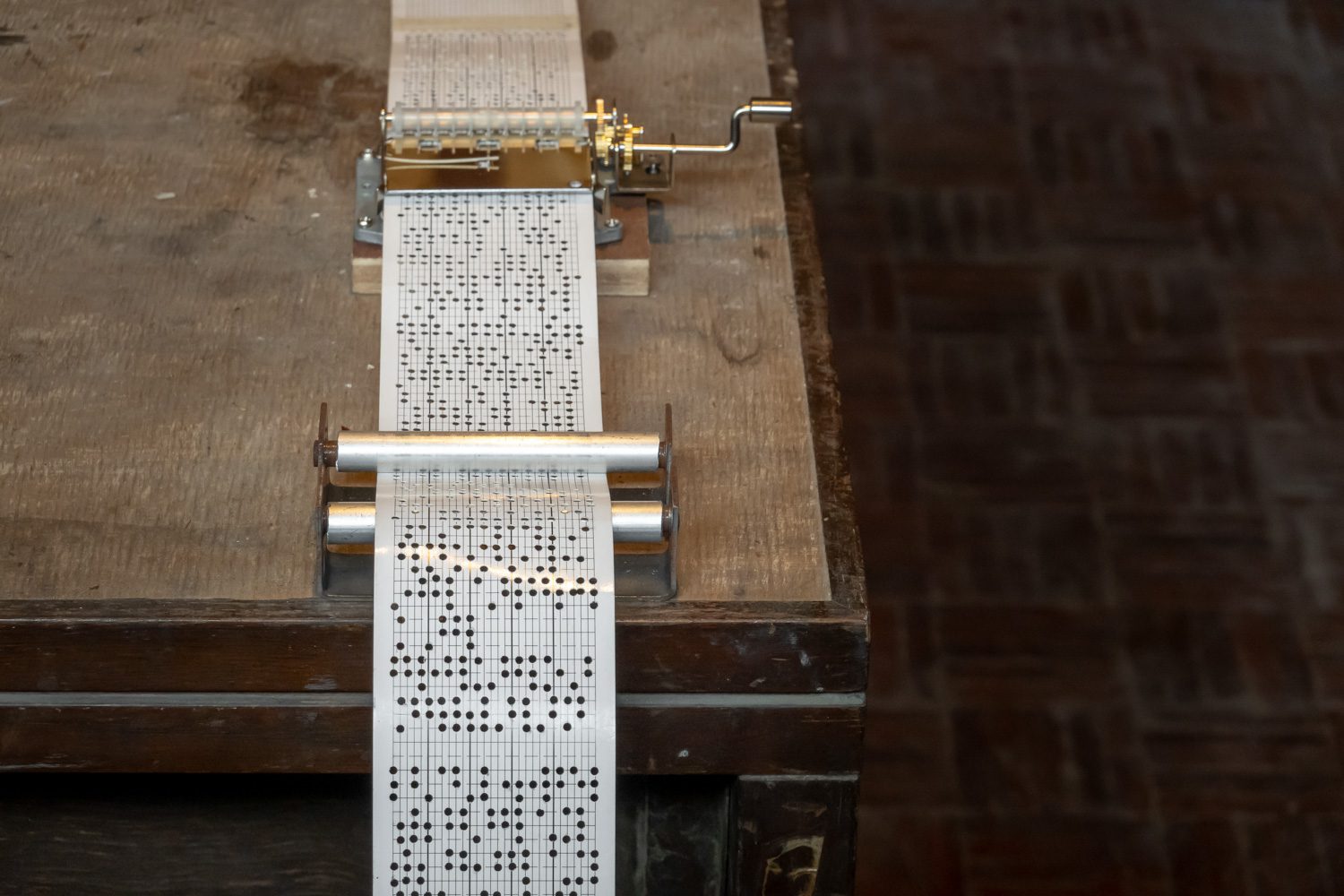
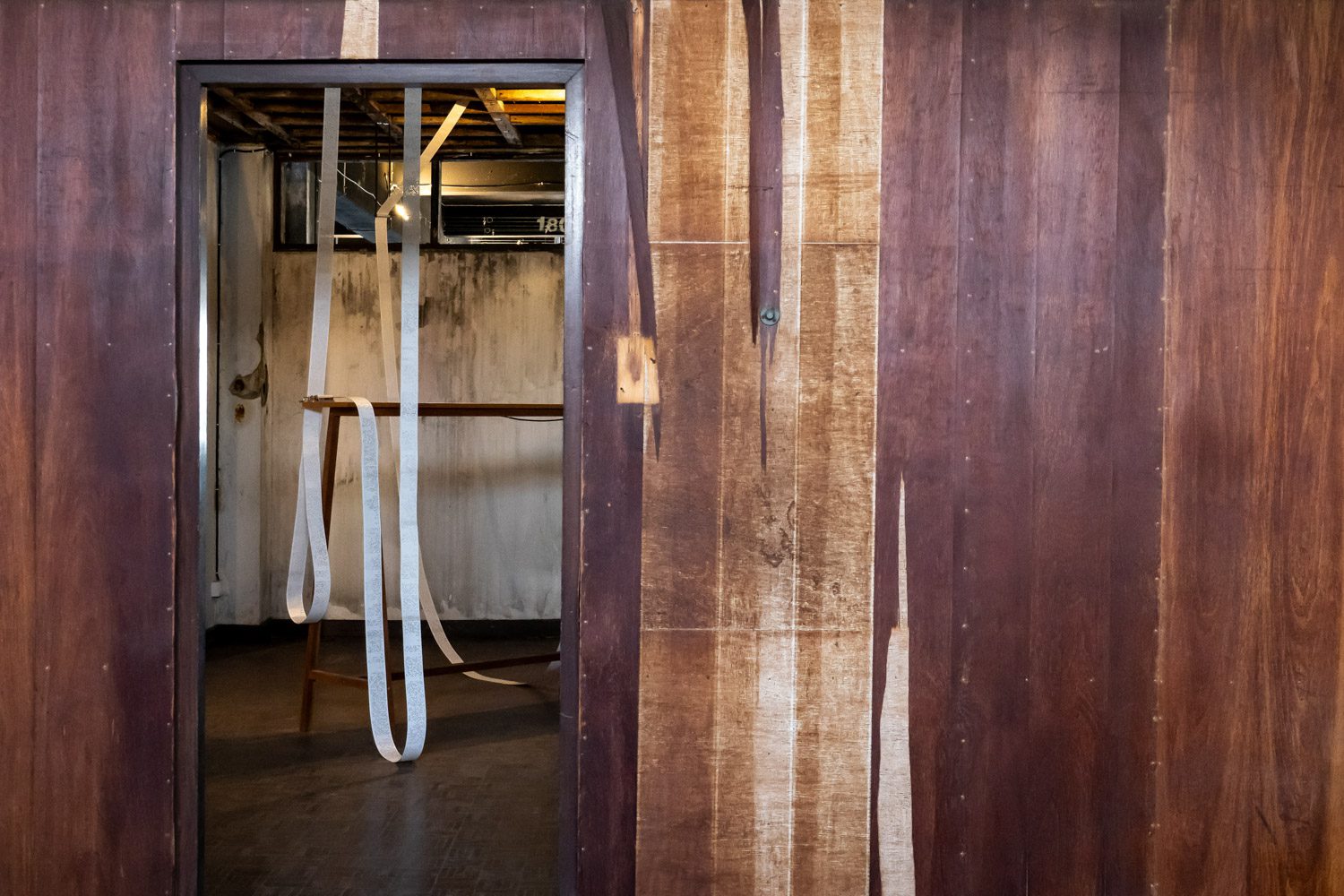
Next is ‘Read Between the Ledger Lines’ (2025) by Anusorn Thanyapalit. Strips of white paper descend from the ceiling, trailing across a table before spilling onto the floor below. Up close, one notices that each strip is punctured with a series of meticulously arranged holes, resembling the structured ‘lines’ that underpin systems of language. The table reveals the cause: by turning a crank, viewers set the paper in motion, and as it advances, the perforations trigger musical notes, creating a composition that unfolds in tandem with the paper’s slow crawl forward.
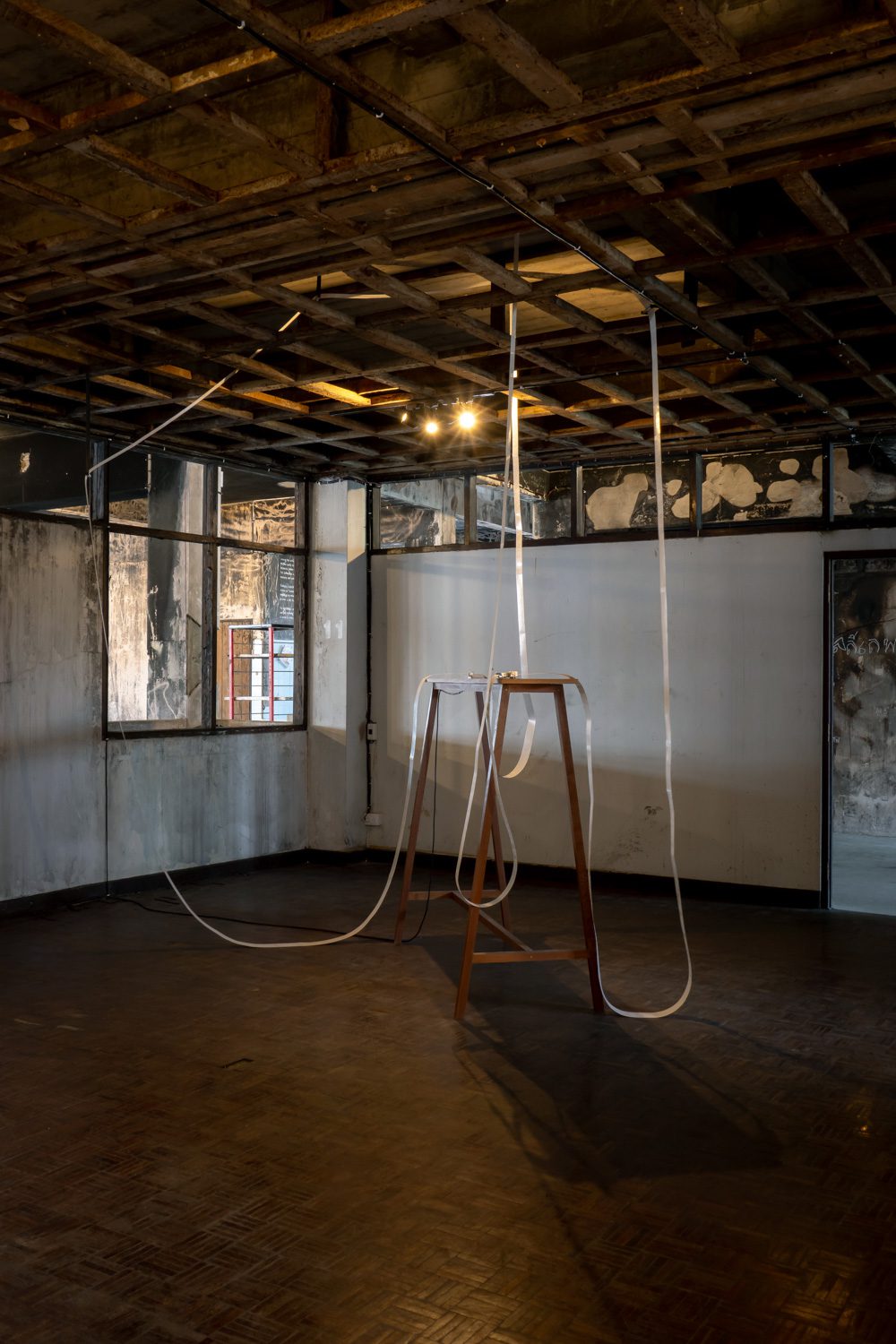
Stepping back, the scene shifts. The paper stretches unbroken from ceiling to floor, cascading downward as if drawn from deep within the building’s interior, like entrails spilling outward where the artist has torn it open. In this sense, the building’s core is not sustained solely by brick, mortar, and concrete in any literal or structural sense, but also by an intangible architecture of paper. These paper ‘innards’ contain no language familiar to us, only a form of language that can be felt rather than understood. Through this work, Anusorn suggests that our relationship to the building has always been mediated and indirect. What we comprehend may only be what it permits us to know, while vast portions remain unseen and imperceptible, residing in registers beyond both sight and grasp.
In ‘From Those Who Are Not Yet to Come…’ (2025), Nat Setthana projects text onto various surfaces of the building. While the accompanying notes reference the presence of the building’s occupants, whether it be those who may have passed through in the past or those yet to come, this idea also ties into the many possible lives of the rooms, from bedrooms to bathrooms. Yet once words are affixed to these surfaces, their material resistance disrupts habitual reading. They no longer exist solely to be read for meaning; instead, their presence demands confrontation, merging semantic content with the tactility of the wall itself.
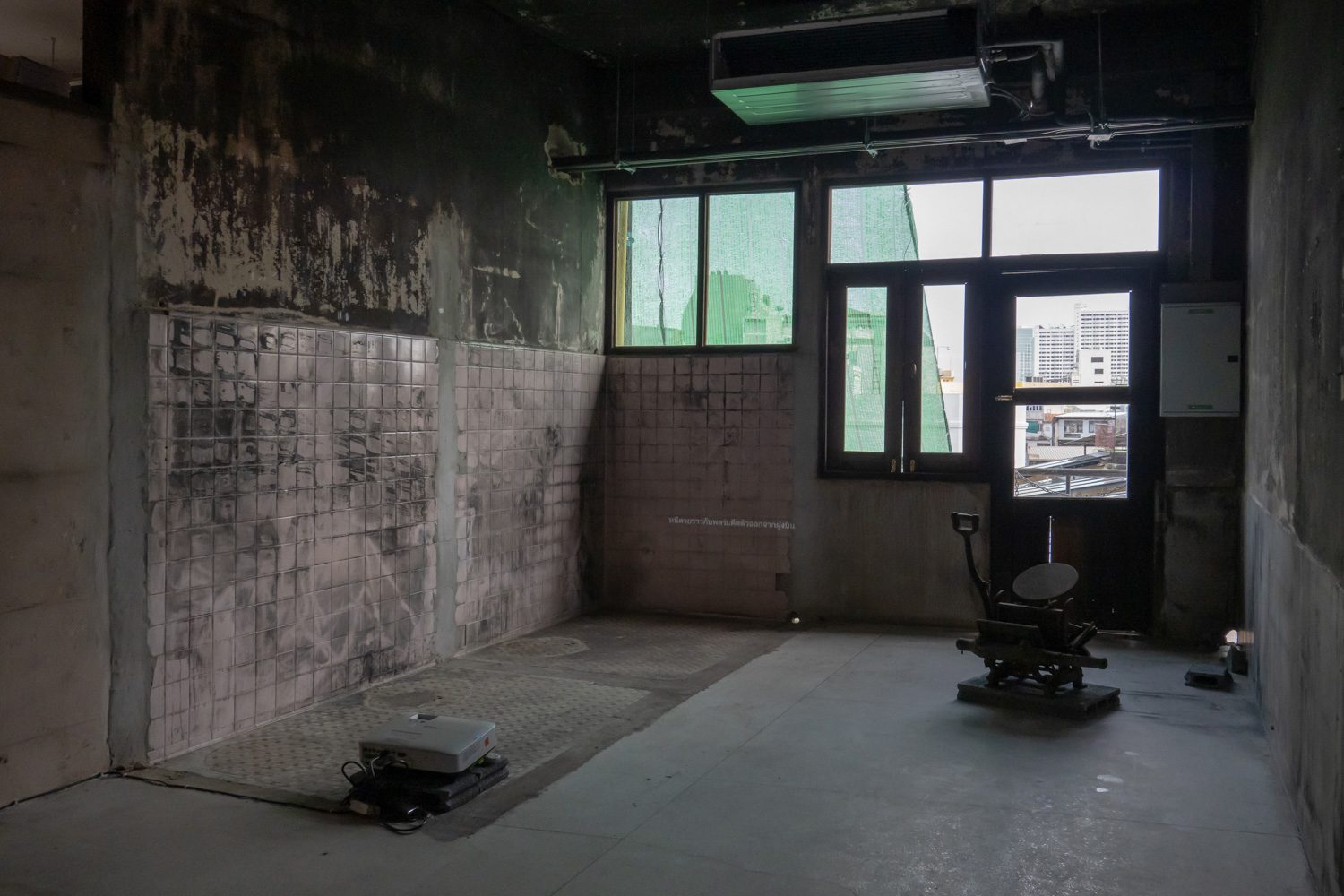
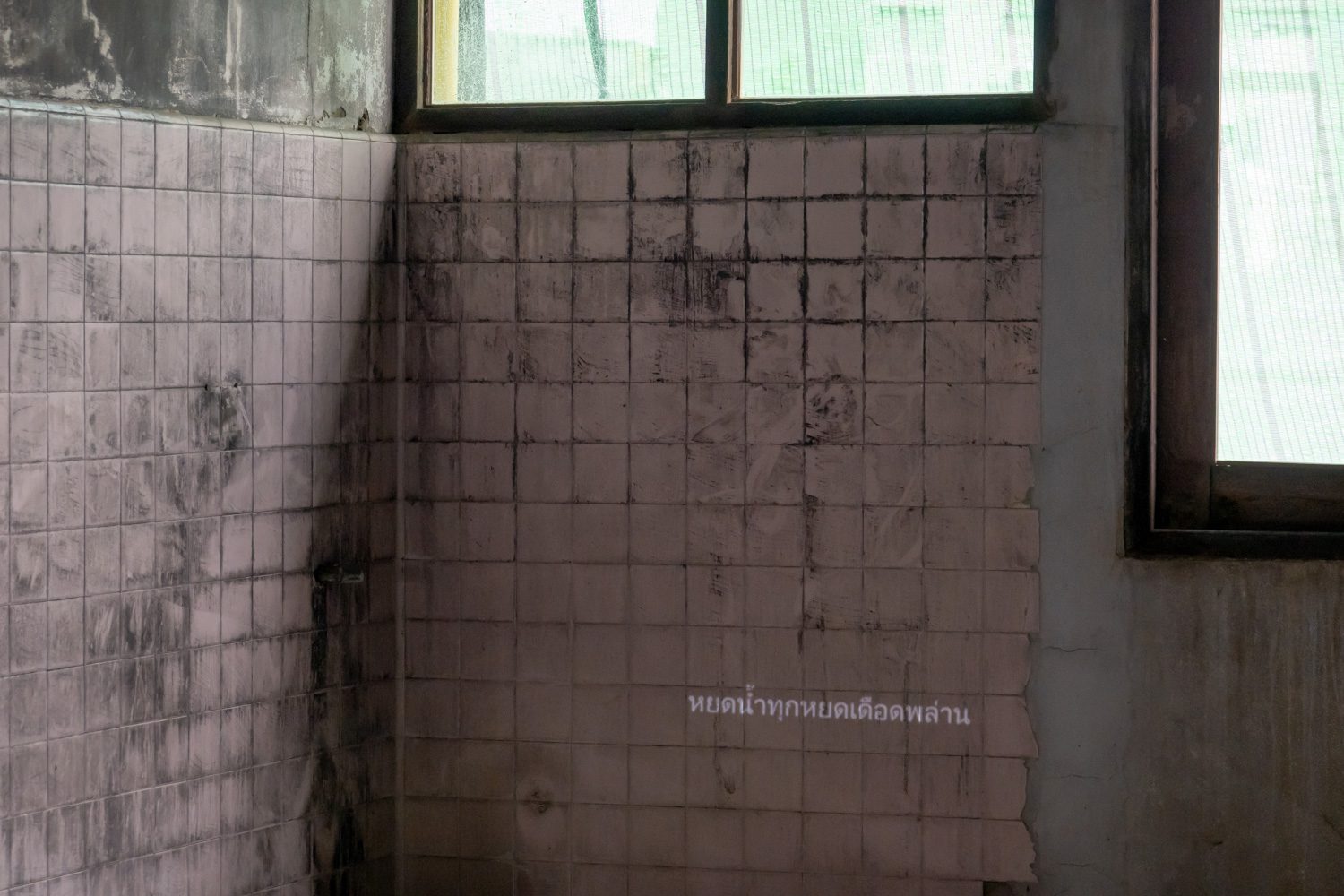
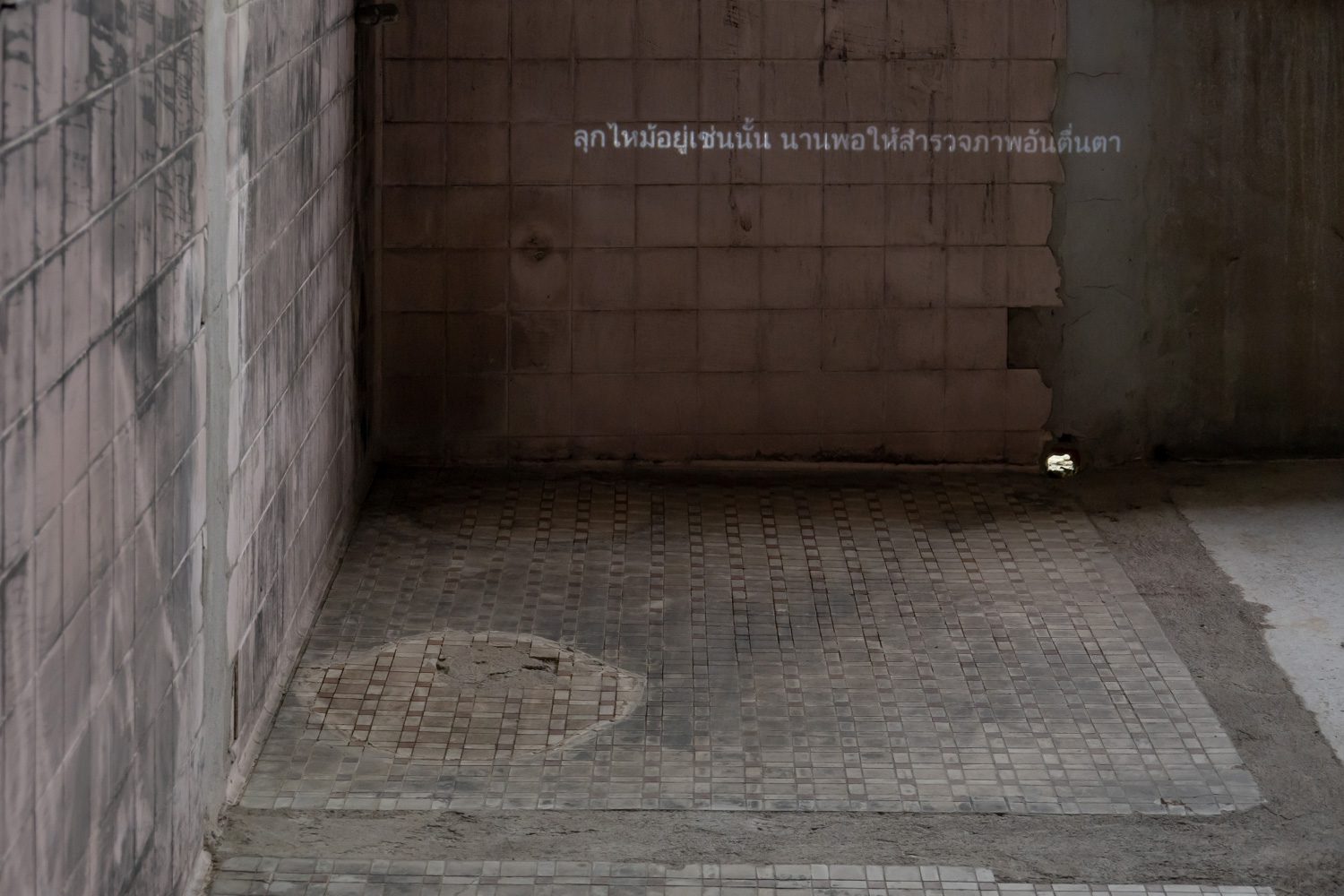
A young woman, a calico cat, and a raincloud do not simply form a narrative stretched across a wall mottled with aging grout. The text binds itself to its backdrop, as if the writing and the surface are narrating each other. The cat climbs along the railing described in the words, which mirrors the actual balcony rail visible behind the work, framing the sky and drifting rain clouds. The narrative distances itself into a third-person view, inviting questions of authorship. Who is telling this story? Could it be the building itself observing the ceaseless rhythms around it, playing the part of a publisher it once knew so well, imprinting words across its walls, onto its weathered grout, and across the surface of its own skin?
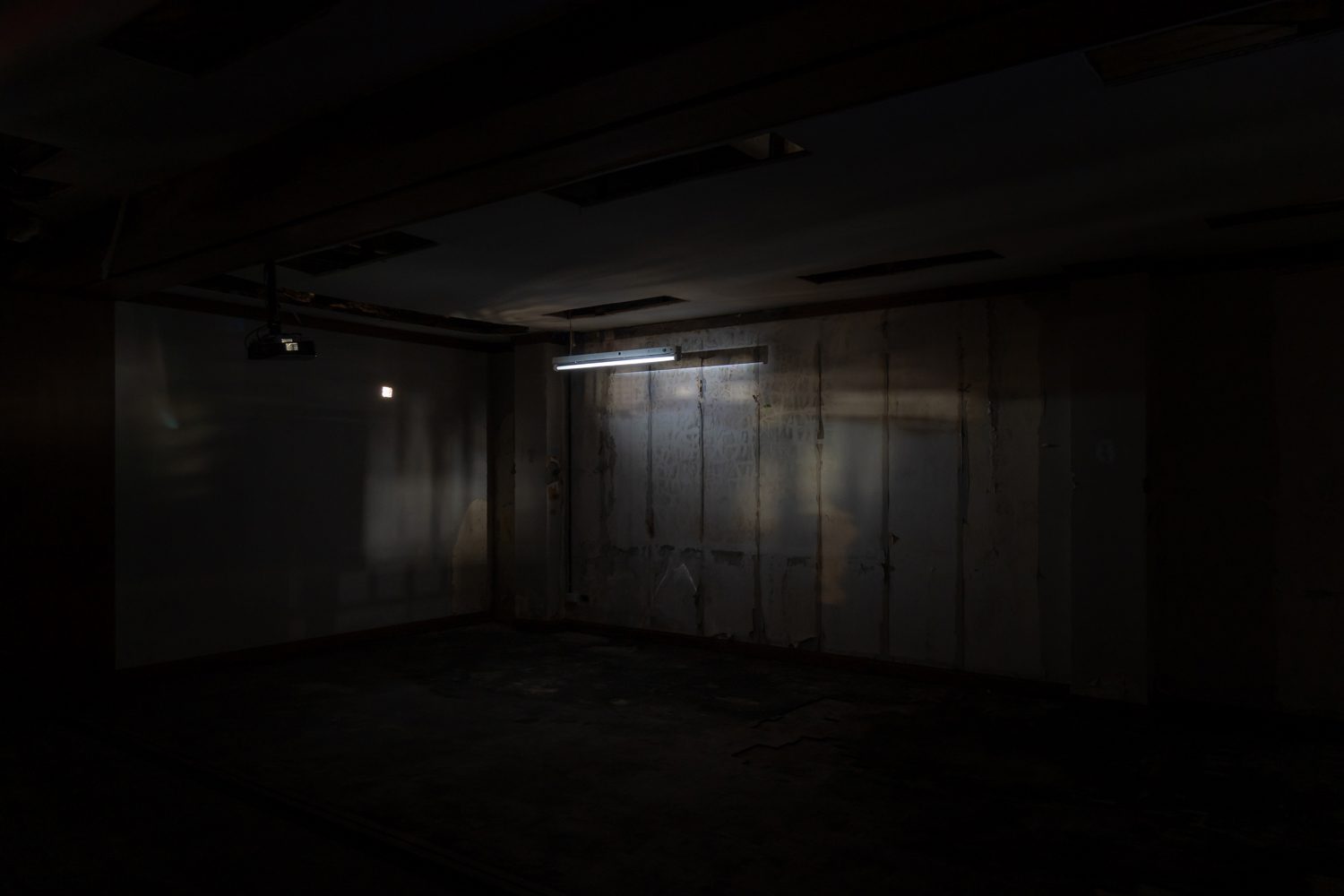
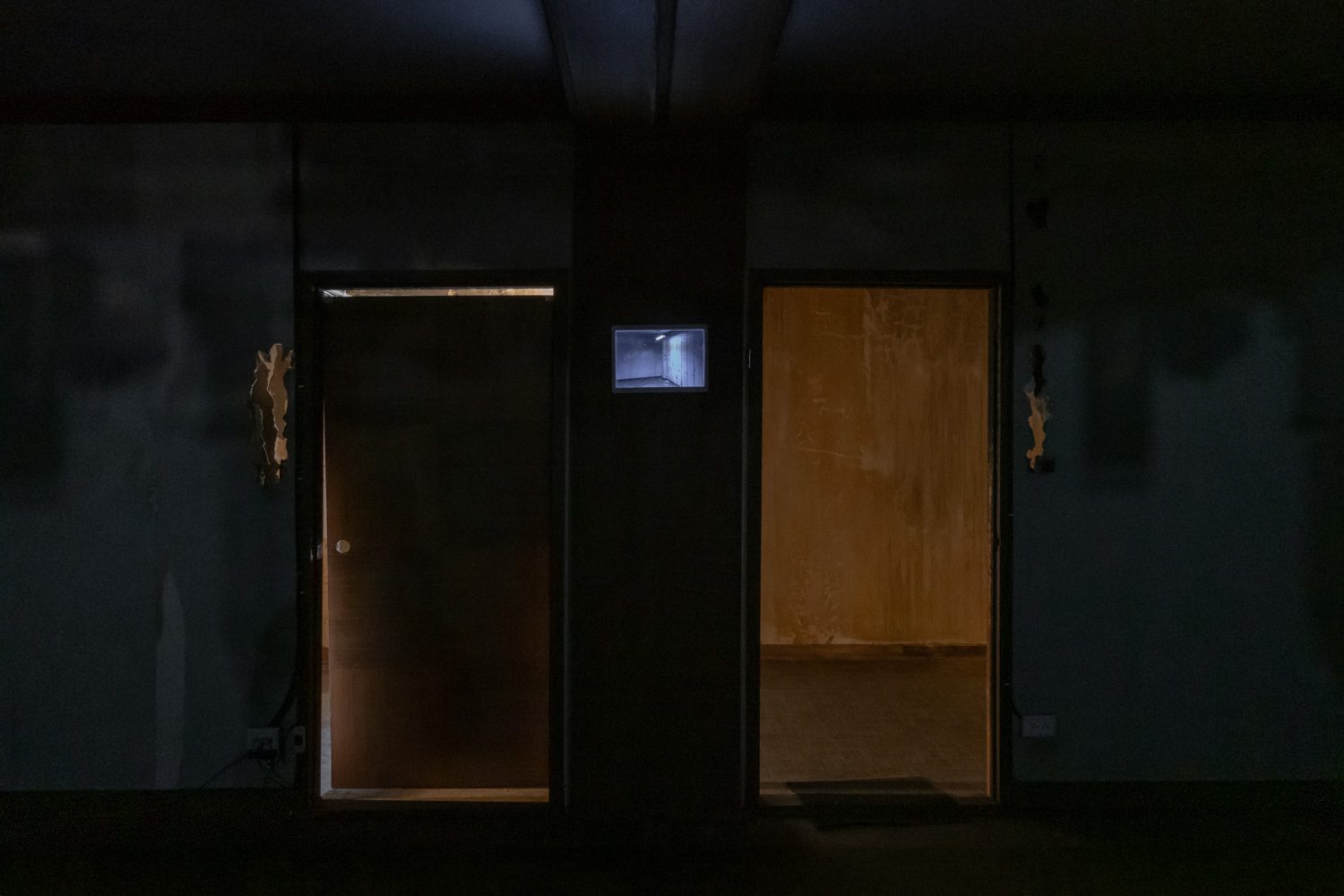
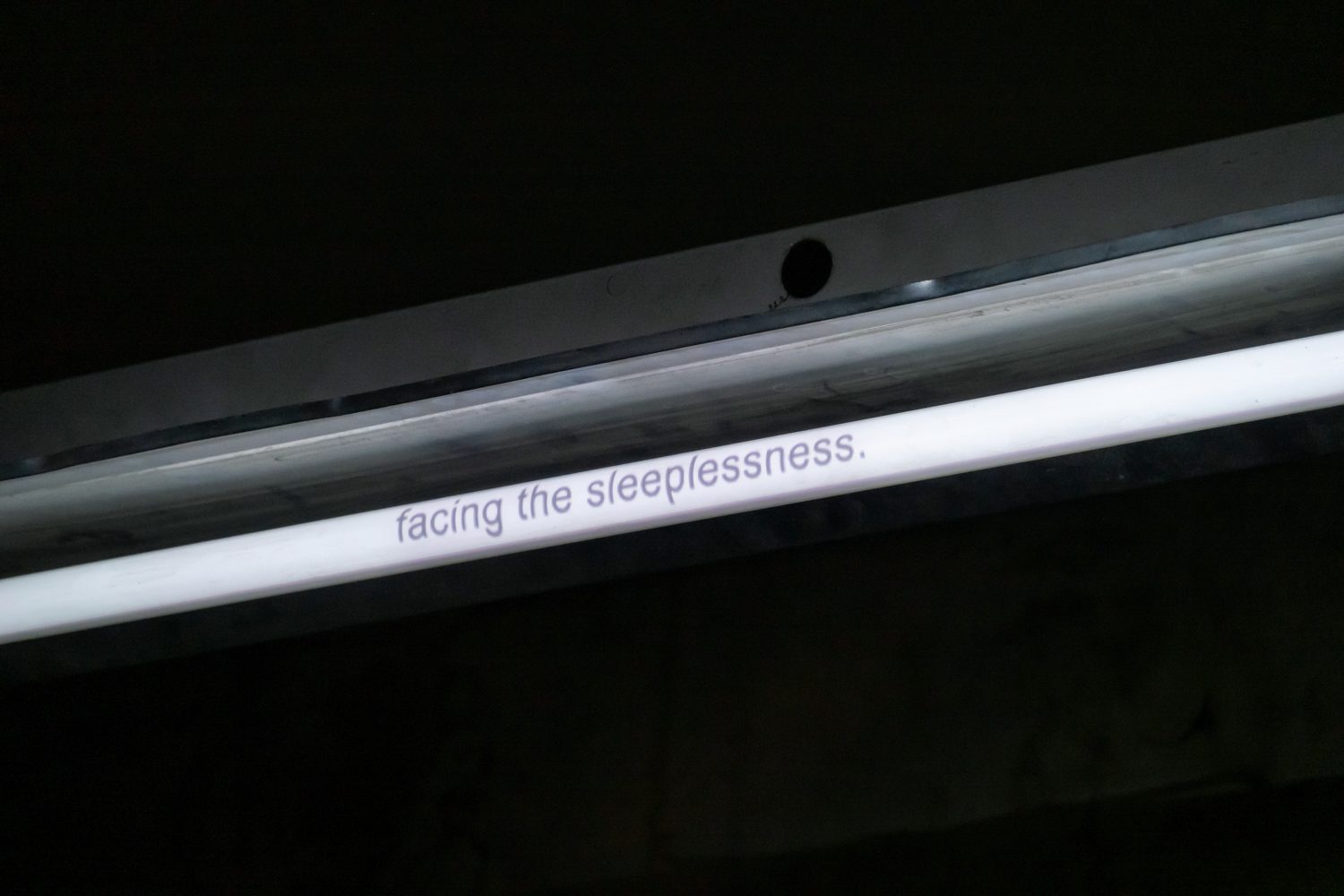
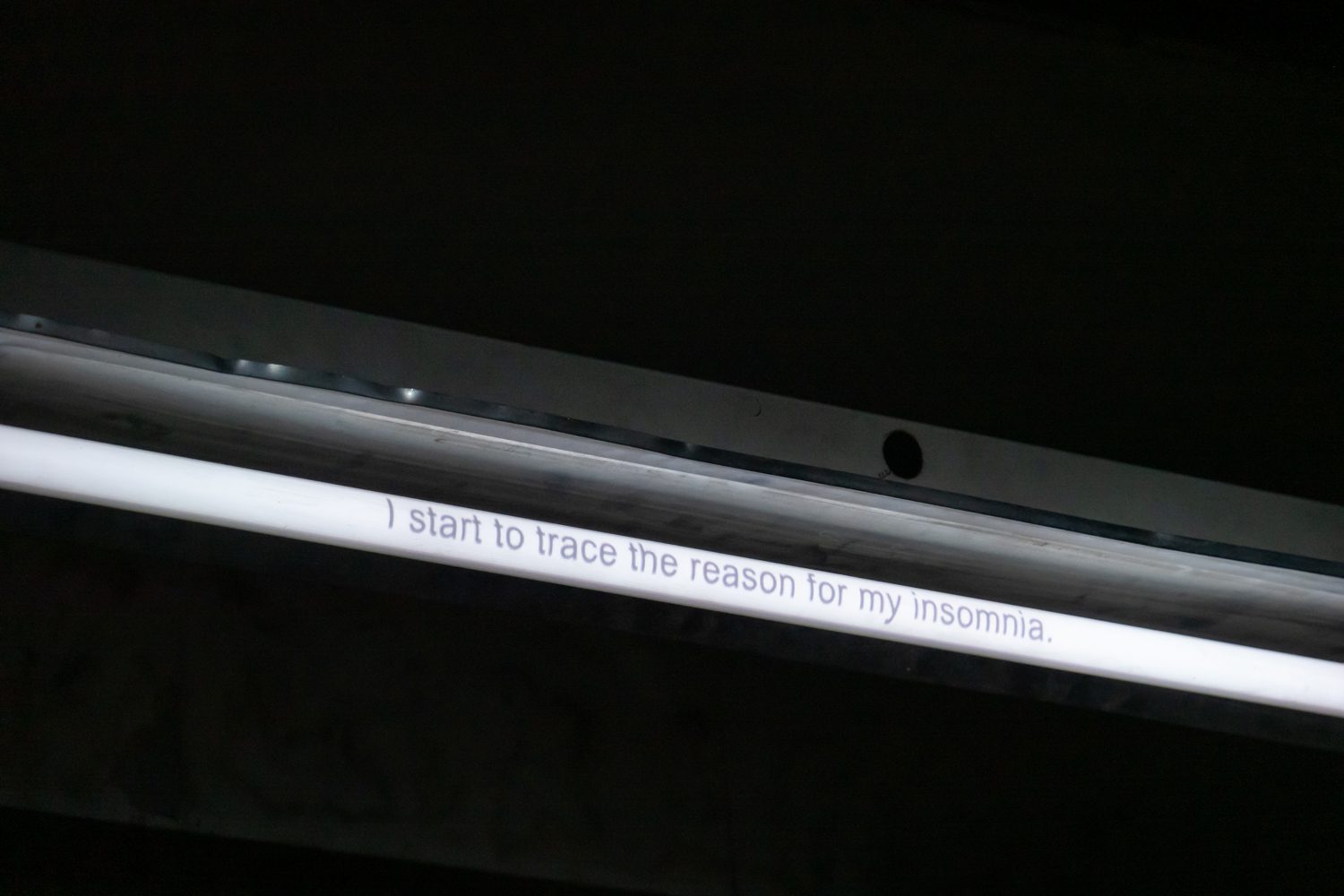
In contrast, the work housed in the darkened room takes on a markedly different character. English letters creep slowly across flickering light tubes, pausing often, hesitating as if caught in thought. The text unfurls like a restless monologue, speaking of insomnia, anxious thoughts, the relentless ticking of clocks, the creeping glow of dawn, and the fragmented memories that surface and recede. All of it circles around the sleepless ‘I,’ which blinks unsteadily across the trembling light tubes that bear the letters themselves. The darkness of the room, pierced only by slivers of light, makes searching for this elusive ‘I’ difficult. In one sense, it becomes a spatial metaphor for insomnia itself. Its tension between interior and exterior, light and dark, forces the eye to strain against the glare. It also intimates that the sleepless presence may not exist for us to witness at all, but is instead the room itself, caught in its own perpetual cycle of thought and darkness. Even without an audience, this ‘I’ would remain trapped in its own relentless loop, submerged in darkness, thought, and its mounting piles of letters. Perhaps we fail to find it because we are already inside it, folded into the consciousness of ‘I’ itself.
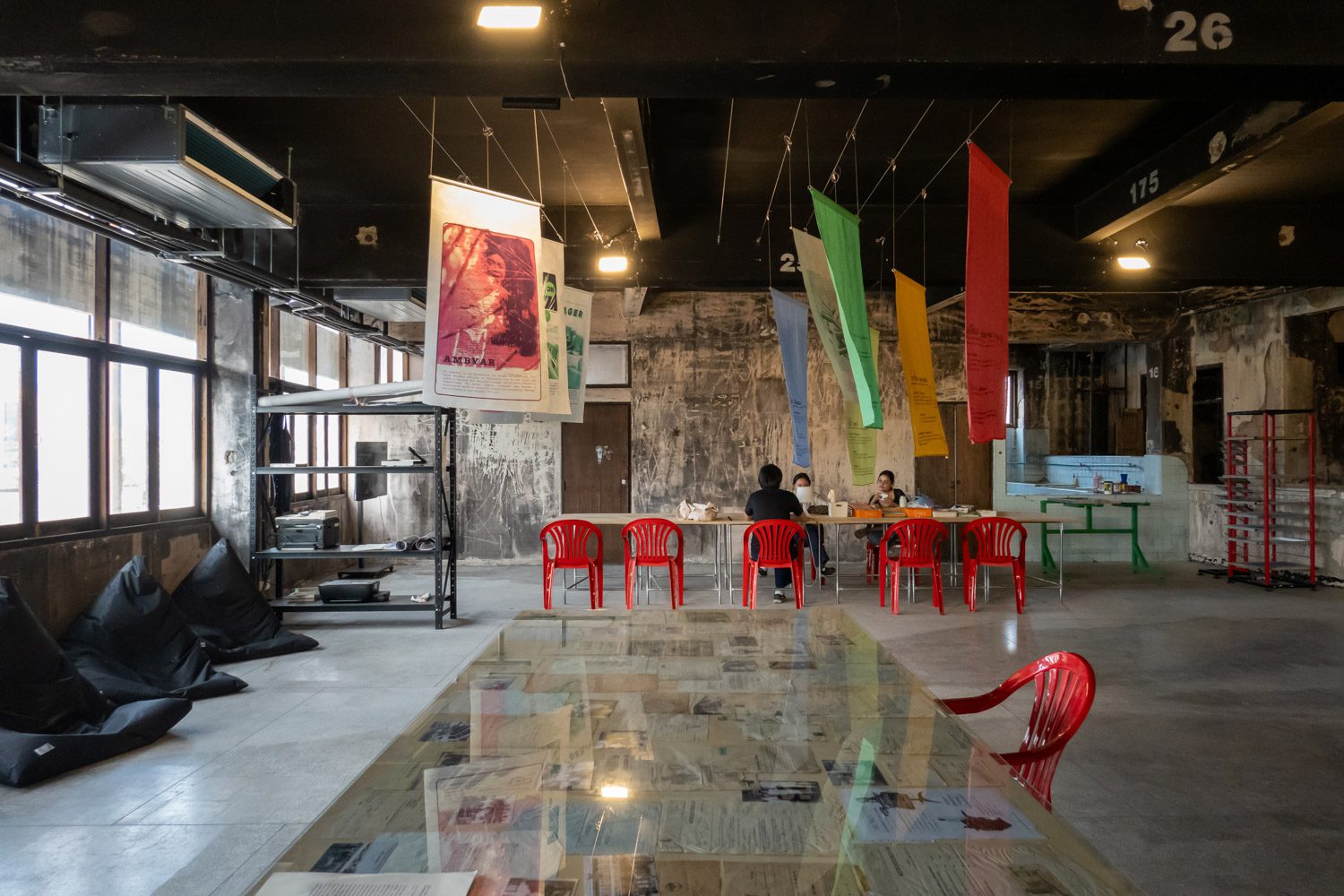
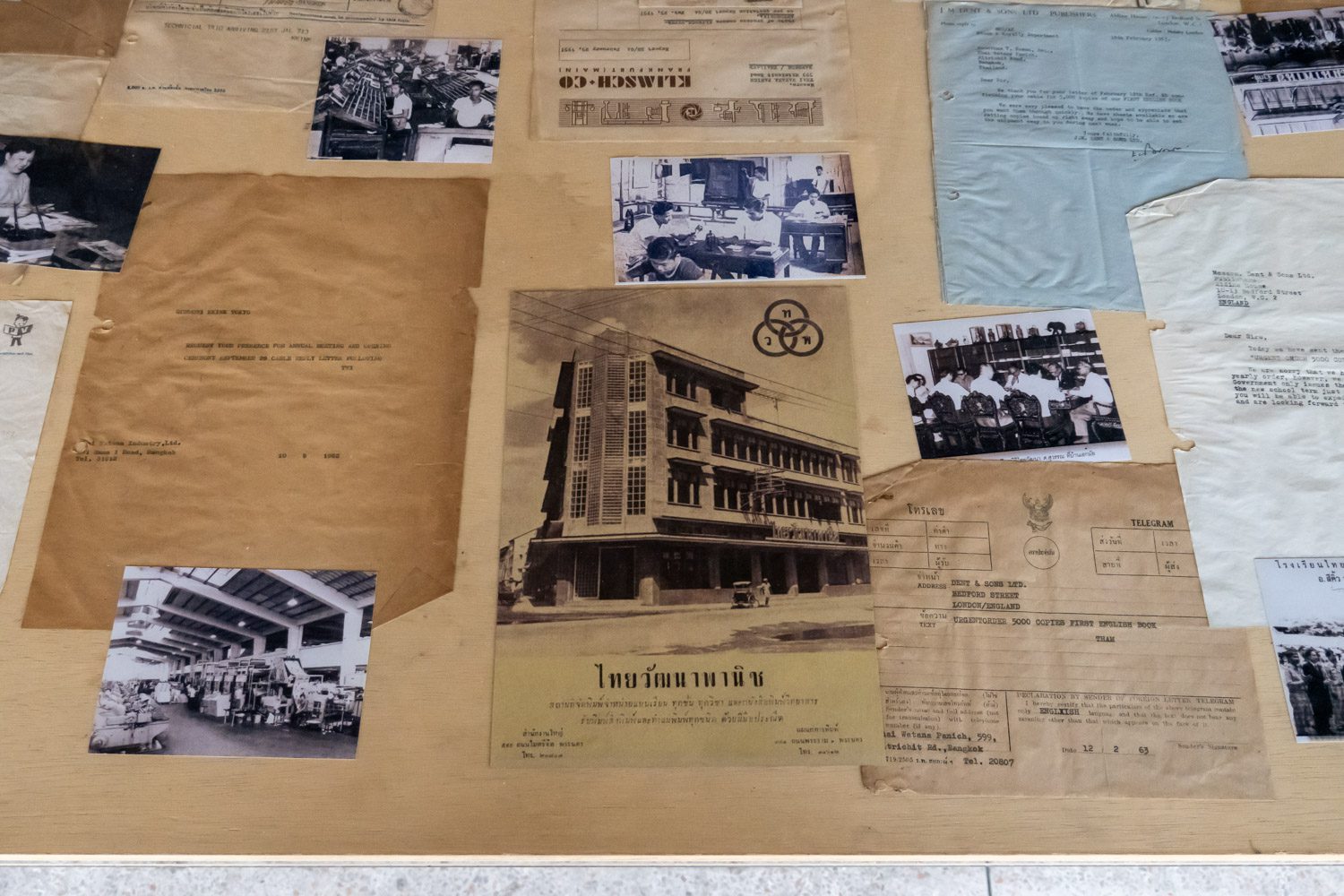
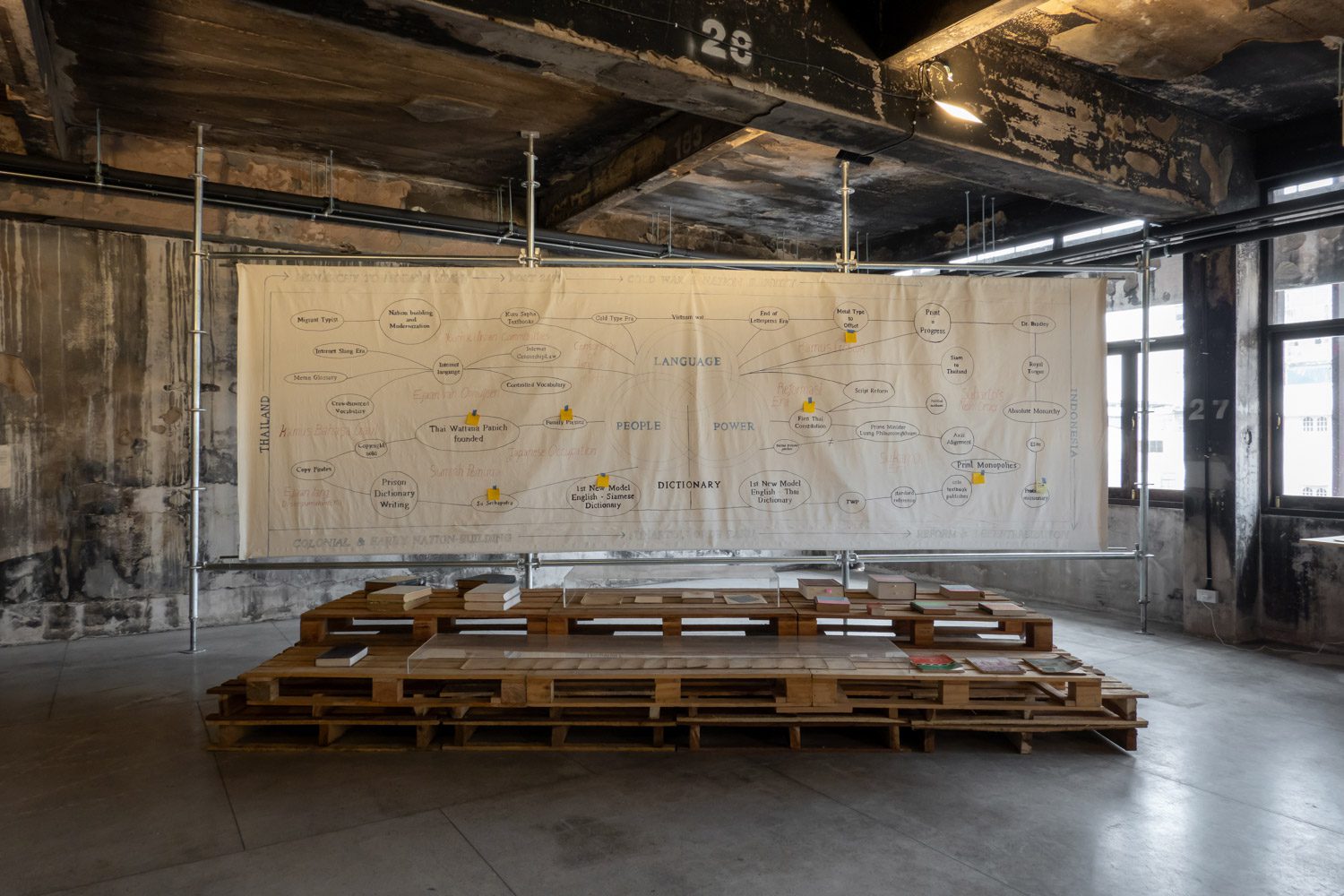
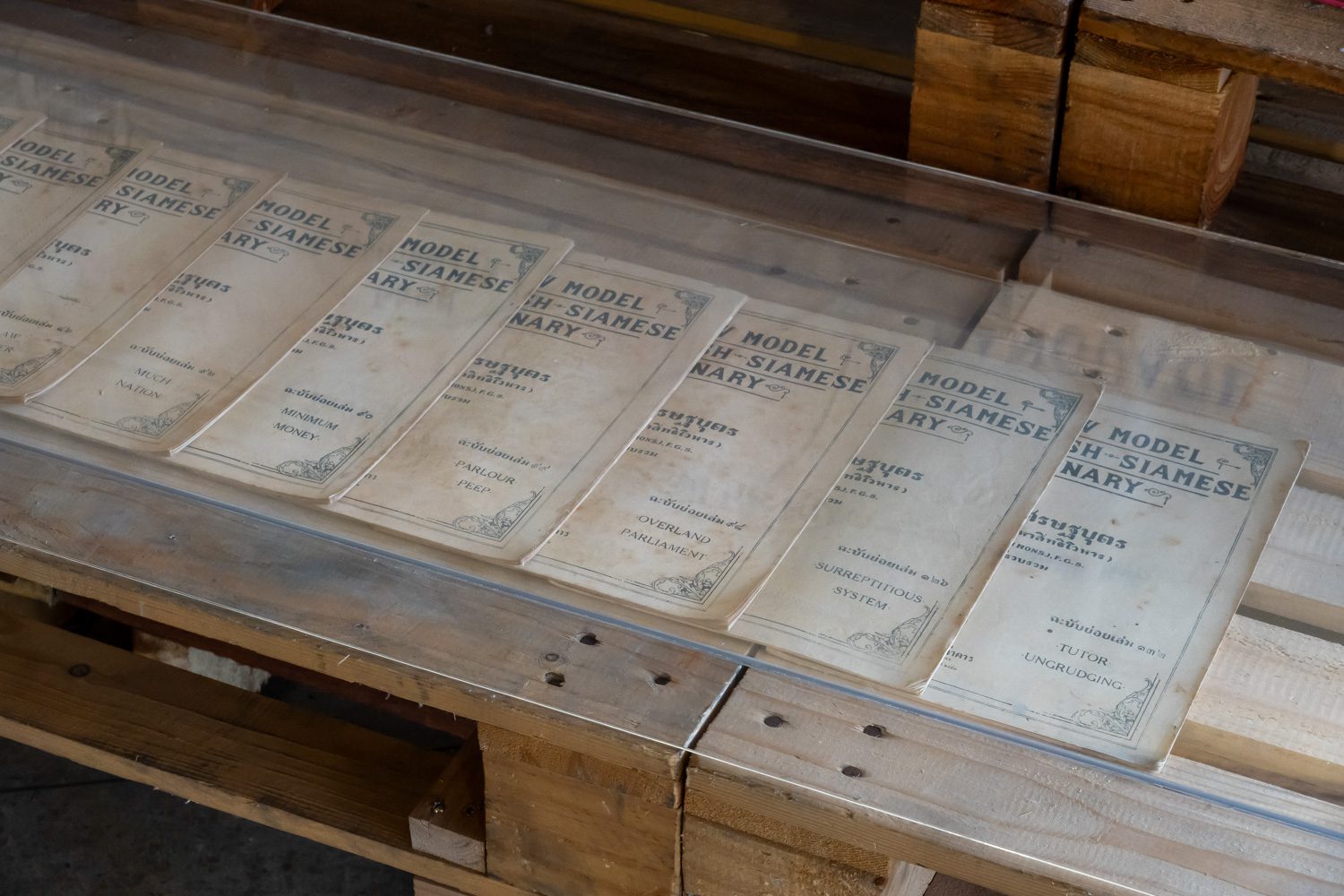
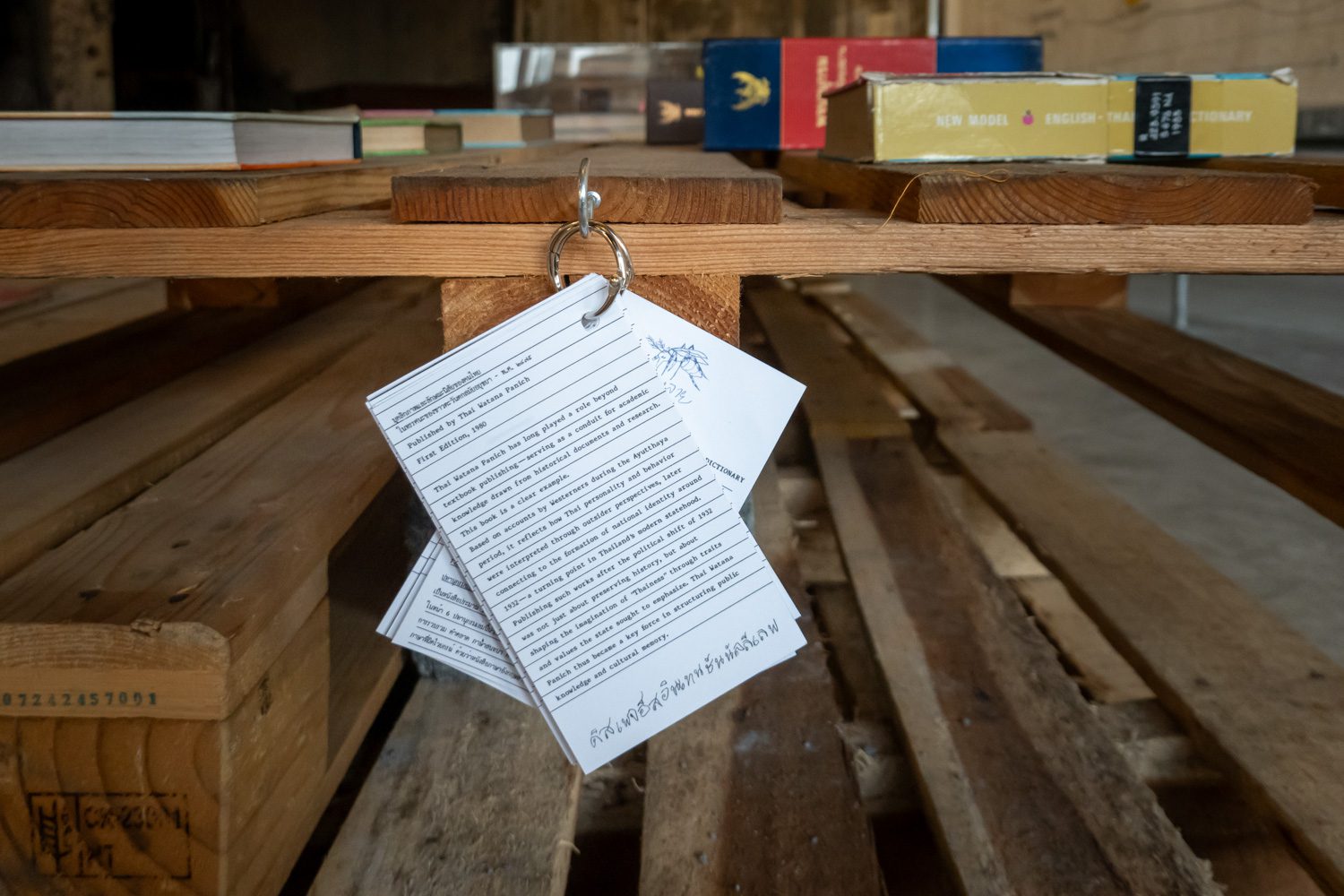
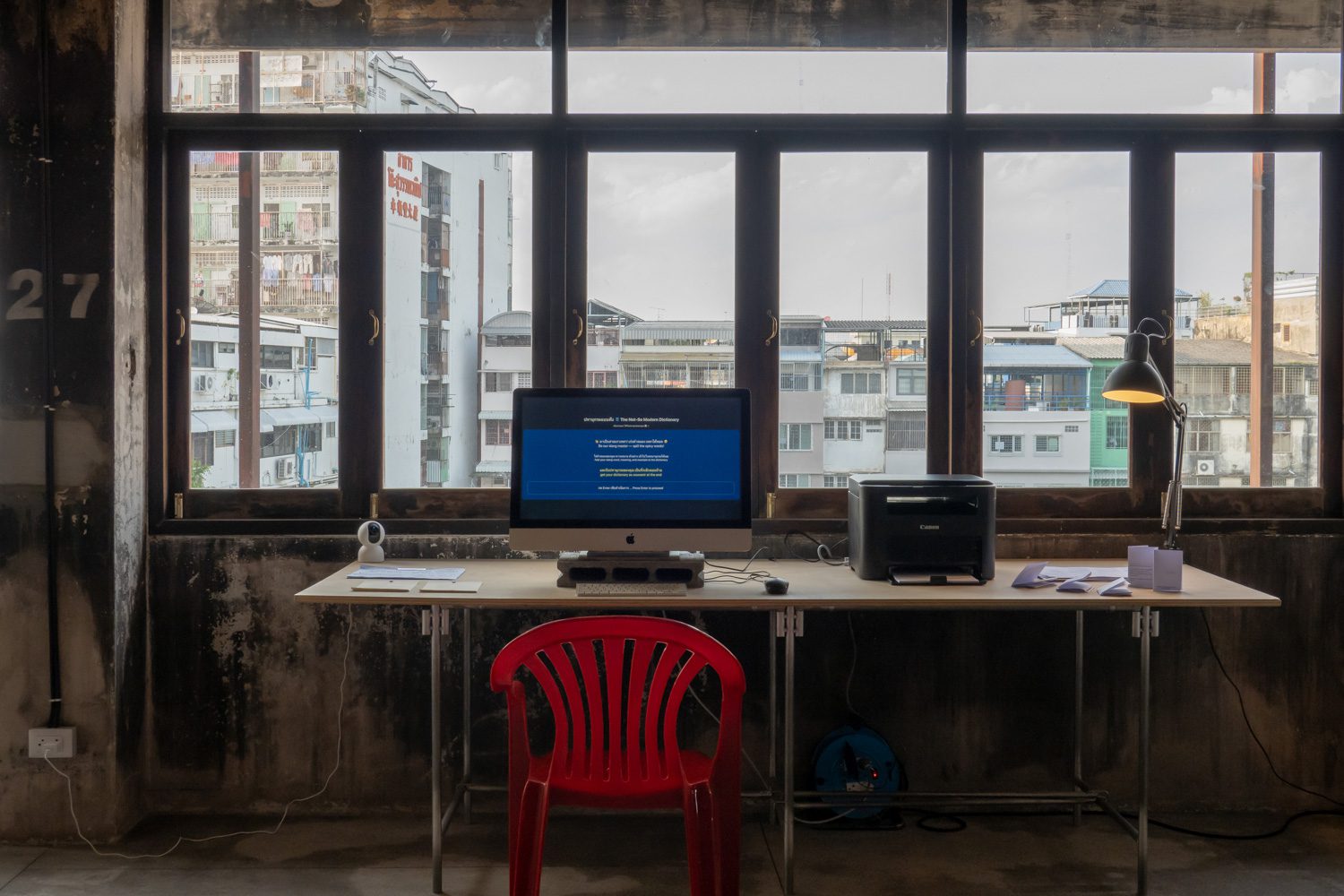
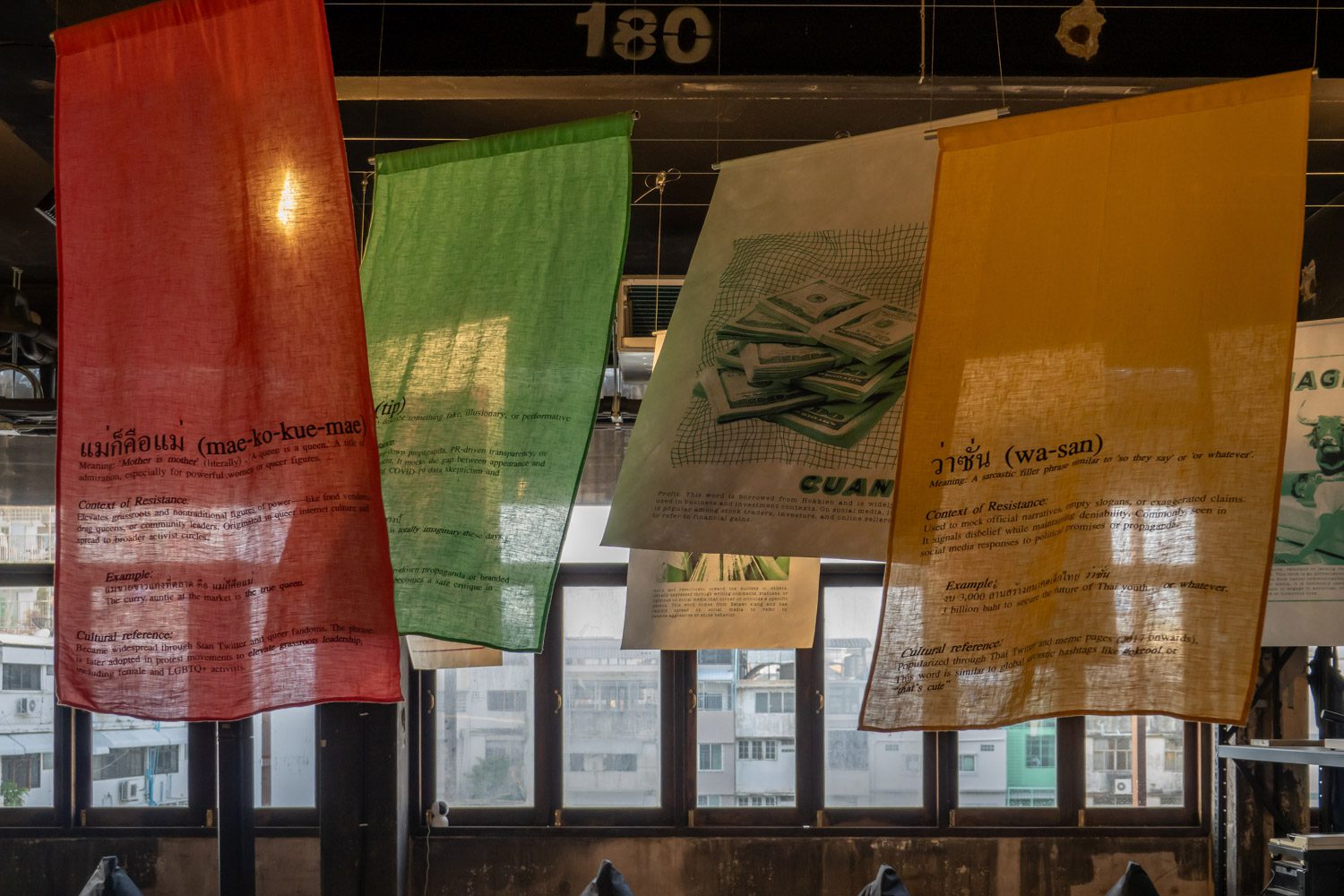
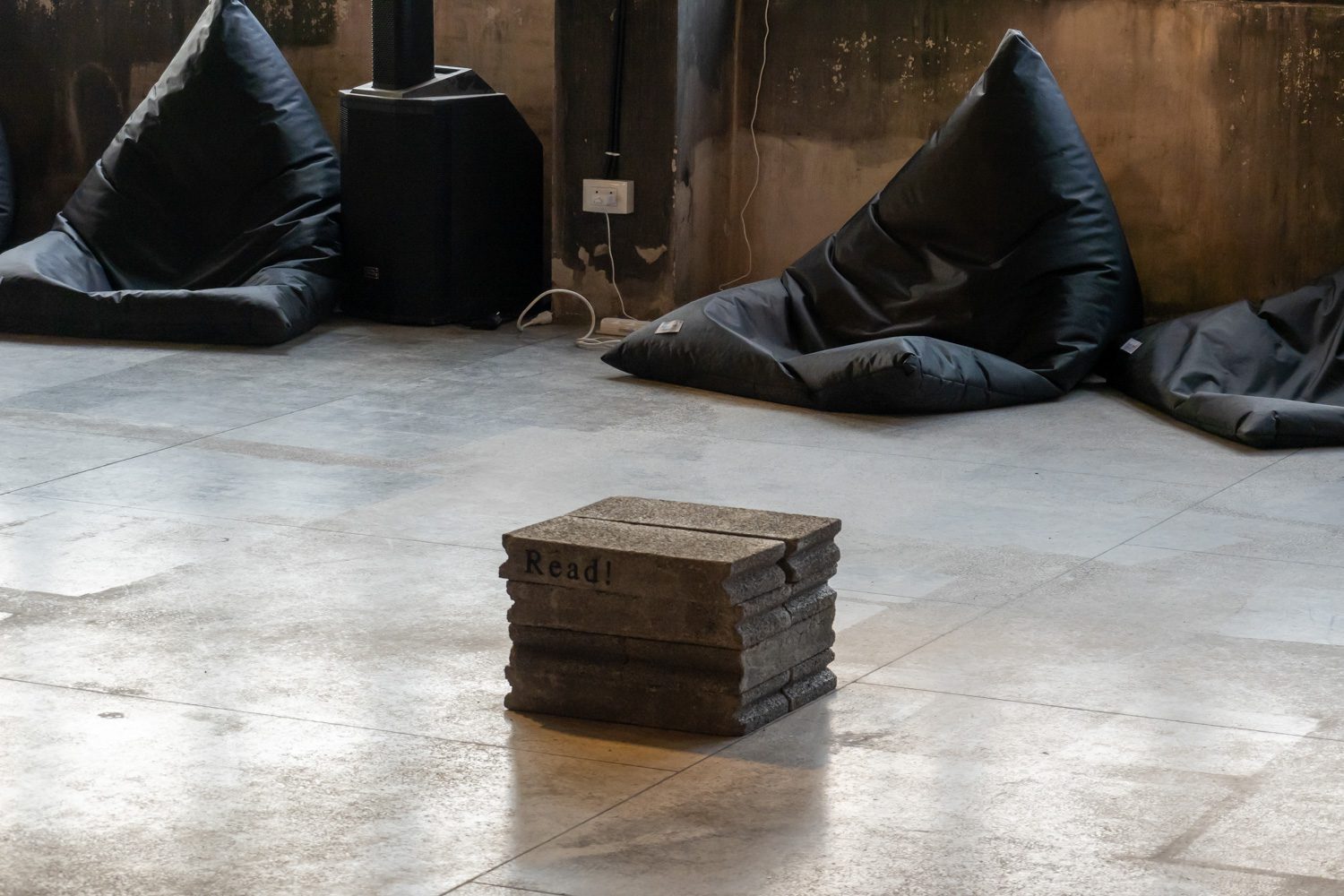
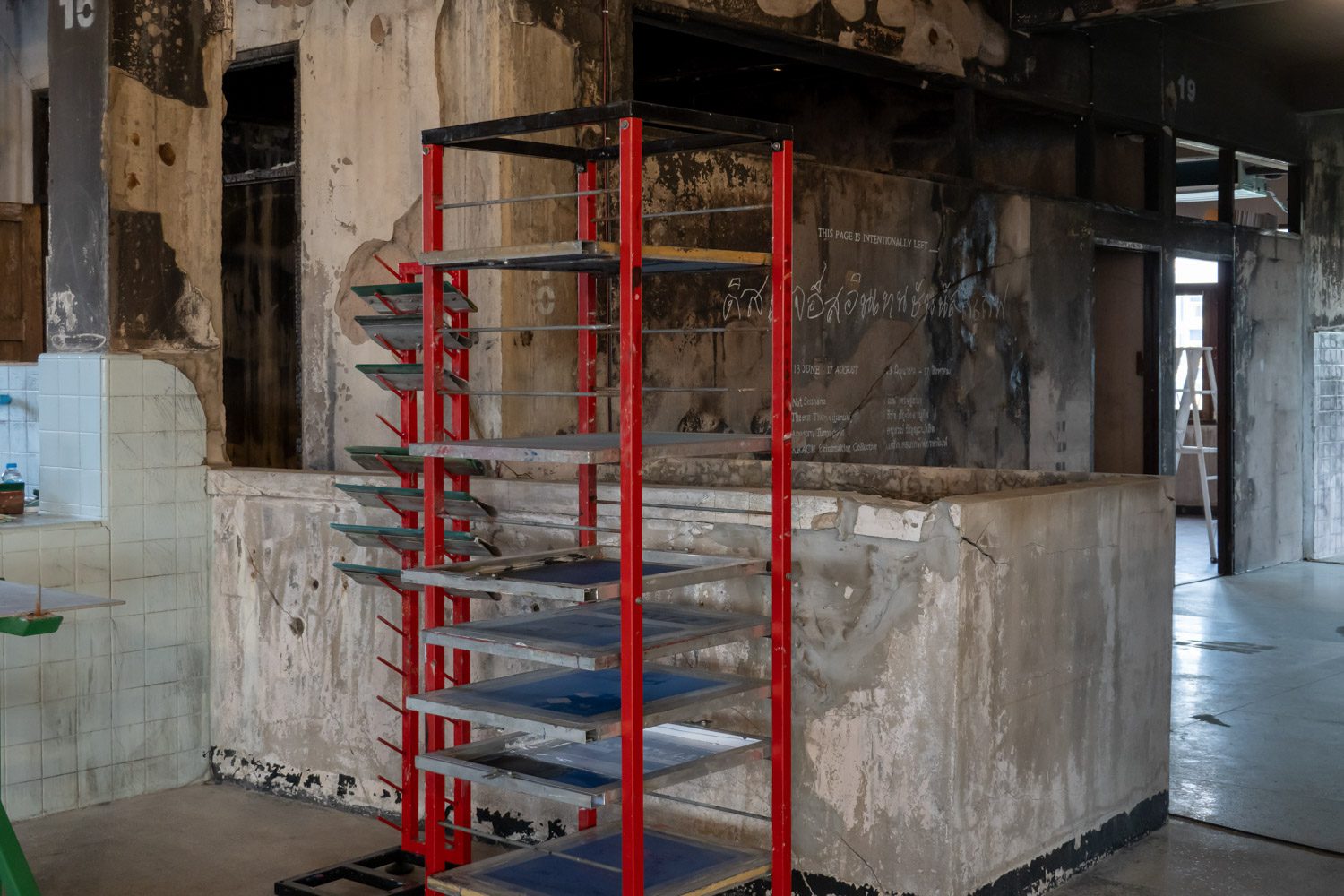
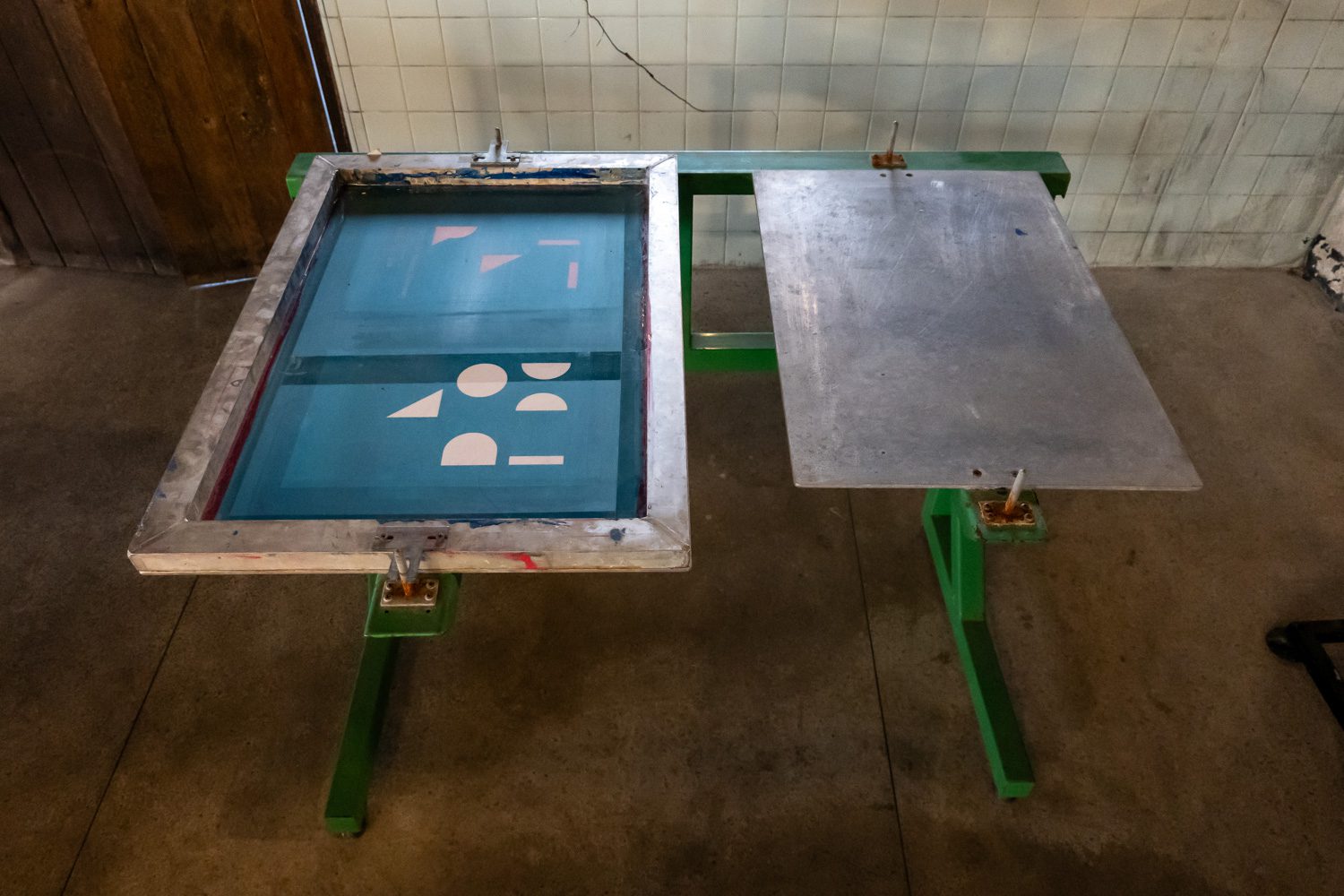
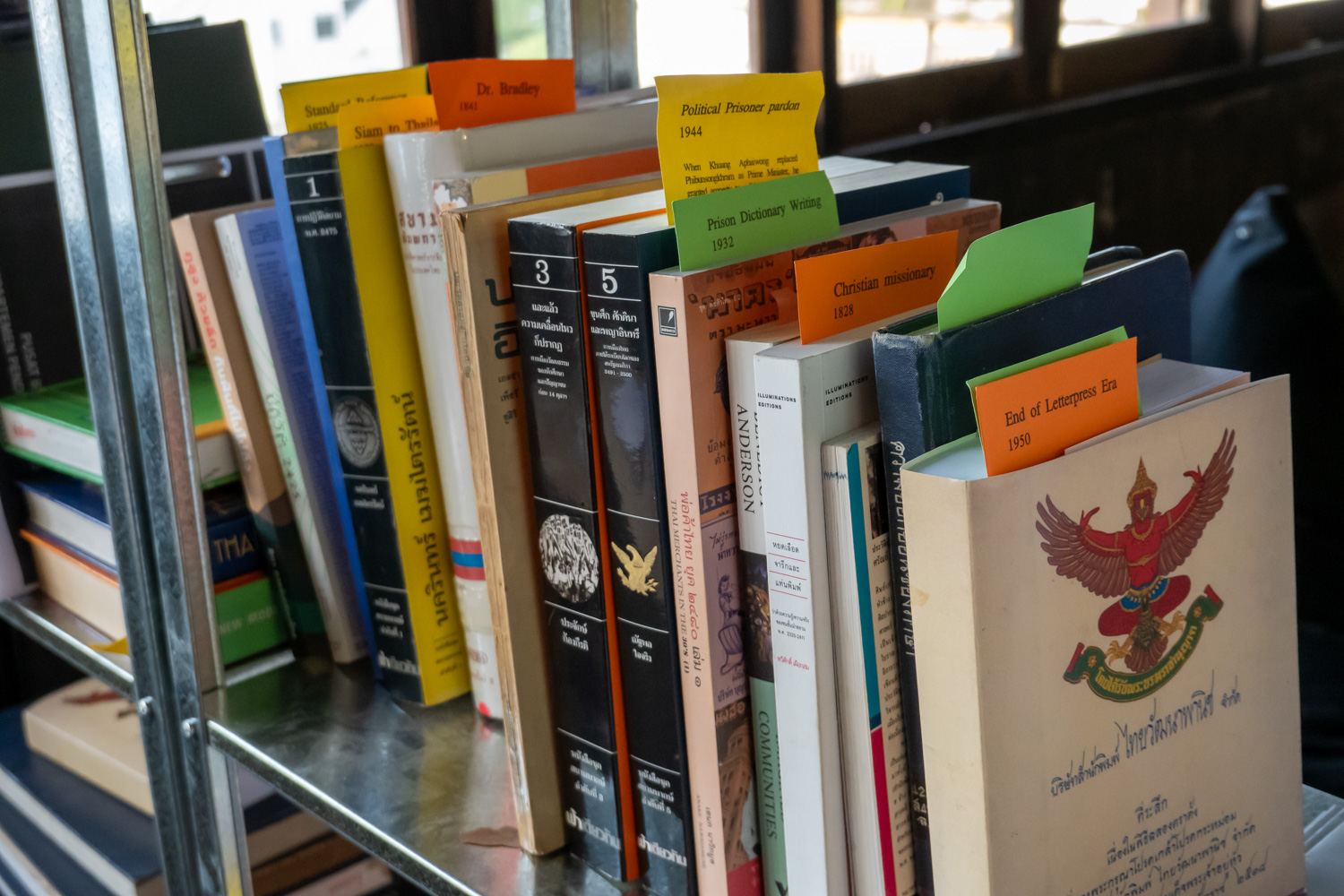
In addition to the three featured artworks, the curatorial framework extends into the ‘Editorial Room (Staff Only)’, developed through data collection and collaboration with the Krack! Printmaking Collective. Conceived as an invitation rather than a barrier, the room’s title subverts its usual connotation of restriction, reframing visitors as part of an editorial team, both recipients and transmitters of the textual networks circulating within the building. Within this space, curatorial interventions unfold as a series of interconnected gestures: a diagram tracing the histories of Thai printing and the Thai Wattana Panich building, linked to books that were once produced here and now return to rest once again upon its shelves; a participatory dictionary that invites visitors to coin new words and definitions, recontextualizing entries by So Sethaputra in response to contemporary contexts and shifting linguistic landscapes; and an assemblage of printing equipment that once operated discreetly behind the scenes but is now repositioned ‘front of house’ as objects on display.
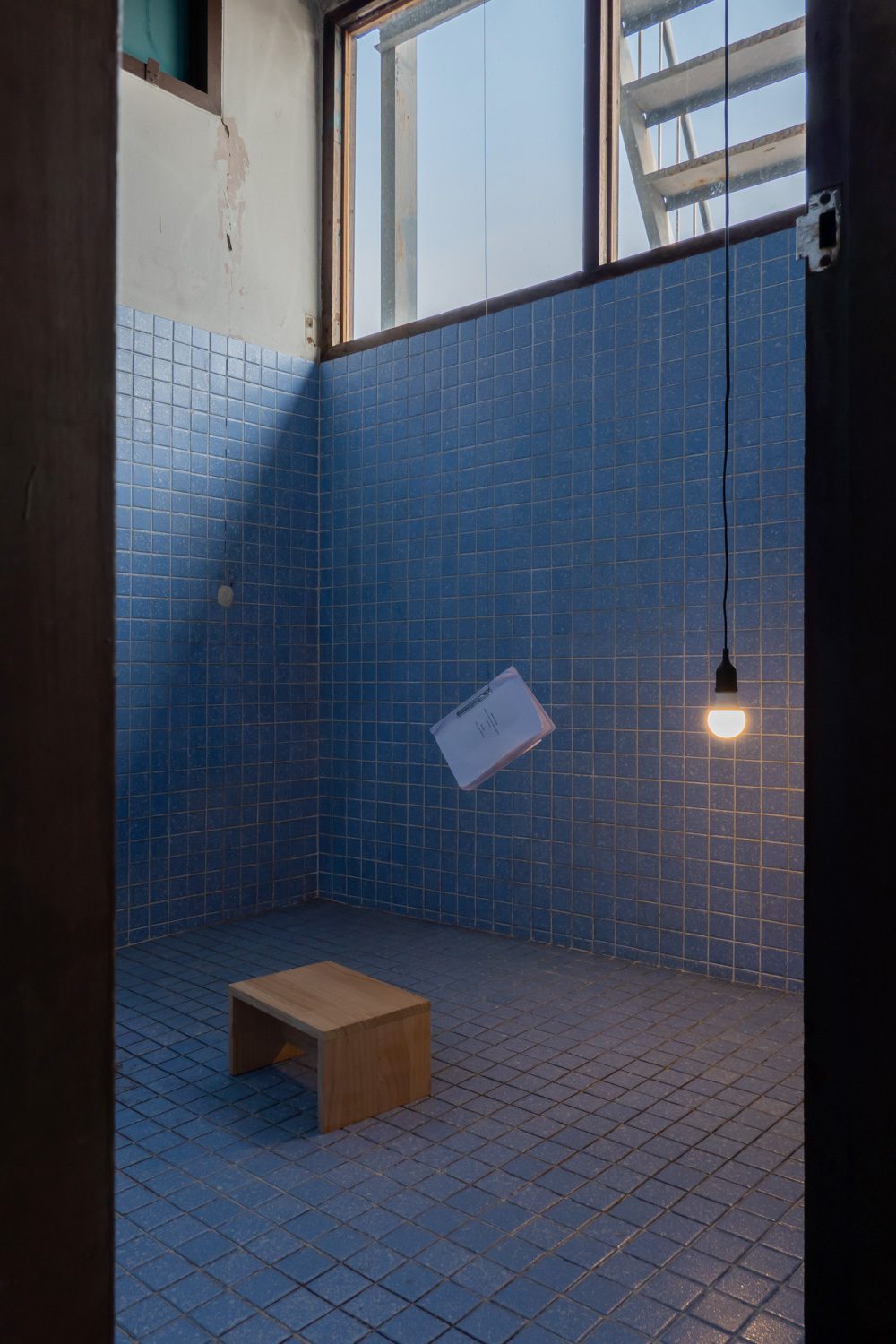
Rather than being ‘intentionally left blank’ to await fulfillment in the manner of a conventional gallery space, ‘This page is intentionally left ____.’ instead intentionally drafts a network of relations between the building, print culture, and language that continues to dwell within silence and emptiness. Plaster fragments and burn marks become inseparable from paper and books; though distant in material and form, they converge as traces embedded in the building’s memory. The exhibition scrapes at the surfaces of Thai Watana Panich, exposing a pulse that persists across non-linear time. The building, once seemingly derelict, is not revived but rather ‘revealed.’
Beneath the surface, beyond dust and brick powder, language, paper, and thought remain, quietly holding it up from within.
‘This page is intentionally left ____.’ is on view from 13 June to 17 August 2025 at Bangkok Kunsthalle, Level 5.
_
1 At its inception, this exhibition drew from works selected through ‘Open Call: Incubation – Working with Space’, a program conceived by Chitti Kasemkitvatana in collaboration with Bangkok Kunsthalle, the Bangkok Art and Culture Centre (BACC), and the Faculty of Painting, Sculpture, and Graphic Arts at Silpakorn University in 2024.